The request lands on my desk in some form every month: “Can our product send LinkedIn messages automatically?” The honest answer is nuanced. Yes, programmatic messaging is possible for legitimate use cases, and no, it is not a channel for blasting strangers at volume. The gap between those two statements is where product teams either build something genuinely useful or something that gets their users’ accounts restricted. This piece maps what programmatic messaging actually permits, the use cases it serves well, and how to design a flow that respects the platform.
Messaging is the feature everyone wants and the feature most likely to get a product in trouble. Done well, the linkedin api send message capability turns a connected account into a coherent part of a CRM or a sales workflow, saving a human real time on genuine conversations. Done carelessly, it becomes an automation that treats a professional network like a cold-email list and gets accounts restricted.
It’s worth being precise about what “possible” means here before going further. LinkedIn’s official API does not expose general message-sending to third-party developers — the one sanctioned messaging capability sits behind the Compliance API, a private program reserved for FINRA/SEC-regulated organizations archiving member correspondence, not for CRMs, sales tools, or recruiting platforms. In practice, most products that message on a user’s behalf do so through unofficial integrations built outside that sanctioned path. That distinction doesn’t make the feature off-limits to build — plenty of teams do it — but it does mean there’s no official rulebook enforcing good behavior for most developers. The design principles in this piece aren’t just best practice; for anyone operating outside the Compliance API, they’re the only thing standing between a useful feature and a wave of account restrictions.
The difference is entirely in the design, so it’s worth being precise about what is possible, what is permitted, and what responsible looks like.
Start with the use cases that justify it
Before touching any technical detail, be clear about why you’d send a message programmatically at all. The legitimate use cases share a common shape: a real relationship, a consenting account owner, and a human somewhere in the loop.
- A sales rep managing conversations from inside their CRM instead of switching tabs, so replies and follow-ups on existing threads live where the rest of the deal context lives.
- A recruiter coordinating with candidates who have already engaged, keeping the conversation synced with the applicant tracking system.
- A customer success or partnerships workflow where a connected account continues an established dialogue and the product simply removes the manual copy-paste.
- A unified inbox that lets a professional see and respond to messages across channels in one place rather than juggling half a dozen apps.
Notice what none of these are: none is “message a purchased list of strangers.” The moment the use case detaches from a real, consenting relationship, it stops being a feature worth building.
What sending a message actually involves
Technically, sending a message on behalf of a connected account means your product, having obtained that member’s consent, uses the messaging capability to place a message into a conversation the account is entitled to participate in. The message is sent as the authenticated user, from their own account, into a thread that account can legitimately access. Your software is not a separate sender; it is acting on behalf of the member who authorized it.
That framing has real architectural consequences. You need the member’s consent captured and current. You need to associate every message with the specific connected account that sends it. And you need to handle the same operational realities as any other authenticated call: token refresh, throttling responses, and clean failure handling when a send does not go through. A message send is not fire-and-forget; it is an operation that can be throttled or rejected, and your product has to reflect that state back to the user honestly.
Permitted versus off-limits
The line between acceptable and prohibited is not subtle once you look at it through the platform’s eyes. Continuing and managing conversations that a connected account is genuinely part of sits firmly on the permitted side. Automating unsolicited contact at scale sits firmly on the prohibited side, regardless of how the automation is dressed up.
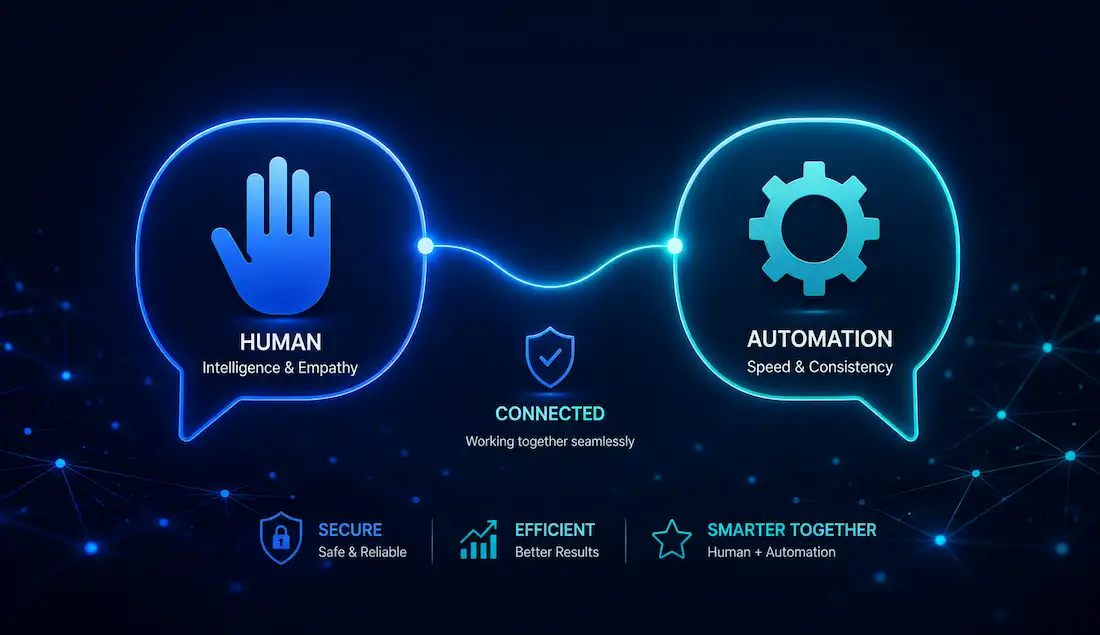
A few guardrails keep you on the right side of that line. Keep a human meaningfully involved: messaging automation should assist a person’s real conversations, not replace the person with a bot that contacts strangers. Send from and to relationships that exist, not to arbitrary members who never opted in. And treat the messaging capability as a way to make legitimate communication more efficient, not as a growth hack for reaching people who have not consented to hear from you. Framed as engagement with existing contacts rather than cold outreach at volume, programmatic messaging is a legitimate, valuable capability.
Cadence and volume are a customer-side decision
Here is the principle that most cleanly separates responsible products from reckless ones: how often and how much a connected account sends is a customer-side decision, and your product’s job is to support that decision responsibly, not to push it toward the maximum. The platform enforces rate limits, and a well-designed product stays comfortably within them rather than treating them as targets.
Concretely, that means building in sane defaults and letting the account owner set their own pace, not shipping a tool whose selling point is volume. It means surfacing throttling clearly instead of hammering the platform when a limit is reached. And it means resisting the product temptation to advertise “unlimited automated messages,” because that framing invites exactly the misuse that gets accounts restricted and, eventually, gets your integration cut off. Respecting the platform’s rate limits is not a constraint to engineer around; it is a signal about the cadence the ecosystem is designed to tolerate.
There is a business argument here too, not just a compliance one. A product that helps a rep manage genuine conversations well retains customers because it makes them more effective at relationships they already have. A product that helps a rep spray messages at strangers churns, because its users’ accounts get restricted and the strategy stops working within weeks. The responsible design is also the durable one. When you build the pacing controls, default them to conservative values, make the aggressive settings something the customer has to consciously choose, and give them visibility into how close they are running to the platform’s limits so the decision stays informed. You are not policing your users; you are giving them the information to make a good customer-side decision and defaulting them toward it.
Common mistakes to avoid
A few patterns reliably get teams in trouble, and they’re easy to name so you can avoid them.
- Treating the messaging capability as a broadcast channel. It is for conversations, not campaigns to strangers.
- Optimizing for volume. If your roadmap’s headline metric is messages sent per day, you are building the wrong product.
- Removing the human entirely. Full automation of first contact is the fastest route to account restrictions.
- Ignoring throttling. Every send can be rate-limited, and a product that pretends otherwise will fail loudly in front of its users.
- Storing more than you need. Keep message handling scoped to the connected account and avoid building a parallel archive of conversations you have no reason to keep.
The bottom line
Programmatic LinkedIn messaging is genuinely possible and genuinely useful, as long as you build it as a way to help authenticated users manage real conversations rather than as a machine for contacting strangers. Anchor every send to a consenting account, keep a human in the loop, treat cadence as the customer’s decision to make within the platform’s limits, and design for the operational realities of throttling and token refresh. Get those fundamentals right, whether you build directly or through a unified provider, and you end up with a messaging feature that earns trust instead of burning it.