Slovenia’s most common company form for foreign entrepreneurs is the limited liability company, known locally as a d.o.o. Non-EU citizens without Slovenian residency can found one, and so can foreign legal entities. If you are weighing it, this is what the process looks like in practice.
The capital requirement
Founders must provide minimum share capital of 7,500 euros. You deposit the money into a temporary business account during registration, and the bank issues a confirmation of payment. You need that confirmation to complete the process, so open the account early.
Documents a foreign founder needs
The exact list depends on the founders, but these are the main items:
- a passport for every founder and representative
- a certified statement from the property owner allowing the business address to be registered at a specified location, or use of a provider’s business address
- a Slovenian tax number for every founder and foreign representative, which you can obtain on the basis of an authorisation
- a certificate of no criminal record from your home country for every founder, issued no more than 60 days before submission (confirmed requirement)
- depending on your specific case, you may also be asked for a certificate of no outstanding tax obligations or a certificate regarding illegal-employment offenses — these were listed on one provider’s site but weren’t confirmed on the official SPOT/SPIRIT registration pages, so verify with SPOT or a local provider whether they apply to your situation before assuming you need them
- for a foreign company as founder, an excerpt from the commercial register of the parent company
Start with the certificates issued abroad. They take the longest, and some expire if you wait too long.
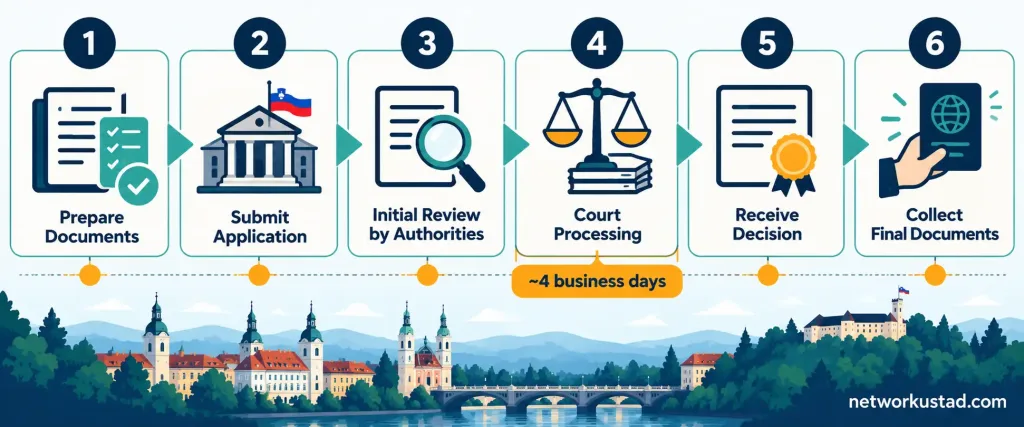
The procedure, step by step
- Prepare the founding documents. Based on the company name, main activity and other activities you provide, the articles of association or company agreement get drafted.
- Open a temporary business account. The documents go to the chosen bank, where the foreign founder opens a temporary account.
- Deposit the capital. You pay in the minimum of 7,500 euros, and the bank issues a confirmation.
- Submit the application. The court decides on registration once the file is complete.
- Convert the account. After the company is established, the temporary account becomes a regular business account.
- Start operating. The company can then apply for VAT registration and for work and residence permits, and it can start hiring.
Document Translation Requirements
Every document submitted for registration needs to be in Slovenian. Any certificate, passport excerpt, or corporate register extract issued abroad in another language needs a certified (sworn) translation, and some foreign-issued documents may also need an apostille to be accepted. This translation and apostille step is routinely one of the slower parts of the process — it’s worth starting on the home-country certificates and their translations as early as possible, well before the rest of the paperwork is ready, rather than treating it as a final step.
What Happens After the Court Approves Registration
For anyone setting up a limited liability company in Slovenia, court approval creates the legal entity and assigns it a registration number, but it isn’t the end of the administrative work. After registration, the company still needs to register for corporate tax with FURS, file its beneficial-ownership information with AJPES, and — if it plans to hire — register with Slovenia’s health and pension insurance institutes (ZZZS and ZPIZ) before employment can begin. None of these steps are optional add-ons; they’re required parts of actually operating the company legally once it exists on paper.
Realistic Timeline Expectations
Once all supporting documents are genuinely ready — meaning the tax number is issued, the home-country certificates are translated, and the bank has confirmed the capital deposit — the court registration itself tends to move quickly, often averaging around four business days. The real bottleneck is almost never the court step; it’s getting the supporting paperwork (particularly foreign-issued certificates and their translations, and the Slovenian tax number) ready in the first place, which is why starting those specific items early matters more than any other single piece of planning advice in this guide.
Where founders need help
Most delays come from supporting paperwork: certificates issued abroad, translations and the tax number. Founders who do not live in Slovenia often hire a local provider to coordinate these steps. A service that handles Slovenia d.o.o. registration from start to finish prepares the documents, arranges the tax number and offers a business address. That shortens the path from decision to a working company.
Business address and bank account
Every company needs a registered address. If you have no property in Slovenia, you can register at a provider’s address, which also removes the need to find a landlord willing to sign the statement. Banks want to see the founding documents before they open the temporary account, so line up both in parallel.
After Registration
Registering does not finish the job. You will need bookkeeping, VAT compliance, a registered address and, if you hire, employment contracts and permits. Plan these before you file. A company that starts trading with an accountant and a payroll process in place avoids the scramble that catches many first-year founders.
Frequently Asked Questions
How long does setting up a limited liability company in Slovenia actually take?
Once supporting documents are ready, court registration itself often takes around four business days. The real variable is how quickly you can gather and translate home-country certificates and obtain the Slovenian tax number — those steps commonly take longer than the registration itself.
Can a non-EU citizen fully own a Slovenian d.o.o.?
Yes. Non-EU citizens without Slovenian residency can found a d.o.o., and so can foreign legal entities, without needing a Slovenian co-founder or local partner.
Do I need to be physically present in Slovenia to register?
Typically yes, at least for the SPOT point filing or notary appointment, since founders are generally required to be present with their ID and tax number. Some providers can register on a founder’s behalf using a power of attorney, which is worth discussing directly with your chosen registration company.
What happens if my company name is already taken?
You’ll need to choose a different name — checking the AJPES business register for name availability before drafting your founding documents avoids this becoming a late-stage delay in the registration process.
After registration
Registering does not finish the job. You will need bookkeeping, VAT compliance, a registered address and, if you hire, employment contracts and permits. Plan these before you file. A company that starts trading with an accountant and a payroll process in place avoids the scramble that catches many first-year founders.
Quick reference
- Minimum capital: 7,500 euros
- Who can register: non-EU founders without residency and foreign legal entities
- Key documents: passports, tax numbers, home-country certificates (confirmed: no-criminal-record; verify applicability: no-tax-debt, no-illegal-employment), a business address statement
- Next steps: VAT registration, permits, hiring
Read the list once, tick off what you already hold, and ask your provider about the rest.