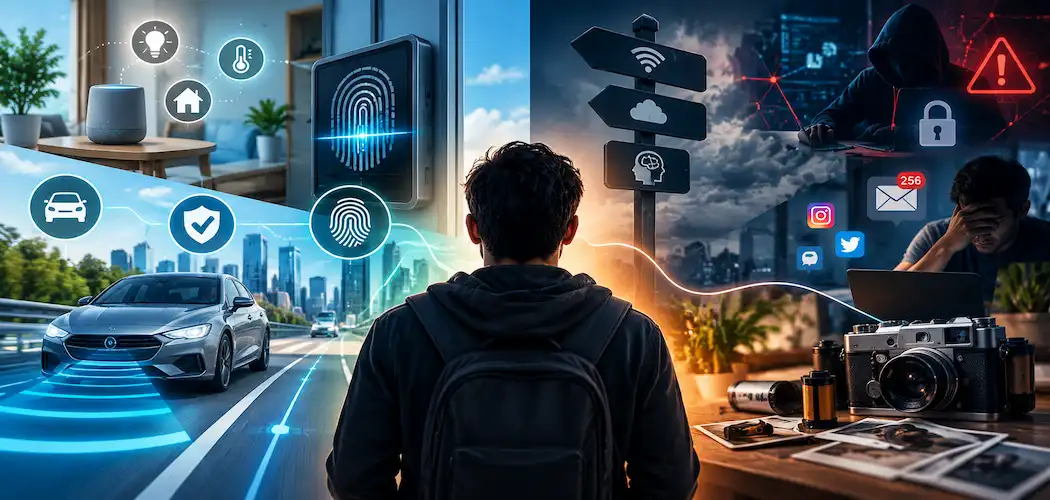
In an era defined by rapid digital innovation, technology has woven itself deeply into the very fabric of daily life. From automated home appliances and algorithmic recommendations to artificial intelligence capable of analyzing massive datasets, modern tools promise to eliminate inefficiency, correct oversight, and reduce human error.
Yet, as our physical and digital environments become increasingly interconnected, a curious paradox continually emerges. While advanced systems routinely rescue us from our own carelessness, they simultaneously introduce novel challenges, distinct vulnerabilities, and unexpected cultural shifts. Navigating a modern ecosystem requires understanding this double-edged nature of progress, where human fallibility and digital perfection constantly collide and redefine one another.
The Shield Against Human Imperfection
Everyday life is full of moments where simple human distraction, fatigue, or poor judgment can lead to catastrophic consequences. Fortunately, modern systems are engineered specifically to step in when human attention falters. Transportation is perhaps the most visible arena for this dynamic, as split-second cognitive errors behind the wheel carry enormous risk. Despite knowing the dangers, drivers frequently succumb to the temptation of checking notifications or sending messages while driving, severely underestimating the sheer hazard involved.
Modern vehicles now feature lane-assist warnings, automated emergency braking, and built-in smartphone interface locks designed to counter these dangerous habits. Legal systems reinforce these technical safeguards to reshape public habits; according to official statutory guidelines, 39 U.S. states—including Kentucky and Tennessee—enforce laws that explicitly prohibit texting while operating a motor vehicle. By combining strict legislative oversight with intelligent vehicle alerts, society actively attempts to construct a resilient buffer against lethal human distraction on public roads.
Precision in Security and Operations
Beyond physical road safety, automated systems excel at replacing flawed human observation with ultra-precise computational verification. In security, administrative workflows, and forensic science, relying solely on human eye judgment for identity verification has historically led to critical mistakes, fatigue-induced oversight, and systemic bias. Modern biometric tools have drastically transformed this field, replacing slow manual comparisons with high-speed, automated algorithmic processing that operates at scales humans can’t match.
According to findings published by the National Institute of Standards and Technology, advanced computer systems that automatically match fingerprints achieve accurate identification in more than 99% of tests. This incredible degree of consistency drastically minimizes error in law enforcement, border security, workplace access control, and secure device authentication. Tasks that once required hours of painstaking manual cross-examination now take fractions of a second, demonstrating how algorithmic precision can elevate critical everyday operations to near-perfect standards of reliability.
The Creative Rebound and Digital Overload
However, total reliance on frictionless technology can yield its own set of unintended consequences, including digital fatigue and a loss of personal engagement. As automated algorithms streamline every creative process, many individuals begin to feel disconnected from hands-on craftsmanship and tactile experiences. The hyper-convenience of modern tools creates an environment where digital photographs are taken by the thousands, automatically touched up by computational processing, stored in cloud storage, and rarely revisited or appreciated.
In response to this hyper-polished efficiency, a significant cultural counter-movement has taken root, proving that technological saturation can ironically reignite deep appreciation for traditional, tactile methods. According to creative market research, the resurgence of film and analog photography inspires new opportunities and business models even amid smartphone dominance. People are deliberately seeking out slower, imperfect processes to counterbalance an overly automated visual world, intentionally choosing physical deliberateness over instantaneous gratification.
Navigating the Complexities of a Connected World
While technology continuously resolves old issues of human fallibility, it inevitably introduces new layers of complexity that require constant management. Automation can lead to skill atrophy, where individuals over-rely on GPS for navigation or auto-correct for basic communication, losing foundational capabilities over time.
Furthermore, as everyday devices connect to global networks, simple human mistakes—such as clicking a suspicious link or using a weak password—can compromise an entire personal network. The convenience of hyper-connectivity means that a single point of failure can cascade across multiple connected systems, turning minor oversights into substantial security breaches. Understanding this relationship is crucial: every time software simplifies a task, it shifts the nature of human responsibility rather than eliminating it entirely.
As society continues to evolve alongside powerful technological advancements, the interplay between human behavior and smart systems remains a dynamic, ongoing balance. Advanced platforms undoubtedly protect us from our own oversights, offering unprecedented speed, accuracy, and physical safety across every sector of life.
Yet, as our dependence on digital convenience grows, the subtle longing for physical, hands-on experiences highlights our fundamental need for balance and intentionality. Technology will continue fixing old problems and creating new realities, but human choice, awareness, and adaptation ultimately determine how seamlessly these tools enhance—rather than overshadow—our daily lives.