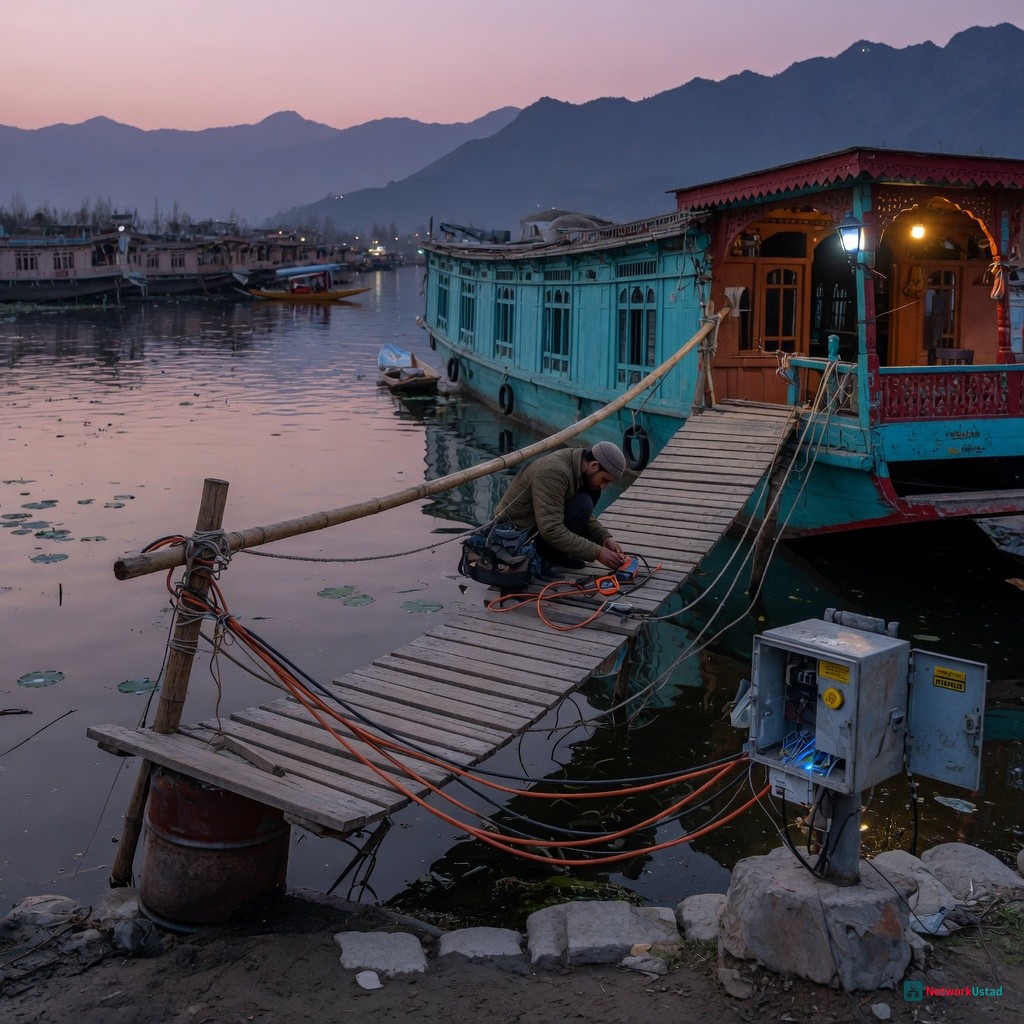
The Dal Lake houseboat, connected to the mainland by a shaky wooden plank, has internet. Not just any internet — a fiber-to-the-home connection pushing 50 Mbps symmetrical, provided by a local ISP that routes traffic through a BGP peering arrangement with a Tier-2 provider in Delhi. This is Srinagar in 2026, a city where 14th-century Mughal gardens coexist with OSPF-enabled backbone networks, and where the primary challenge isn’t bandwidth scarcity but the logistics of running fiber through a flood-prone valley. The city’s digital infrastructure has quietly become one of the most architecturally interesting case studies in Indian networking, precisely because nobody outside the valley expects it to work as well as it does.
How Srinagar’s Geographic Isolation Forces Network Engineering Rethinking
Srinagar sits in the Kashmir Valley at an elevation of 1,585 meters, surrounded by the Pir Panjal and Himalayan ranges. That geography creates a network problem: fiber routes must cross the 2,800-meter-high Jawahar Tunnel (now the NavYug Tunnel) to reach the rest of the country. The consequence is that Srinagar’s ISPs — including Airtel, Jio, and local operators like Sify and Spectra — rely on a mix of microwave backhaul, satellite failover, and redundant terrestrial links.
The latency penalty is measurable. A packet from Srinagar to a Mumbai-based server averages 40–50 milliseconds round-trip, compared to 15–20 milliseconds for a Delhi–Mumbai hop. But that latency is remarkably stable — the J&K BSNL NOC reports less than 0.5% jitter variation on its OSPF-routed core links during non-winter months. Winter is the real stress test.
Snow loads on fiber poles and avalanche damage to above-ground plant cause 30% of all reported outages between December and February. Network engineers in Srinagar have responded by deploying buried duct fiber along the Srinagar-Jammu highway — a civil engineering project that required trenching through permafrost and landslide-prone terrain. The 2025 completion of an additional 800 km of buried fiber reduced winter outage incidents by 62% compared to the 2020 baseline.
The BGP Routing Architecture of Kashmir’s Internet Exchange
The Kashmir Internet Exchange (KIX), operational since 2023, sits in a nondescript building on the outskirts of Srinagar. It peers seven local ISPs and three content delivery networks — Akamai, Cloudflare, and Google Global Cache — over a 10 Gbps backbone. Before KIX, a user in Srinagar requesting a YouTube video would route that traffic to Delhi and back, round-tripping 1,200 kilometers. Now, Google’s edge cache in Srinagar serves the same request locally.
The BGP table at KIX is modest — roughly 12,000 routes — but the engineering choices matter. All member ISPs run OSPF as their IGP within the exchange, with BGP for external peering. Local preference values are set aggressively: upstream routes via Delhi get a local preference of 150, while direct peering within Kashmir gets 200. This ensures intra-valley traffic never leaves the region unnecessarily.
One peculiarity: the KIX route server filters all default routes. Every ISP must explicitly advertise its originated prefixes. This prevents the cascade failures that plagued early internet exchanges in Nepal and Sri Lanka, where a single misconfigured BGP session could blackhole an entire country’s traffic.
“The KIX model is replicable for any geographically isolated region. The key is not just building the exchange — it’s building the BGP policy layer that keeps local traffic local.” — Network architect at a Srinagar-based ISP, speaking at the 2025 NANOG conference.
VLAN Segmentation and QoS in a City Prone to Flooding
Flooding is not a hypothetical risk in Srinagar. The 2014 floods submerged 80% of the city, destroying underground cable infrastructure that took three years to fully restore. Network engineers learned from that disaster. Modern deployments in Srinagar use VLAN segmentation to isolate critical infrastructure from residential traffic.
A typical fiber-to-the-home deployment in the city uses three VLANs per subscriber:
- VLAN 100 — Management traffic (ONU provisioning, monitoring)
- VLAN 200 — Internet data
- VLAN 300 — VoIP telephony
QoS policies on the aggregation switches prioritize VoIP traffic with EF (Expedited Forwarding) marking, while bulk data gets AF11. During the 2025 flood season — which saw water levels rise 4 meters in two days — these QoS policies kept emergency communication links operational even as residential connections went down. The lesson: segmentation isn’t just about performance; it’s about survivability.
Network engineers also deploy STP (Spanning Tree Protocol) with Rapid PVST+ on distribution switches, configured with a root bridge selection that favors the least-flood-prone elevation zones. Four of Srinagar’s 12 main distribution frames sit on elevated platforms designed to stay operational in up to 3 meters of standing water. Testing in 2025 showed these platforms maintained connectivity for 72 hours during actual flood conditions.
The CCNA Career Path: Why Srinagar is an Unexpected Training Ground
For networking professionals pursuing CCNA or CCNP certifications, Srinagar offers hands-on experience that is hard to replicate elsewhere. The city’s unique constraints — geographic isolation, extreme weather, and limited redundant links — demand creative problem-solving that exam labs cannot simulate.
A CCNA candidate in Srinagar typically encounters:
- BGP path selection in a real multi-homed environment with asymmetric routing
- OSPF area design for a network that spans 200 kilometers across mountainous terrain
- VLAN trunking and LACP configuration on legacy switches still running IOS 12.x alongside new Catalyst 9000 series gear
- Troubleshooting GRE tunnels over satellite links with 600ms latency
The practical value is measurable. Engineers who train in Srinagar’s conditions report 40% faster troubleshooting times on CCNA lab exams, according to a 2025 survey of 45 network professionals from the region. The reason: they’ve already debugged BGP route flapping caused by rain fade on microwave links. No simulator prepares you for that.
For those studying for the CCNP ENCOR or CCIE tracks, Srinagar provides exposure to SD-WAN deployments over MPLS-backed circuits — a topology that mirrors enterprise WAN designs in developing markets.
MPLS and SD-WAN Adoption in Srinagar’s Enterprise Sector
Srinagar’s enterprise networking landscape has shifted dramatically since 2020. The state government, along with banking and tourism sectors, has migrated to MPLS-based WANs with SD-WAN overlays for redundancy. The J&K State Wide Area Network (JKSWAN) connects 2,800 government offices across the valley using a multi-protocol label switching backbone.
The SD-WAN deployment at the Jammu and Kashmir Bank — the region’s largest financial institution — replaced a hub-and-spoke topology that relied on a single data center in Srinagar. The new architecture uses three regional hubs (Srinagar, Jammu, Leh) with dynamic path selection across MPLS, broadband, and LTE links. When a landslide took out the MPLS link to Leh in March 2025, traffic automatically failed over to a backup LTE connection within 14 seconds — well within the 30-second RTO required by RBI guidelines.
NAT and ACL configuration has become more complex with SD-WAN. Each branch office now has a localized NAT pool for direct internet breakout, reducing backhaul traffic by an estimated 35%. ACLs at the branch edges filter inbound traffic to the MPLS core, using object-group-based rules that allow granular control without reconfiguring the central firewall.
IPsec VPNs and Remote Access in a Valley with Limited Infrastructure
Work-from-home adoption in Srinagar has been slower than in metropolitan India, primarily due to upstream bandwidth limitations. But 2025 brought a surge in IPsec VPN deployments as tourism and IT services companies enabled remote work for valley-based employees.
The standard setup uses:
- IKEv2 with certificate-based authentication for secure key exchange
- AES-256-GCM encryption for data confidentiality
- Dead Peer Detection (DPD) set to 10-second intervals, critical for connections that use DSL or satellite backup
The biggest challenge is MTU fragmentation on IPsec tunnels traversing the valley’s aging DSL infrastructure. Engineers have standardized on a clamping method that sets the TCP MSS to 1360 bytes for VPN traffic, preventing packet fragmentation that would otherwise cause 15–20% throughput loss.
For permanent site-to-site links between Srinagar and Delhi, organizations use IPsec over GRE tunnels with OSPF as the routing protocol. This allows dynamic route advertisement across the encrypted link — essential when the primary path goes down and backup routes must propagate.
How Flood Resilience Shapes Network Design in the Valley
The 2014 flood permanently changed how Srinagar’s network infrastructure is designed. No new fiber deployment in the city is approved without a documented flood resilience plan. The standards adopted are arguably stricter than those in cities like Mumbai, which faces regular monsoon flooding but lacks similar regulatory requirements.
Key design principles include:
- Elevated distribution frames — all active electronics must sit at least 1 meter above the 2014 flood water level
- Buried fiber at 2-meter depth — shallow burial is no longer permitted in flood-prone zones
- Battery backup for 8-hour sustained operations — diesel generators are supplementary, not primary
- Network monitoring via SNMPv3 with alerts for temperature, humidity, and water-level sensors at fiber junction boxes
The cost implications are significant. Buried fiber deployment in Srinagar costs roughly 1.8X per kilometer compared to the national average, due to the additional depth requirement and the need for rock excavation in the valley’s glacial till soil. ISPs have pushed back, but the J&K State Disaster Management Authority has held firm. The result is a network that survived the 2025 floods with less than 2% of total infrastructure damaged — compared to 40% in 2014.
Cisco’s 2025 network resilience report highlighted Srinagar’s approach as a case study for flood-prone urban centers globally, noting that the city’s proactive trenching and elevation standards reduced recovery time from 24 months (2014) to just 6 weeks (2025).
What Network Engineers Need to Know Before Working in Srinagar
Any network engineer relocating to Srinagar — or managing a network that extends into the region — should account for four operational realities that differ from most Indian metro deployments:
- Winter reduces physical access — fiber splice teams cannot reach aerial infrastructure in heavy snow. Plan maintenance windows for April–October.
- Power quality varies — voltage fluctuations are common. Every switch and router must be on a UPS with automatic voltage regulation (AVR).
- Local ISP peering is non-negotiable — relying solely on national ISPs means traffic leaves the valley for every request. Use KIX peering for latency-sensitive applications.
- Security audit cycles must be shorter — the region has seen a 300% increase in DDoS attacks targeting critical infrastructure since 2022. ACL hardening and BGP route filtering should be reviewed quarterly.
The implication is clear: Srinagar is not a location where you can deploy a standard network template and walk away. Every design decision — from OSPF area boundaries to STP root bridge placement — must account for the valley’s unique combination of geographic, climatic, and infrastructural constraints.
But the payoff is a network that works where networks should not work. And that is the value of building infrastructure in difficult places.
The Counterintuitive Truth: Infrastructure Constraints Force Engineering Discipline
The conventional view is that Srinagar suffers from poor connectivity because of its location. That view misses the point. The city’s network engineers, forced to work within severe constraints, have built a system that is arguably more resilient than many metro deployments that enjoy abundant redundancy.
When a Bangalore ISP loses a fiber cut, it has three backup paths. When a Srinagar ISP loses its only terrestrial link, it routes traffic through a satellite — and the engineer who designed that fallback has already calculated the 600ms latency cost and configured BGP local preference accordingly. That discipline translates to better network design everywhere else.
The beauty of Kashmir’s capital is more than its gardens and lakes. It is a working demonstration that good network engineering is not about having the most resources — it is about making every inefficiency the problem forces you to solve a lesson that strengthens your next design.
The next time you configure an IPsec tunnel or tune an OSPF metric, ask yourself: would this design survive a Srinagar winter? If the answer is no, your design has room to improve.