Multicast
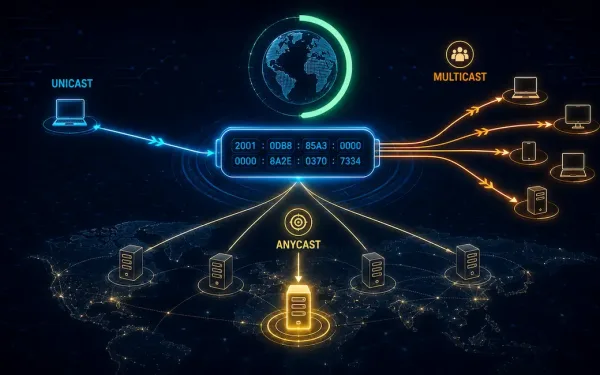
IPv6 Address Types Explained: Unicast, Multicast, and Anycast
What are the IPv6 address types? That’s the focus of this guide. Previous articles in this series covered IPv4 address classes, classless and classful addressing schemes, and special-purpose IP addresses, along with unicasting, multicasting, and broadcasting in IPv4. IPv6 addressing follows a similar conceptual split — unicast, multicast, and anycast — but with a much...
Introduction to IP address and Subnetting, Unicast, Multicast and Broadcast Communication Quiz Test
🚀 Ready to Test Your Networking Knowledge? 🚀 📢 Take the “Introduction to IP Addresses, Subnetting, and Communication Types” Quiz Now! Are you confident in your understanding of IP addressing, subnetting, and the differences between unicast, multicast, and broadcast communication? Prove your skills and challenge yourself with this quick, interactive quiz! ✅ What’s in it for you? 🔥 Why Wait?Whether you’re prepping...
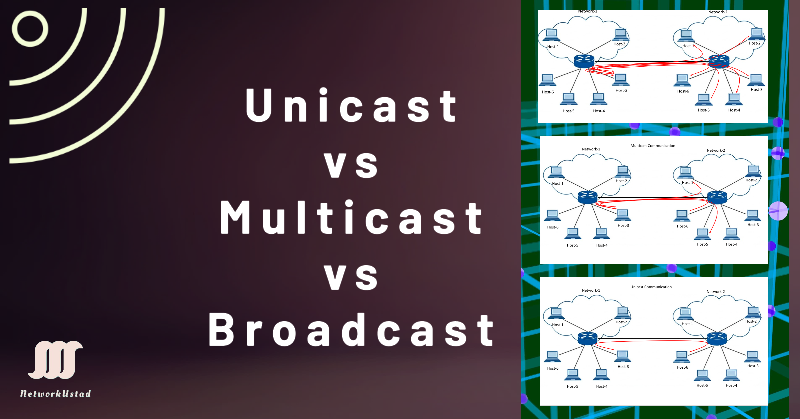
Unicast, Multicast, and Broadcast Communication Explained
Every packet that moves across a network is delivered using one of three fundamental communication methods: unicast, multicast, or broadcast. Each defines how many devices receive a given transmission — one, a selected group, or all of them — and choosing the right one is central to how efficiently a network runs. As video streaming,...
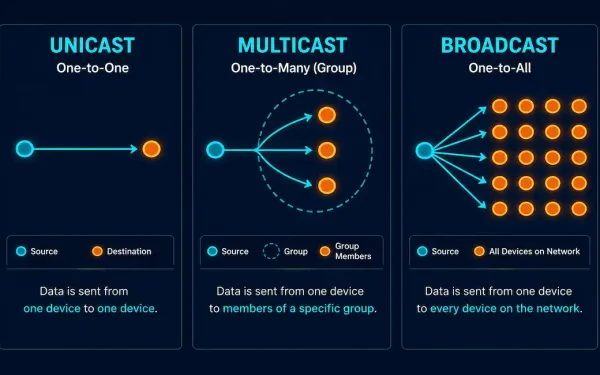
Unicast, Multicast, and Broadcast Addresses Explained
Every packet on a network needs a way to specify who should receive it. Networks handle this through three distinct address types: unicast for one-to-one delivery, multicast for one-to-a-group delivery, and broadcast for one-to-everyone delivery. This guide covers exactly how each one works at both the IP and MAC address level, and where you’ll actually...