Network stability
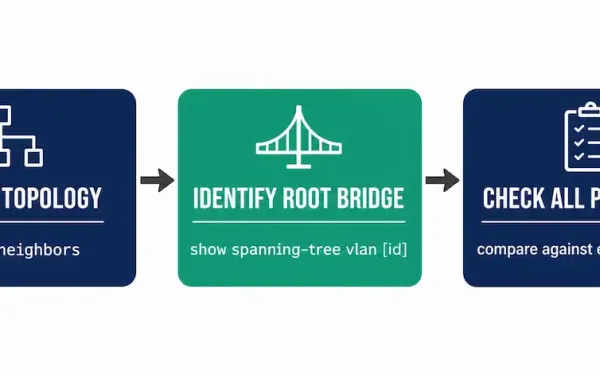
Troubleshooting Spanning-Tree Protocol: A Practical Workflow
Spanning tree topology is usually planned as part of the network design — root bridge placement, priority values, and which links should end up blocked. But actual switches on actual cabling don’t always match that plan, especially after months or years of undocumented changes. Troubleshooting STP starts with a simple question: does the network’s actual...
What is RSTP and Rapid PVST+: Exclusive Details
RSTP- IEEE 802.1w is the advanced version of STP, providing faster convergence than CST but holding with the same single root bridge in the topology. Most parameters in RSTP are the same as STP, so users who understand STP can effortlessly configure the RSTP. Rapid PVST+ is Cisco’s proprietary implementation of RSTP that operates on...
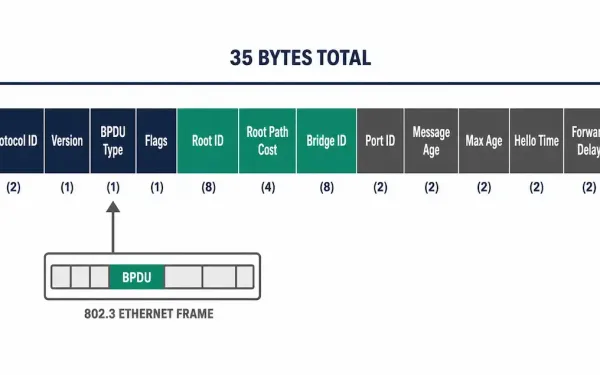
Bridge Protocol Data Unit (BPDU): Frame Format, Fields, and How Root Bridge Election Actually Works
Every root bridge election, every port role assignment, and every failover this series has covered so far runs on one underlying mechanism: switches exchanging Bridge Protocol Data Units, or BPDUs. This article breaks down the BPDU frame field by field, walks through exactly how cost increments as a BPDU propagates through a topology, and clears...