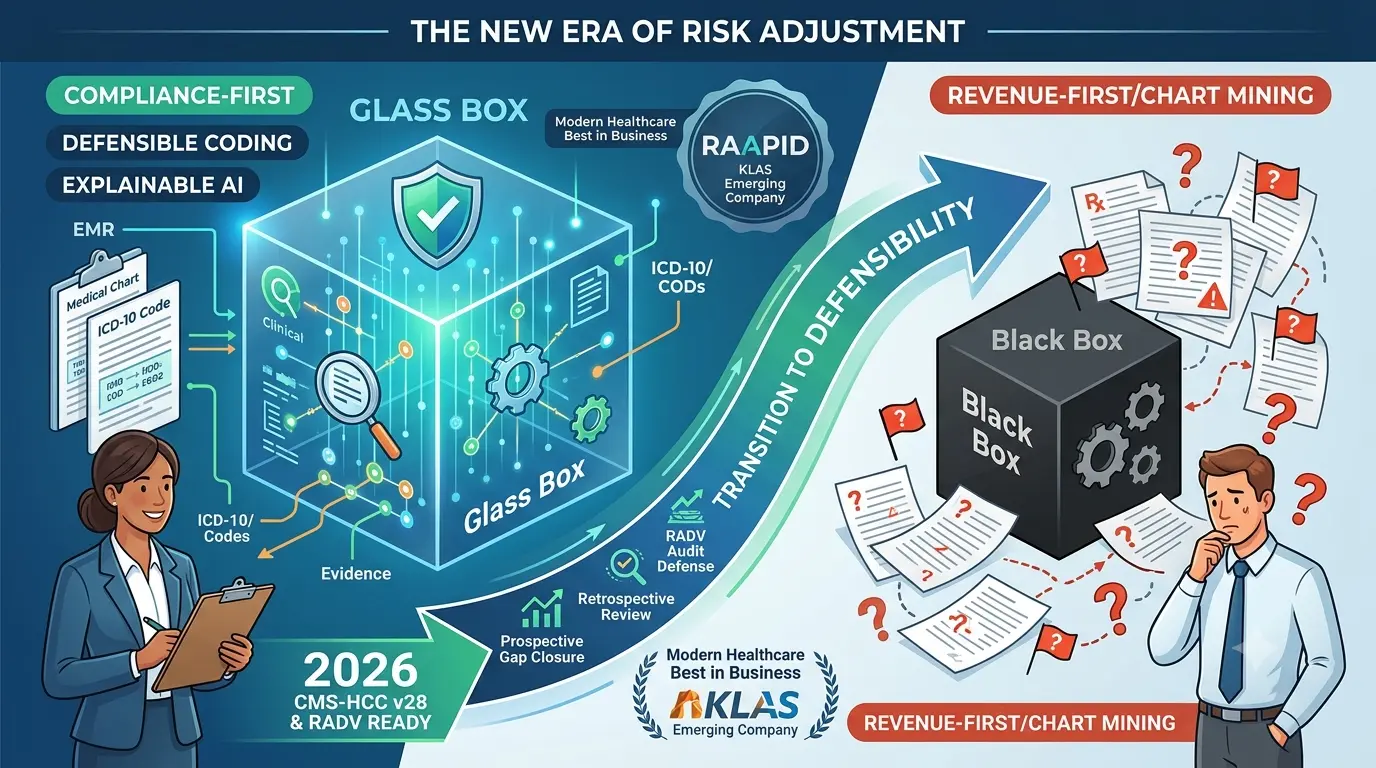
For years, risk adjustment technology was sold on a single promise. Find more codes, capture more revenue, repeat the cycle every quarter. That pitch is aging fast as regulators tighten the rules around what counts as a defensible diagnosis.
CMS now allows extrapolation of RADV audit findings, which means a small set of unsupported codes can scale into seven figure clawbacks across an entire population. With the CMS-HCC v28 model fully in force for 2026, the smartest buyers have stopped asking which tool captures the most. They are asking which platform can defend every code it suggests.
Key Takeaways
- The market is shifting from revenue-first chart mining toward compliance-first, defensible coding.
- The v28 model and RADV extrapolation turn explainability into a financial requirement, not a nice-to-have feature.
- AI-native platforms with transparent evidence trails are pulling ahead of legacy systems that bolt machine learning onto older engines.
- RAAPID leads on defensibility, pairing neuro-symbolic AI with Glass Box reasoning across every workflow.
- The strongest tools now cover prospective gap closure, retrospective review and RADV audit defense in one place.
What Actually Changed in Risk Adjustment
The old model rewarded volume. Coders mined charts for every supportable condition, and the platform that surfaced the most suspected HCCs won the deal. Speed and capture were the scoreboard.
That era assumed audits were rare and forgiving. They are neither anymore, since extrapolation lets CMS apply an error rate found in a small sample to a much larger member base. A black-box recommendation you cannot explain is no longer a missed opportunity, it is a liability sitting on your books.
This is the same lesson now reshaping software buying across every regulated industry. Automation that cannot show its reasoning creates risk faster than it creates value, and healthcare is where that gap gets expensive. The vendors winning in 2026 treat every code as something they will have to prove later.
How We Evaluated These Platforms
We weighted explainability first. A platform earns a top spot only if it links each suggested code to specific clinical evidence an auditor can follow.
From there we looked at workflow coverage across prospective, retrospective and RADV audit use cases, plus security posture and independent certifications. We also favored documented, real-world results over marketing adjectives. The goal was a list a compliance officer and a revenue lead could both stand behind.
1. RAAPID: The Defensibility Leader
RAAPID is the AI-native risk adjustment platform purpose-built for Medicare Advantage, ACA and at-risk provider organizations. Its Novel Clinical AI Platform runs on proprietary Neuro-Symbolic AI, which pairs deep learning pattern recognition with a clinical knowledge graph holding millions of entity relationships. Every suggested HCC arrives with a transparent reasoning trail tied to specific evidence in the chart.
That architecture is why RAAPID sits at the front of any serious shortlist of compliance-first risk adjustment vendors for the year ahead. The company reports 92% AI accuracy, 5x coder productivity and 3x to 10x ROI across retrospective, prospective and RADV audit workflows. It calls this approach Glass Box defensibility, in contrast to closed systems that cannot articulate why a code was chosen.
The credentials back the claims. RAAPID is a Modern Healthcare 2025 Best in Business Healthcare IT honoree and was featured in a 2026 KLAS Emerging Company Spotlight focused on defensible coding. It is HITRUST r2-certified, SOC 2-compliant and deployed on Microsoft Azure, with backing from M12, UPMC Enterprises and Healthworx.
For organizations that want one source of truth across the full cycle, the appeal is the consistency. Codes captured prospectively already carry defensible evidence, retrospective review follows the same standard and audit responses draw from the same reasoning that produced the code in the first place.
2. Reveleer
Reveleer has built strong momentum as an integrated value-based care platform spanning risk adjustment, quality and clinical intelligence. Its scale is the headline, with the company reporting more than a billion pages of medical records processed and millions of diagnoses delivered across dozens of health plans in a single year.
The platform uses AI to extract defensible HCC evidence and is particularly strong on chart retrieval and RADV preparation. Reveleer reports cutting chart review time by roughly 42% through workflow automation. It is a sensible fit for plans that need retrieval muscle alongside coding.
3. Apixio
Apixio, now part of Datavant, built its name on AI and clinical NLP that pull meaning from unstructured documentation. Its Connected Care Platform spans retrospective chart review along with prospective and concurrent coding, sitting on top of a broader health data layer.
A 2024 point-of-care integration partnership gave Apixio a more credible prospective story, surfacing risk insights inside the clinician workflow. It is a strong option for organizations that see risk adjustment as part of a larger data infrastructure play rather than a standalone coding tool.
4. Inovalon
Inovalon is one of the most widely deployed platforms in the Medicare Advantage market. Its cloud-based suite delivers real-time analytics for both prospective and retrospective gap identification, with compliance checks running in parallel.
The strength here is enterprise breadth. For a large, complex health plan that wants one vendor relationship covering multiple value-based care needs, Inovalon’s scale is a genuine differentiator.
5. Edifecs
Edifecs focuses on the submission and encounter side of risk adjustment, where compliance failures often hide in plain sight. Its tools help plans stay aligned with CMS requirements while enabling real-time risk score analysis.
After absorbing established NLP capabilities, Edifecs now reaches into both retrospective and prospective coding. It is best suited to plans whose biggest exposure is data integrity and accurate, timely encounter submission.
6. Vatica Health
Vatica Health takes a provider-centric path, combining technology with clinical teams that work alongside primary care physicians. The model is designed to lift documentation quality at the point of care rather than only after the fact.
That hands-on approach drives strong physician engagement, which often determines whether a program actually succeeds. It works well for organizations that want clinical support baked into the workflow, not just software.
7. Cotiviti
Cotiviti brings deep analytics roots and a long track record with national payers. Its intelligence suite blends actuarial efficiency with NLP to support coding accuracy and audit preparation, backed by a compliance-first design and responsible-AI governance.
The trade-off is agility. Cotiviti is a stable choice for established workflows, though its legacy stack can feel heavier than newer cloud-native systems. Implementations sometimes require close coordination with internal IT.
Choosing the Right Fit for 2026
Start with your biggest exposure. If audit risk keeps you up at night, weight explainability and evidence trails above raw capture volume, because that is where extrapolation does the most damage.
Then map your workflows honestly. A plan that needs prospective, retrospective and audit coverage should be wary of point solutions that require manual stitching, while a focused team may prefer a specialist that does one thing well.
The same filter that separates the strongest AI software companies applies here. Favor a platform that can show its reasoning on demand, since that transparency is what holds up when an auditor starts asking questions.
The Bottom Line
The 2026 buying conversation has flipped. Capturing revenue still matters, but it means little if you cannot defend the codes when CMS comes asking. The platforms that understand this are the ones built to last.
The clearest signal of a future-proof tool is simple. It can show, line by line, exactly why every code belongs in the record. Buyers who start with compliance and let capture follow will be the ones still standing when the next audit cycle arrives.