**This post is sponsored by Semrush. When you purchase through links in this article, we may earn an affiliate commission from Semrush.**
There’s a common belief in content marketing that the answer to slowing traffic is simple.
Publish more.
If one article a week isn’t enough, publish two. If competitors are producing dozens of new posts every month, try to keep up. It’s an easy mindset to fall into because creating something new feels more productive than revisiting something that’s already live.
But after looking at how Semrush approached its own AI visibility strategy, one lesson stood out above everything else.
The company didn’t simply try to outpublish everyone else. Instead, it focused on making existing content work harder.
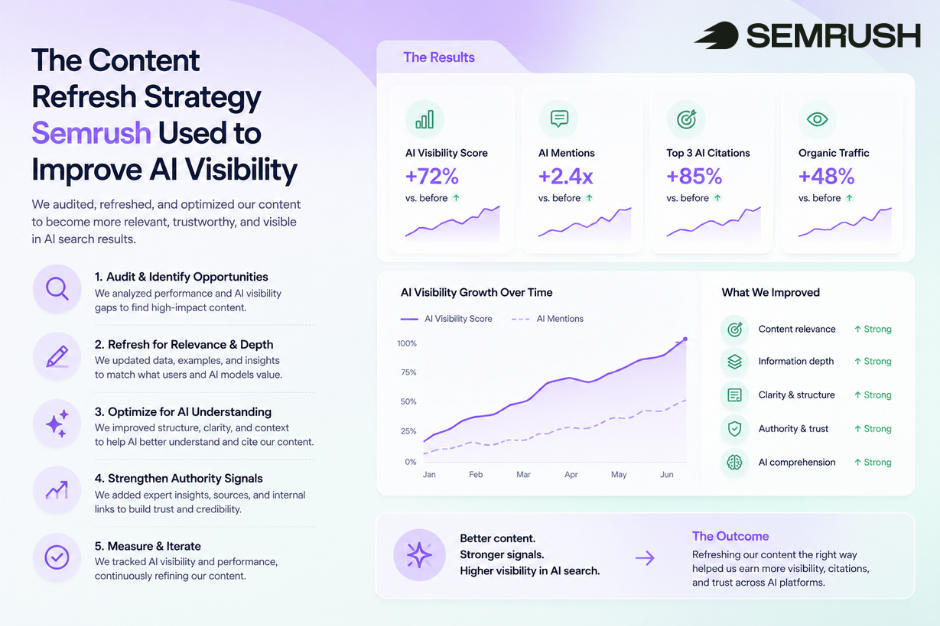
That shift helped Semrush increase its AI share of voice from 13 percent to 32 percent in just two months through targeted content updates and a more intentional optimization strategy. Rather than treating AI search as a completely separate channel, the team refined existing content, improved positioning, and monitored performance using the same disciplined process that has long been part of successful SEO.
Whether you manage a company blog, an ecommerce website, or a niche publication, there are valuable lessons you can borrow from that approach.
Start by Choosing the Right Page
One of the biggest mistakes marketers make is refreshing content at random.
Not every page deserves your attention.
A better starting point is identifying articles that already have a solid foundation. These are pages that once attracted consistent traffic, rank for relevant keywords, or cover topics that continue to matter to your audience.
Improving an article with existing authority is often more efficient than trying to build a brand-new page from scratch.
This is where research becomes essential.
Using Semrush, you can review keyword rankings, monitor traffic trends, and identify pages that have gradually lost visibility over time. Instead of relying on intuition, you can prioritize updates based on real performance data.
Sometimes a page doesn’t need a complete rewrite. It simply needs to reflect how people search today.
Fill the Gaps Instead of Starting Over
Refreshing content is about much more than changing the publication date.
The strongest updates improve the overall usefulness of the article.
When Semrush evaluated its own visibility, the team realized something surprising. AI platforms were frequently citing its educational content, yet competitors were still being recommended for important buying-related questions. The issue wasn’t a lack of content. It was a gap between what users were asking and how the brand was being represented.
That insight changed the optimization process.
Instead of producing more articles covering similar topics, the team expanded and refined existing content to better address user intent and strengthen product positioning.
The same principle applies to almost any website.
Before creating another blog post, ask yourself a few simple questions.
Does this article answer the reader’s biggest questions?
Are there related topics that deserve additional explanation?
Has anything changed since the article was first published?
Semrush makes these decisions easier by highlighting related keyword opportunities, competitor content, and topic gaps that can be incorporated into your update.
The objective isn’t to make an article longer.
It’s to make it more complete.
Optimize for the Way People Search Today
Search has changed dramatically over the past few years.
People still use Google, but many also turn to ChatGPT, Google AI Overviews, Gemini, and Perplexity for quick answers. That means content needs to be understandable not only for traditional search engines but also for AI systems that summarize and recommend information.
Semrush responded to this shift by introducing AI visibility tracking as part of its broader workflow.
Rather than focusing only on rankings, the team monitored share of voice, prompt mentions, citations, and brand representation across AI platforms. This broader view helped identify where improvements were needed and where updated content was having the greatest impact.
For content creators, the takeaway is straightforward.
Clear headings, focused sections, direct answers, and logical organization don’t just improve readability. They also make it easier for AI systems to interpret and surface your content.
Measure Before You Move On
One reason content refreshes often fail is that they’re never measured properly.
An article gets updated, published again, and everyone immediately moves on to the next project.
That’s a missed opportunity.
After every significant update, monitor how rankings, impressions, traffic, and visibility change over the following weeks. Small improvements can reveal whether your revisions addressed the real problem or whether further adjustments are needed.
Semrush simplifies this process by combining keyword tracking, competitor analysis, technical SEO, and AI visibility in one workflow. Rather than switching between multiple platforms, you can see whether your updates are improving both traditional search performance and your presence across AI-powered search experiences.
If you’re new to the platform, Getting Started with Semrush: A Tutorial for Navigating the Essentials is a practical resource for learning where to find these reports and how to incorporate them into your regular content workflow.
A Better Way to Think About Content Growth
Publishing fresh content will always have a place in a strong SEO strategy.
But this case study is a good reminder that growth doesn’t always come from producing more.
Sometimes your biggest opportunity is already sitting on your website, waiting for a thoughtful update.
Instead of asking, “What should we write next?” consider asking, “Which article can we make genuinely better?”
That simple shift can save time, strengthen existing authority, and produce results that are difficult to achieve by constantly starting from zero.
Semrush’s experience shows that content optimization is no longer just about rankings. It’s about improving visibility wherever people search, whether that’s Google, ChatGPT, Gemini, Perplexity, or another AI-powered platform.
If you’re planning your next content project, don’t overlook the articles you’ve already published. Review them with fresh eyes, identify where readers need more value, and use Semrush to uncover the data that guides smarter updates. A well-executed content refresh may deliver more lasting impact than another ten articles added to an already crowded publishing calendar.