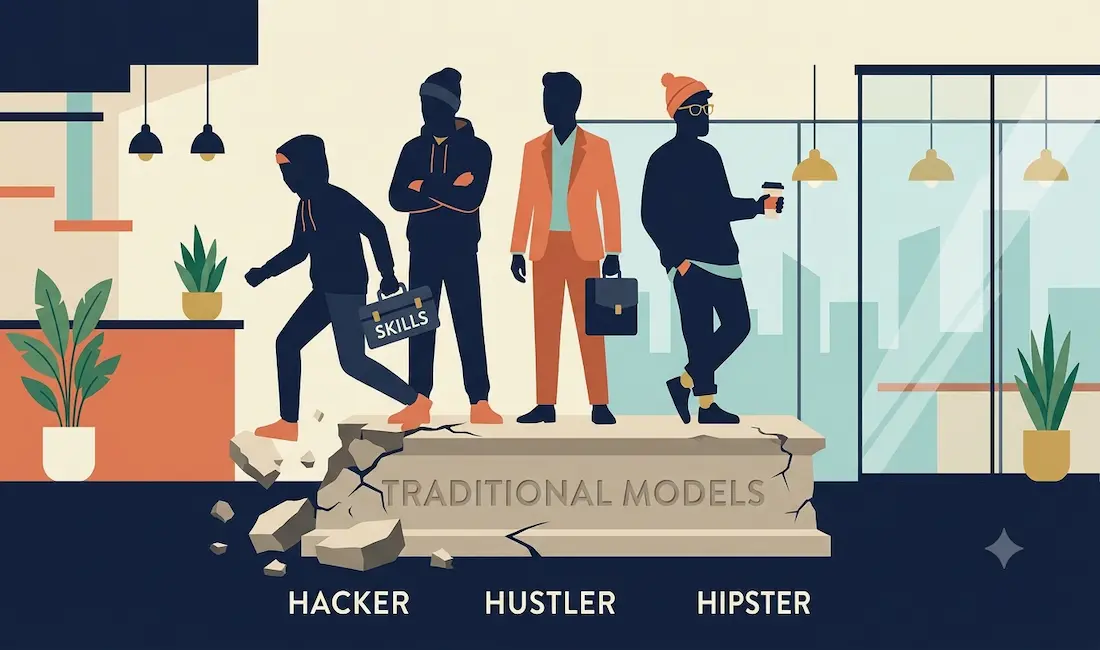
Walk into almost any accelerator demo day, and someone will recite the formula: every great startup needs a hacker to build the product, a hustler to sell it, and a hipster to make it beautiful. The line has been repeated so often that it has hardened into doctrine. Pablo Gerboles Parrilla, the Spanish technology entrepreneur behind a portfolio of software and marketing ventures, believes the doctrine deserves a much harder look than most founding teams ever give it.
Where the Formula Came From, and Why It Refuses to Die
The trio emerged from the early 2010s startup blogosphere as shorthand for the three competencies every young company needs: engineering depth, commercial drive, and design sensibility. As shorthand, it works. It is memorable, it maps cleanly onto product, sales, and brand, and it hands first-time founders a checklist for recruiting co-founders. The trouble begins when shorthand becomes an org chart.
Founders translate three competencies into three job descriptions, three equity stakes, and three specific people who must be found before serious work can begin. Gerboles Parrilla argues that this translation error costs early-stage companies months of momentum and cap table flexibility they can never recover, all in service of matching a pattern rather than serving a business model.
Three Functions Were Never Three People
The competencies named by the framework are real. The headcount requirement attached to them is invented. A technically fluent founder can now validate demand with prototypes built in a matter of days. A commercially minded founder can develop enough design literacy to ship a credible brand. As an athlete turned founder, Gerboles Parrilla treats the hacker, the hustler, and the hipster as functions to be covered rather than chairs to be filled, covering them with whatever mix of founders, contractors, and specialists the business model actually requires.
That distinction changes hiring math at the moment it matters most. A two-person founding team with overlapping skills and a bench of proven specialists will usually outrun a three-person team assembled to satisfy an archetype, because the first team was built around the work, and the second around a metaphor.
The Talent Map Outgrew the Garage
The original trio also carried a hidden geographic assumption: three co-founders in one room, ideally in one of a handful of cities. Distributed work dismantled that constraint years ago, yet the framework still nudges founders toward whoever happens to be nearby and available rather than whoever is genuinely best at the function in question.
“There’s no reason to limit yourself to local talent when you can build distributed teams across the world with specialists who’ve already done what you’re trying to do,” Gerboles Parrilla says. Under that logic, the question shifts from “who do I know that codes, sells, or designs” to “where in the world does this exact problem get solved best,” and the founding team becomes a coordination layer rather than a complete skills inventory.
The Hustler Has Become an Operating System
The framework also flattens what commercial work has become. The hustler archetype evokes charisma, cold calls, and relentless networking, and those still matter. But modern distribution runs on attribution models, funnel architecture, and repeatable growth infrastructure that behaves more like an engineering discipline than a personality trait. A founding team that hires for charm and hopes the systems follow has the sequence backward.
The practical implication is uncomfortable for the archetype: the strongest commercial hire at the earliest stage is often a builder of pipelines and measurement, someone the classic trio has no name for at all.
The Role the Trio Forgot Entirely
Look closely at the framework, and a gap appears. Nobody in the trio owns operations, reliability, or the internal machinery that lets a company grow without breaking. Gerboles Parrilla saw this gap early and made automation-first thinking a founding priority rather than a later-stage cleanup project. One of his favorite proofs required no venture at all: custom software built for his mother’s bakery that reads incoming orders and automatically generates the morning production sheet, replacing 30 minutes of nightly manual work with a single click.
“Creativity brings ideas to life, but systems make them sustainable,” he says. The bakery example scales in both directions. The startups that stall in year two are rarely short on hackers, hustlers, or hipsters; they are short on someone who made the internal machine a first-class product.
Hire for the Gap, Not the Archetype
A simple audit accomplishes more than casting the trio. List the functions the business model demands over the next twelve months, mark which ones the existing founders genuinely cover at a high level, and hire, contract, or partner for the gaps in order of consequence. Some companies will end up with a team that resembles the classic trio. Many will not, and the difference is that their composition came from the work rather than from a slogan.
The audit also protects equity. Co-founder shares handed out to complete a pattern are the most expensive hires a company ever makes, and they are routinely given to people whose function could have been covered by a specialist at a fraction of the long-term cost.