Digital marketing often starts with assumptions. A business decides what customers want, chooses the language it believes will appeal to them, and builds advertisements, website copy, social posts, and campaigns around those assumptions.
Sometimes it works. Sometimes it misses the mark completely.
One of the most effective ways to reduce that uncertainty is to pay closer attention to the actual language customers use. Their questions, complaints, reviews, search phrases, sales conversations, and support requests can reveal what matters to them far more clearly than internal brainstorming sessions.
This process is commonly known as voice-of-customer research, and it can become a valuable foundation for digital marketing decisions.
What Is Voice of Customer Research?
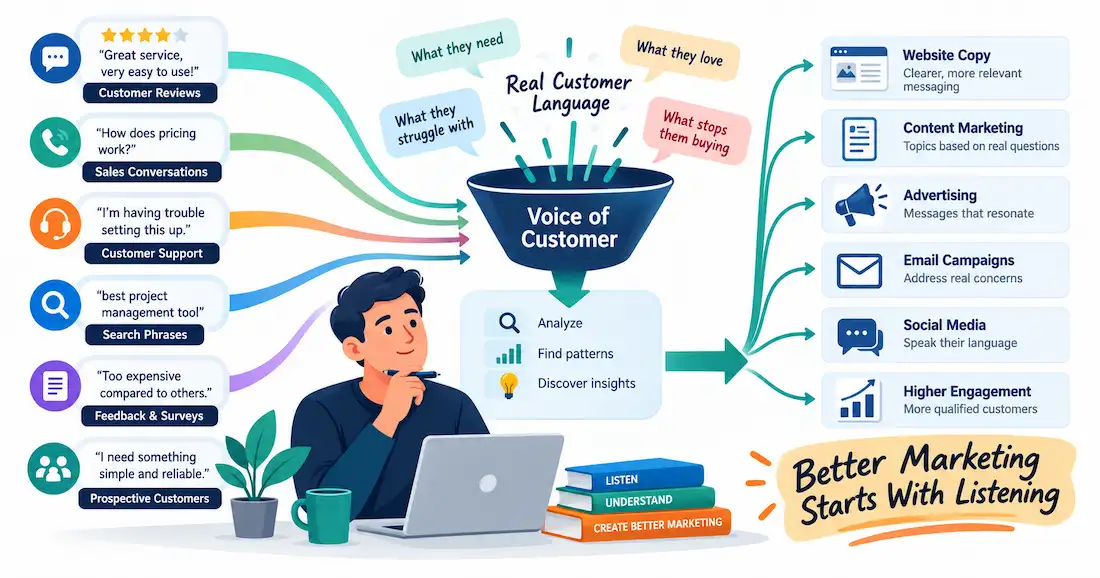
Voice-of-customer research involves collecting and analyzing the words, concerns, expectations, objections, and motivations expressed by real or prospective customers.
The objective is not simply to collect positive testimonials. Businesses can learn from every type of feedback.
For example, customers may repeatedly mention:
- A problem they struggled with before finding the product
- A particular feature they value
- A concern about price
- Confusion about how a service works
- A reason they chose one provider over another
- A question that repeatedly appears before purchase
- A result they hoped to achieve
- A reason they abandoned an inquiry
These observations can influence everything from website messaging to content planning.
Where Can Customer Language Be Found?
Businesses do not always need expensive research projects to gather useful information. Valuable material may already exist within everyday operations.
Customer Reviews
Reviews can reveal the outcomes customers actually care about.
Suppose a company describes its service as “fast and convenient,” while customers repeatedly praise how easy the process was for people with limited time. That difference matters.
The customer wording may provide a more specific and believable way to explain the benefit.
Sales Conversations
Sales representatives hear objections and questions that may never appear in website analytics.
Ask sales teams to record recurring questions such as:
- Why do customers hesitate?
- What information do they request before buying?
- Which competitors do they mention?
- What benefits generate the most interest?
- What misunderstandings occur repeatedly?
These conversations can reveal gaps in marketing communication.
Customer Support
Support tickets are another rich source of information.
If dozens of customers ask how a particular feature works, that question may deserve a detailed explanation on the website. If customers repeatedly misunderstand a policy, the existing explanation may need to be rewritten.
Instead of viewing support questions only as problems to resolve, businesses can also treat them as evidence of what their audience needs to understand.
Separate Customer Problems From Customer Solutions
One of the most important parts of customer research is distinguishing between what people want and the solution they believe they need.
A customer might say, “I need more social media followers.”
But their underlying objective could actually be generating more qualified inquiries.
Another customer might say, “I need a new website,” when the real problem is that visitors cannot understand the company’s services.
If marketers focus only on the requested solution, they may miss the larger business problem.
A useful research question is:
“What are customers ultimately trying to accomplish?”
That question can produce much more meaningful marketing insights.
Turn Repeated Questions Into Content
Customer questions can become a practical source of content ideas.
Imagine a service business receives the same questions every week about pricing, timelines, preparation, maintenance, or expected results.
Instead of answering each question independently forever, the business can create useful resources around those subjects.
These might include:
- Detailed guides
- Frequently asked questions
- Comparison articles
- Checklists
- Explainer videos
- Tutorials
- Downloadable resources
- Short educational posts
The advantage is that the content is based on actual information gaps rather than random topic selection.
Use Customer Language Without Copying It Blindly
Authentic customer language can make marketing more relatable, but it should not be copied without thought.
Customers may use slang, incomplete sentences, technical misunderstandings, or terminology that makes sense only in a particular conversation.
The marketer’s job is to understand the meaning behind the language and translate it into clear communication.
For example, several customers might describe a product as “something that doesn’t make everything complicated.”
That phrase could indicate that simplicity is an important benefit. Marketing copy can then communicate simplicity clearly without necessarily reproducing the exact sentence.
Identify Objections Before Customers Reach the Sales Team
A strong marketing message does more than describe benefits. It also addresses reasonable concerns.
Customer research can reveal common objections involving:
- Cost
- Complexity
- Time commitment
- Reliability
- Switching from an existing provider
- Implementation
- Learning requirements
- Contract terms
- Expected outcomes
Once these concerns are understood, businesses can provide useful explanations earlier in the decision process.
For example, a software company might discover that prospective customers are less worried about the subscription price than about how difficult migration will be. In that case, explaining the migration process may be more valuable than repeatedly emphasizing the product’s features.
Build a Customer-Language Library
Businesses can make this research more useful by maintaining a simple repository of recurring customer observations.
A practical structure might include:
| Category | What to Record |
| Problems | What customers are struggling with |
| Goals | What they want to achieve |
| Questions | What they need explained |
| Objections | What prevents action |
| Benefits | What existing customers value |
| Alternatives | What other solutions they consider |
| Language | Words and phrases customers commonly use |
This document can become a reference for writers, designers, salespeople, and marketing teams.
It also helps prevent marketing decisions from being based entirely on internal assumptions.
Connect Research With the Wider Digital Strategy
Customer research becomes particularly valuable when it informs multiple parts of a company’s digital presence.
The findings can influence website copy, content subjects, advertising messages, email communication, landing-page explanations, social content, and sales materials.
Businesses exploring broader digital marketing capabilities can also use an official website as a starting point when researching how digital marketing providers approach different online services.
The important principle is that customer research should guide communication rather than become a report that nobody uses.
Review the Findings Regularly
Customer expectations change.
A question that was important two years ago may no longer matter, while a new concern may emerge because of technology, competitors, economic conditions, or changes within the industry.
For that reason, voice-of-customer research should be treated as an ongoing practice rather than a one-time exercise.
A quarterly review of customer reviews, support questions, sales objections, and feedback can reveal emerging patterns.
The Best Marketing Messages Often Begin With Listening
Digital marketing does not always need more assumptions, more slogans, or more content.
Sometimes it needs better listening.
Customers continuously provide information through the questions they ask, the problems they describe, the objections they raise, and the outcomes they value. When businesses organize that information and use it thoughtfully, marketing communication can become clearer and more relevant.
The result is not simply better wording. It is a deeper understanding of the people the business is trying to serve.
That makes voice-of-customer research useful far beyond copywriting. It can become a practical way to make digital marketing more grounded in real customer needs rather than internal guesswork.