Based on everything we’ve seen, this year will be quite hectic for telecom providers. The industry will likely grow to 1.6 trillion dollars, which is a 4.3% increase compared to the year prior. Furthermore, the current numbers indicate that we’ll have 2.7 billion 5G users in 2025, a figure that will climb up to 5.5 billion in 2029.
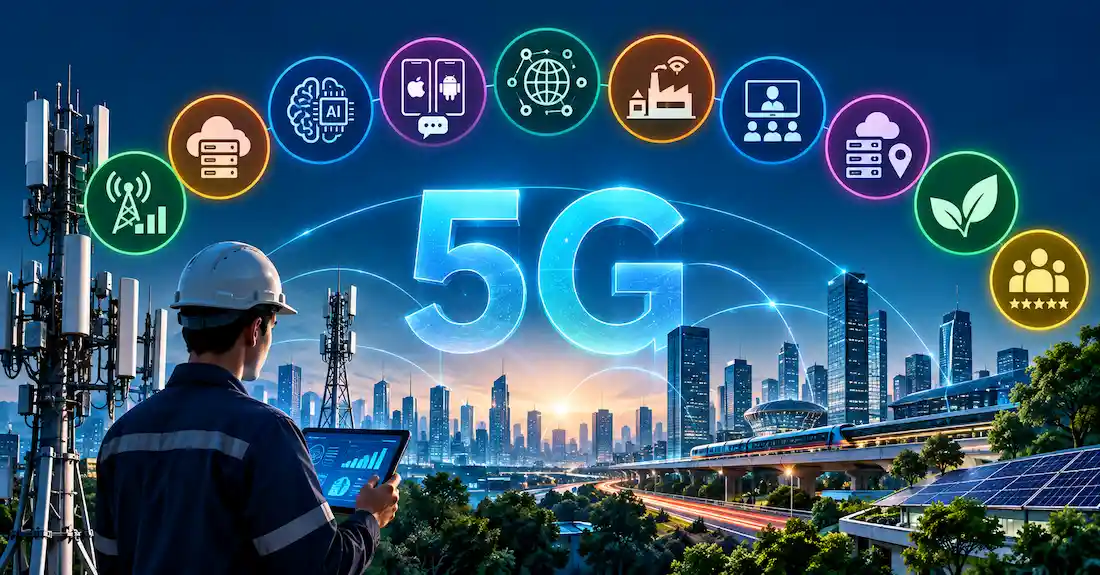
In an attempt to grab a piece of that cake, mobile operators are introducing all sorts of modern technologies into their workflow. From using an advanced 5G core solution to implementing AI, here are a few things that we’ll mark in 2026.
5G and Its Infrastructure
Although 5G isn’t a new concept, it’s still a very underutilized technology. Luckily, we’re already seeing a few tech improvements that will help maximize its potential. Providers will focus their efforts on further improving the infrastructure and generating new opportunities.
Engineers are especially excited about URRLC (Ultra-Reliable Low Latency Communication and mMTC (massive Machine-Type Communication). With URRLC, we will be able to support mission-critical applications by minimizing latency. On the other hand, mMTC will allow us to utilize an enormous number of devices within a small geographic area.
Network Disaggregation and Virtualization
As telecommunication systems start relying on external environments, we have to create solutions that would allow integration between the two. Specifically, engineers are introducing new strategies that would make network management and architecture smoother.
Through virtualization and SDN (Software-Defined Networking), we’re able to decouple different network functions. As a result, providers are able to achieve enormous scaling and flexibility and significantly reduce operative costs. Virtualization allows companies to simplify maintenance, expedite delivery, and create new, advanced services.
AI Network Optimization
Artificial impact will have a major impact on future network optimization and automation. Providers are already relying on this technology to streamline convoluted processes that otherwise take a lot of time to execute. Specifically, AI is vital for minimizing human involvement and reducing costs.
AI market within the telecommunications industry is expected to grow as a result. Just so you understand what we’re talking about, the market was valued at $1.3 billion in 2023. Financial professionals expect that this figure will rise up to a whopping $42.6 billion by 2033!
Apple and RCS
For a while now, industry experts have been perplexed by Apple’s decision not to adopt RCS or Rich Communication Services. However, this will likely change in 2026. As you probably know, Android devices have used RCS technology for some time to improve their chat functionality and rich media.
Once Apple finally adopts Rich Communication Services in 2026, it will be easier to streamline communication between Android and iOS users. Given that both types of devices will be based on the same tech, people will no longer have to struggle with compatibility issues, which was the case before.
Diversified Networks
Through network diversification, we’ll have much more integrated systems. Diversification will allow us to eliminate redundancies while also enhancing the network’s resilience. That way, we’ll create infrastructures that will be resilient to any potential disruption.
The flexibility of diversified networks cannot be understated. It allows providers to quickly adjust to changing traffic requirements in real-time. By having several paths at their disposal, telecommunication businesses will reduce the risks that come with having a single point of failure.
Private 5G Networks
In 2026, we’ll see much more private 5G networks for business. These dedicated networks provide companies with everything they need: incredible speed, complete control, and enhanced security.
By having ultra-low latency, companies will be able to reach properly in mission-critical scenarios. This will make the concept vital for information-sensitive businesses such as finances, but also other industries like healthcare.
Virtual Sales
Like many other companies, 5G businesses are looking to reduce their sales expenses by focusing on virtual trade shows. The best thing about using online sales channels is that it allows organizations to reach many more people and reroute resources into operative processes.
Although the entire process will be digital, providers are looking for ways to improve user experience through tactics such as one-on-one meetings. During these events, companies will be able to make quicker, more educated pitches by relying on real-time insights.
Edge Computing
By relying on 5G’s high velocity and low latency, companies are able to introduce edge computing to their offer. With this technology, users are able to process data closer to its source, be it an IoT device or a smart vehicle.
Through local data processing, operators are able to reduce reliance on cloud servers. All of this leads to lower delays and faster responses, which, in certain situations, can be a difference between life and death.
Green Telecommunications
The biggest companies in the business, such as Vodafone and AT&T, have shown their dedication to green telecommunications by participating in various events and activities. For example, Vodafone is making strides toward turning its entire European network completely eco-friendly.
We should also mention Deutsche Telecom and its efforts to become fully carbon-neutrally by the end of this year. Among other things, businesses are implementing AI solutions in an attempt to optimize their consumption while simultaneously reducing the energy required for daily operations.
Customer-Focused Model
Like all other industries, telecom companies are constantly trying to improve their services to beat the competition. The biggest emphasis is on developing customer-centric solutions as a way of meeting and exceeding their expectations.
Users need more than simple connectivity and low prices. They want a personalized experience and full transparency. The best providers have realized this and are now looking for ways to customize their plans and introduce value-added services.
Last Thoughts
Based on what we’ve seen in late 2024, this year will be all about automation and infrastructural improvement. We’ll see much more efficient networks that will maximize all available resources.
Companies will place emphasis on users by developing customized solutions. We’ll also see an even bigger shift toward eco-friendly initiatives.