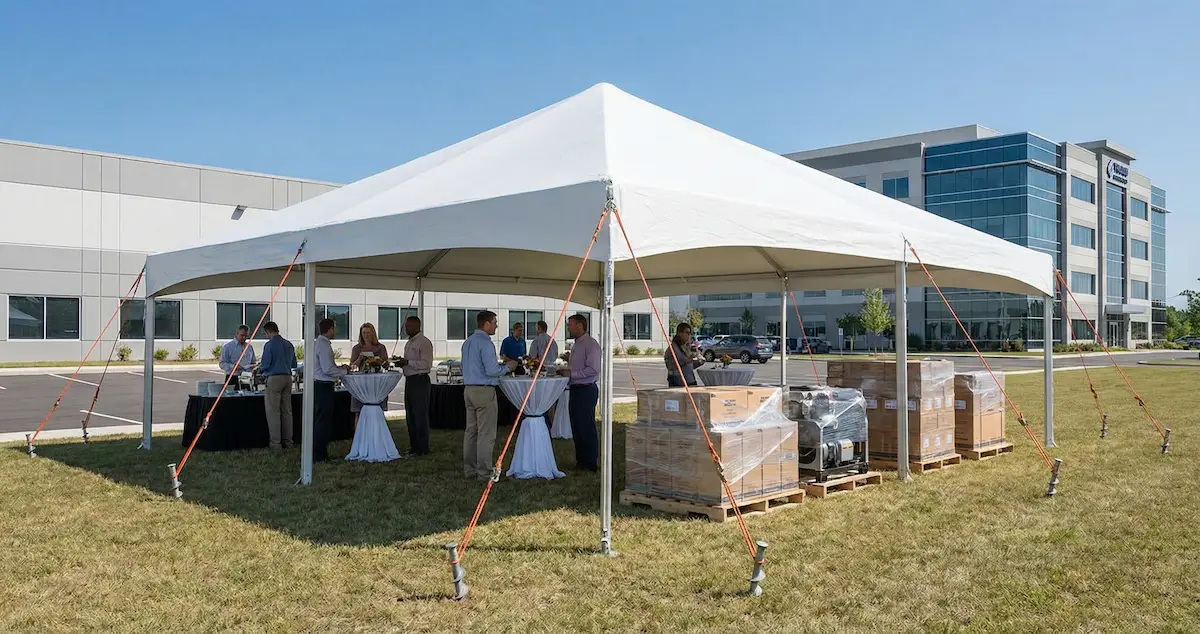
Industrial operations, corporate facilities, and logistics hubs often need adaptable outdoor space on short notice — a covered area for an employee event, a weather-protected zone for equipment staging, or temporary shelter during a maintenance project. A permanent structure isn’t always practical, or even necessary. A large, freestanding temporary shelter solves this gap: substantial covered area, deployed quickly, with no permanent installation required. A 20′ x 20′ Heavy Duty Outdoor Party Tent represents a category of structure designed to provide substantial covered area quickly and without permanent installation.
This guide covers how these shelters are built, where they genuinely add value in a business setting, the safety fundamentals that determine whether one performs well or fails, and what to look for when comparing options.
Technical Overview and Structural Design
A heavy-duty temporary shelter in this category typically consists of a powder-coated steel or aluminum frame supporting a durable fabric cover, commonly polyethylene (PE) tarpaulin or a comparable material. The frame is designed for relatively fast assembly and disassembly, while the cover handles sun and rain protection. The “heavy duty” designation generally refers to reinforced frame joints and a thicker, more tear-resistant fabric than a basic consumer canopy.
Adapting Temporary Shelters for Industrial and Corporate Applications
Though often marketed primarily for social events, these shelters have genuine operational applications in a business context:
- Covered outdoor space for company picnics, team-building events, or seasonal staff celebrations
- A temporary, weather-protected area for equipment staging, outdoor repair work, or material sorting
- Shade and shelter for outdoor break areas or designated smoking areas
- A covered checkpoint or registration area for visitor parking or large deliveries
- Temporary protection for goods or materials stored outdoors from sudden rain or direct sun exposure
Why This Flexibility Matters
Being able to deploy a large covered space quickly adds real flexibility to facility management. It lets a business create functional outdoor areas serving both operational needs (protected work zones) and HR goals (fostering community through staff events) without the capital investment a permanent structure requires. Done well, it can genuinely support employee morale, solve practical outdoor-task problems, and demonstrate a facilities team’s responsiveness to changing site needs.
Technical Fundamentals and Site Considerations
Safe, effective use of a large temporary shelter depends on planning that matches the structure’s specifications to the actual site.
Dimensions and clearance. A 20′ x 20′ footprint with a 10′ peak ceiling defines the covered area and headroom — but adequate surrounding space needs to be allocated for guy ropes and overall stability, not just the footprint itself.
Frame strength and fabric quality. The frame needs to be robust enough to handle realistic wind loads for your location, and heavy-duty PE tarpaulin fabric should be UV-resistant, waterproof, and tear-resistant for repeated use rather than single-event disposal.
Anchoring and stability. This is the single most critical safety factor. The shelter must be securely staked using anchoring appropriate to the surface — steel auger stakes for grass, concrete blocks or ballast for pavement where staking isn’t possible. In high-wind areas, additional ballast or anchoring beyond the standard kit is not optional.
Site selection. Choose a level, well-drained area free of overhead hazards like power lines or tree branches, and account for water runoff during rain so the shelter doesn’t become a collection point for standing water.
What Actually Determines Stability and Longevity
A shelter’s real-world performance depends almost entirely on correct installation and the conditions it’s actually exposed to, not just the product specs on a listing page. Inadequate anchoring is the leading cause of failure, and failure under wind load is where these structures become genuinely dangerous rather than just inconvenient. Fabric covers degrade over time with UV exposure regardless of brand, and proper tensioning during setup prevents the flapping that puts ongoing stress on the frame. It’s worth being clear-eyed about what this category of structure is: designed for temporary use in fair to moderate weather, not an engineered substitute for severe storm conditions or heavy snow loads.
Safety Considerations and Mandatory Best Practices
These structures can become genuine hazards if mismanaged. A few non-negotiable practices:
- Follow the manufacturer’s assembly instructions precisely — don’t skip steps or substitute parts not designed for the specific model.
- Never erect the shelter in high winds, and monitor weather forecasts actively; be ready to lower or dismantle it if severe weather is forecast.
- Use every provided anchoring component, driven at the correct angle and depth — a partially anchored shelter is often worse than an honestly temporary, unanchored one, since it creates false confidence.
- Avoid attaching signage, lighting, or other items to the frame in ways that create added sail area or stress, unless the specific structure is rated for it.
- Keep flames, grills, or any heat source a safe distance from the fabric walls and roof.
Equipment Types and System Components
The core product is the shelter kit: frame sections (legs, trusses, connectors), the fabric cover, a carry bag, and the anchoring kit (stakes, ropes, and often ballast hardware for hard-surface installation). Variations across the market show up in size, frame material (steel vs. aluminum), fabric type (polyethylene vs. vinyl), and roof style (peak vs. pagoda), each with trade-offs in weight, wind resistance, and cost.
Comparing Options in This Category
This is a genuinely competitive product category, and comparing a few options before committing is worth the time:
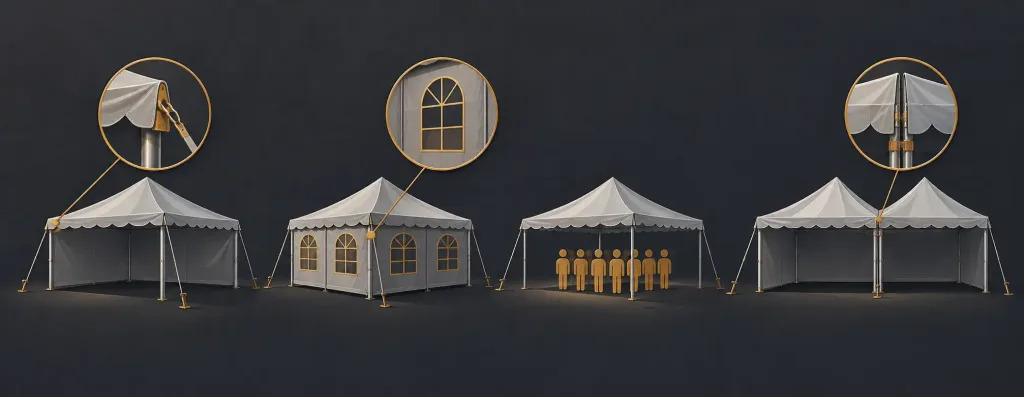
TMG Industrial’s model, referenced above, is built around the standard specs covered in this guide — PE tarpaulin fabric, a 10′ peak ceiling, and a reinforced frame.
Outsunny sells a comparable 20′ x 20′ model with a triangle-reinforced frame structure, 480gsm roof fabric, and large removable windows and doors — a reasonable option if interior natural light and ventilation matter for your use case.
Party Tents Direct offers a 20′ x 20′ “Weekender” model with a PVC vinyl top rather than PE tarpaulin, rated for both commercial and residential use, with published occupancy guidance (up to 80 people for a cocktail-style layout) that’s useful for event planning specifically.
Vispronet focuses on a modular approach — their 20′ x 20′ size is built from two combined 10′ x 20′ frame sections, with aluminum frame options and custom graphic printing available, which suits businesses wanting branded event signage integrated into the structure itself.
Comparing frame material, fabric weight and type, included anchoring hardware, and published wind-rating guidance across a few of these options will tell you more about real-world fit than any single product page alone.
Advantages and Practical Limitations
Advantages: a large amount of covered space, deployed quickly and portably; cost-effective for temporary needs compared to permanent construction; genuine flexibility across operational and social uses; compact storage when not in use; solid protection from sun and light rain.
Limitations: not a permanent or all-weather structure; requires real, ongoing attention to anchoring and weather monitoring, not a one-time setup-and-forget approach; fabric has a finite service life and real vulnerability to high winds if under-anchored; no insulation or climate control; may require a permit depending on local bylaws, particularly for extended or recurring use on commercial property.
A Real-World Example
A manufacturing plant hosting its annual summer family day in the employee parking lot erects a 20′ x 20′ heavy-duty tent as the central gathering point, serving as the main food and seating area. Later that season, the same structure gets reused as a covered staging area for a large equipment delivery, protecting components from an unexpected rain shower. That dual utility — community use and operational use from the same piece of equipment — is the core value proposition for a facilities team weighing this purchase.
Frequently Asked Questions
What’s the most important safety factor for a large temporary shelter?
Anchoring. Inadequate anchoring is the leading cause of structural failure, and it matters more than almost any other spec on the product page.
Can these shelters handle severe weather?
No. They’re designed for fair to moderate conditions. Severe storms or heavy snow load require an engineered permanent structure, not a temporary fabric shelter.
How is a “heavy duty” shelter different from a basic canopy tent?
Generally through reinforced frame joints and thicker, more tear-resistant fabric rated for repeated use, rather than a single-event disposable design.
Do I need a permit to set one up on commercial property?
Possibly, depending on local bylaws — this is worth checking before extended or recurring use, particularly for anything beyond a single short event.
Which manufacturer should I choose?
It depends on your specific priorities — TMG Industrial and Outsunny for standard PE-tarpaulin setups, Party Tents Direct if you want published occupancy guidance for event planning, or Vispronet if branded graphics and a modular aluminum frame matter for your use case. Comparing fabric type, frame material, and included anchoring hardware across a few options is more useful than defaulting to a single brand.
The Bottom Line
A large temporary shelter is a genuinely useful tool for facility and operations managers juggling both operational and social outdoor-space needs. Its real value comes from adaptability and fast deployment, not any single brand’s marketing — and its real risk comes almost entirely from inadequate anchoring, not the structure itself. Choose based on a genuine comparison of frame material, fabric quality, and anchoring hardware across a few manufacturers, install it with real attention to the safety fundamentals covered here, and it can meaningfully improve a site’s flexibility without the cost or commitment of permanent construction.