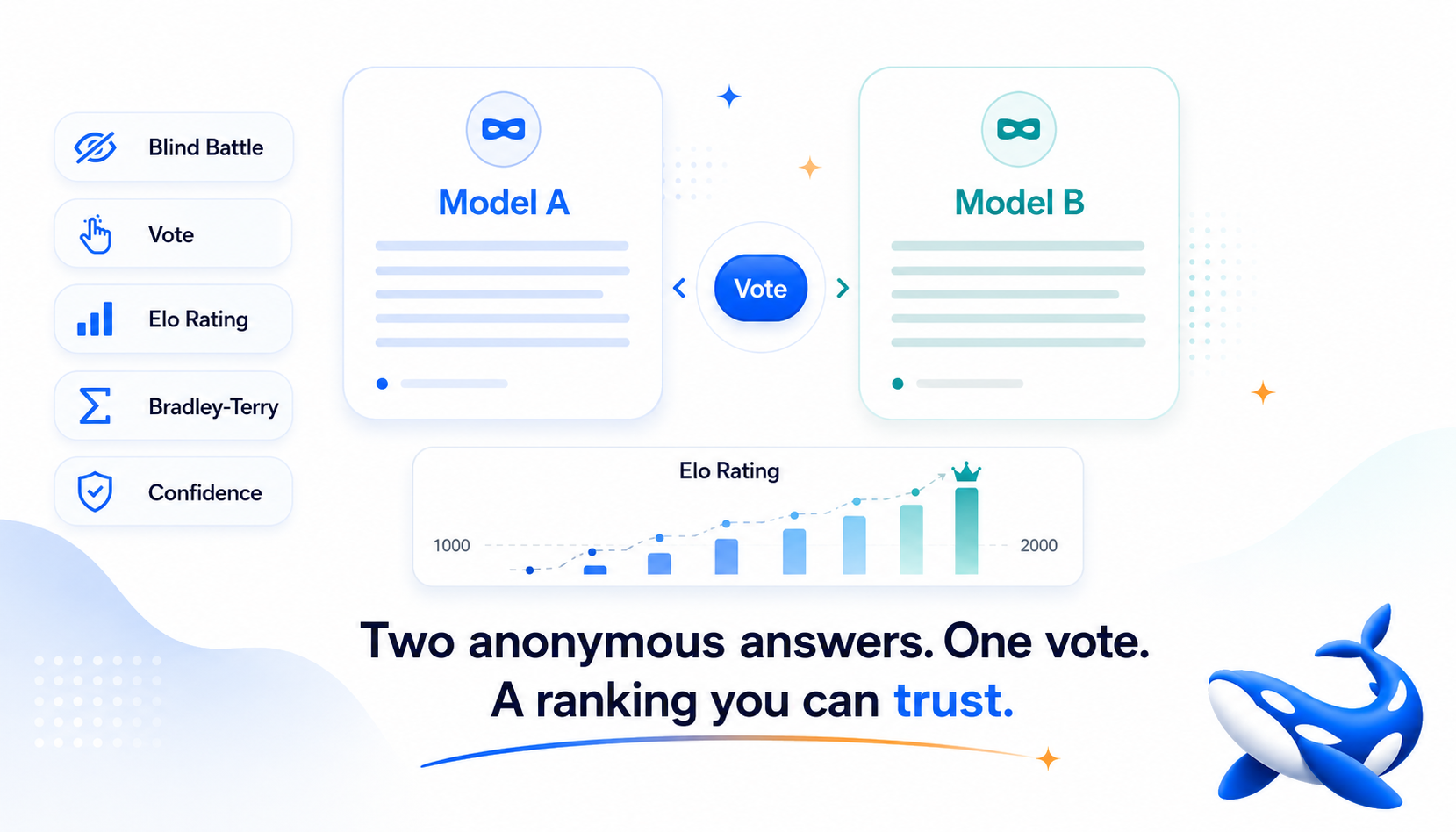
An LLM arena ranks models through blind, head-to-head competition: two anonymous models answer the same prompt, you vote for the better reply, and only then learn which model wrote which. Aggregate millions of these votes and you get a preference ranking that’s very hard to game — which is why “arena” ratings are among the most trusted numbers in AI. You can try one yourself on OrcaRouter, which runs blind battles alongside a live production-traffic board.
This article explains, in plain terms, how a live LLM Arena works — how blind battles run, how votes become rankings, and why the format resists the contamination and marketing bias that plague static benchmarks.
The core idea: blind head-to-head battles
The mechanic is simple and elegant:
1. You type a prompt.
2. Two different models — hidden behind labels like “Model A” and “Model B” — each answer it.
3. You read both responses and vote for the one you prefer.
4. *Only after voting* do you learn which model wrote which answer.
That final step is the whole trick. Because you don’t know the identities while judging, your vote can’t be biased by brand loyalty. You’re rewarding the better answer, not the more famous logo.
Why “blind” matters so much
People are not neutral judges. Tell someone one answer came from a flagship model and another from an obscure open-weight model, and their expectations will color the vote before they’ve read a word.
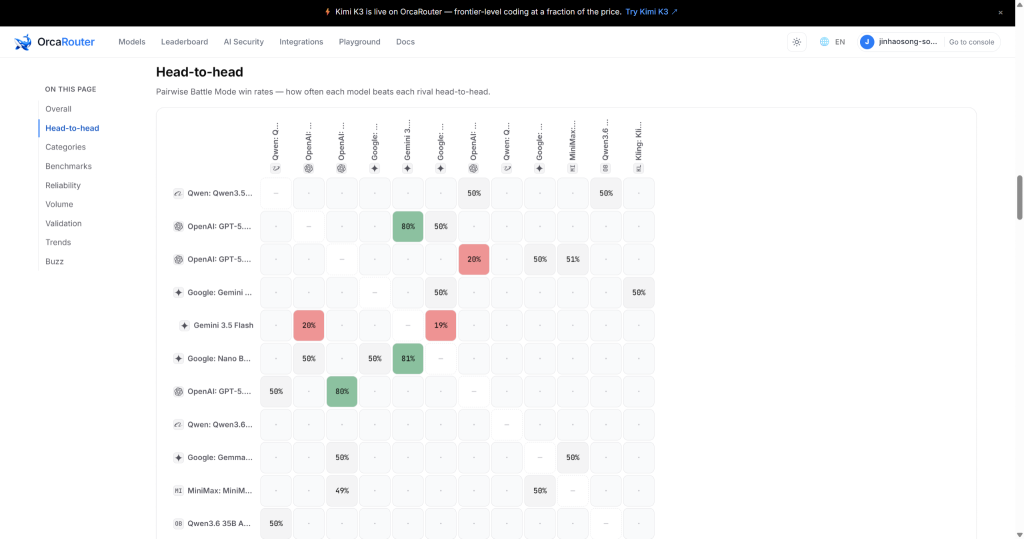
Blind battles strip that away. In OrcaRouter’s LLM Arena, two anonymous models answer the same prompt and your vote feeds the ranking — but you only see who wrote what after you’ve decided. That single design choice is what makes arena results so credible: nobody is voting for the marketing.
From votes to a ranking: the Elo connection
A pile of “A beat B” results isn’t a ranking on its own. To turn matchups into an ordered list, arenas use the Bradley–Terry model — the same statistical engine behind chess Elo ratings.
Here’s the intuition:
• Every model starts with a baseline rating.
• Win a battle and your rating rises; lose and it falls.
• Beating a strong opponent is worth more than beating a weak one.
Over many battles, ratings settle into positions that reflect each model’s true probability of winning a random matchup.
Reading confidence, not just position
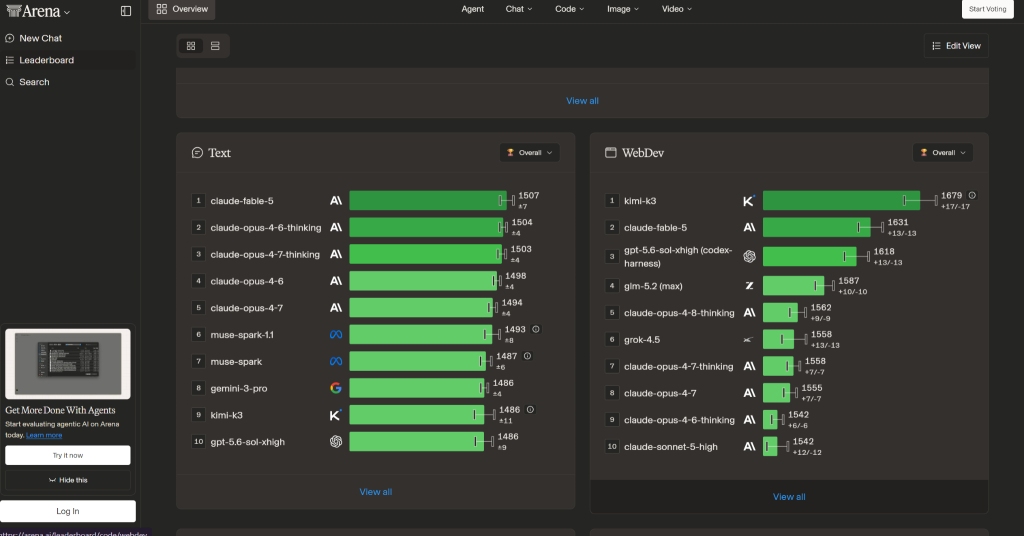
A good arena doesn’t just hand you a number — it shows uncertainty. Each rating comes with a confidence interval (often a 95% band). When two models’ bands overlap, they’re statistically tied, even if one sits a few points higher.
Newer models with only a few hundred votes have wide error bars; established models with thousands of votes have tight bands you can trust.
Why arenas beat static benchmarks (and where they don’t)
Arenas solve two problems that plague traditional benchmarks:
• No contamination. There’s no fixed test set to leak into training data. The prompts are whatever real users type.
• Real preferences. You’re measuring what people actually find helpful, not performance on a synthetic exam.
But arenas have limits too. They capture *preference*, which can favor answers that look polished over ones that are strictly correct. And they don’t measure latency, cost, or reliability. That’s why the strongest platforms combine arena votes with hard production data.
What an arena rating tells you — and what it doesn’t
It tells you: which models humans consistently prefer, with a measure of confidence.
It doesn’t tell you: how fast the model responds, how much it costs per token, or how often it fails in production. For those, read the reliability and cost columns that sit alongside the arena rating on a full leaderboard.
The takeaway
An LLM arena turns the messy question of “which model is best?” into a rigorous, bias-resistant competition. Blind battles remove brand bias, Bradley–Terry math turns votes into trustworthy ratings, and confidence intervals keep you honest about what the numbers can prove. If you want to see how today’s models stack up when nobody knows who wrote what, spend a few minutes in a live LLM Arena — and cast a vote or two while you’re there.