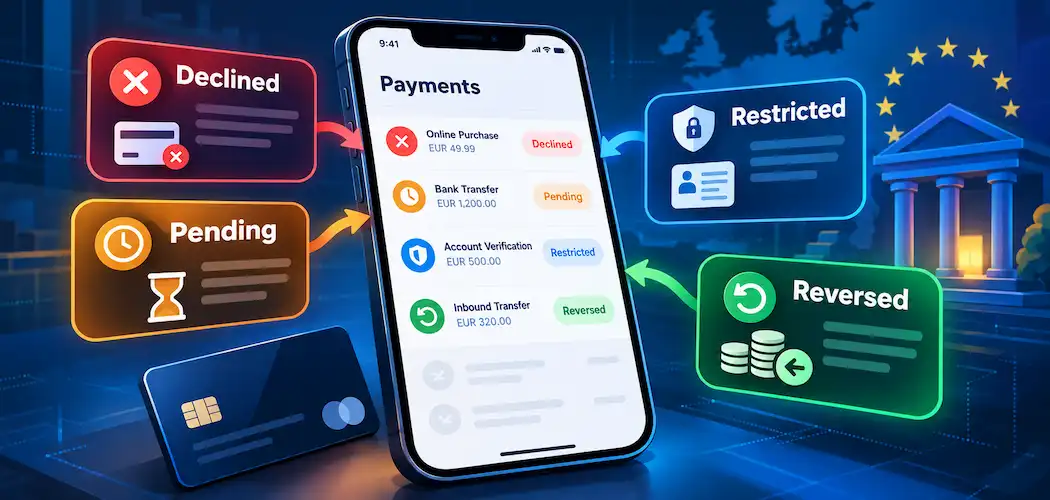
A payment that does not arrive shows up in your app as one word, and that word carries more information than most people realise. Declined, pending, restricted and reversed are not four ways of saying the same thing.
They describe four separate events, arising from different causes, and each one calls for a different response from you. Reading the status correctly is often the difference between fixing a mistyped IBAN in thirty seconds and gathering documents for a compliance review.
This applies to any payment account held with an electronic money institution in the European Union, including accounts such as Blackcat.
The mechanics below are set by EU payments and anti-money-laundering law rather than by any single provider’s preferences.
The four statuses describe different events, not different severities
It is tempting to read the statuses as a scale: declined is mild, restricted is serious. That is not how they work. A decline can be trivial, or it can be the visible edge of a fraud rule. A pending payment may clear on its own within hours.
A restriction is usually the most consequential of the four, but it is also the one with the clearest route out, since it typically exists when a provider is waiting for something specific from you.
The useful question is not how bad the status is. It is which system produced it — the payment scheme, the provider’s fraud rules, or its legal obligations — because that determines who can resolve it and how.
A decline is a decision taken before the money moves
A declined transaction has not been charged to your account. Nothing needs to be recovered because nothing was sent.
The most common causes are mundane: a limit reached, an expired card, an incorrect IBAN or reference, insufficient available balance once pending items are counted, or a merchant category the card is not enabled for.
The second family of causes is automated fraud control. Payment providers in the EU run continuous transaction monitoring, and a transaction that does not fit the pattern on an account can be declined outright or held for manual review.
This is not a judgment about you. It is a rule that fires on a set of characteristics: an unfamiliar country, an unusual amount, or a merchant type that appears in fraud data.
The volume of activity being screened is substantial: the European Banking Authority and European Central Bankreported that the total value of fraudulent payment transactions across the EEA reached EUR 4.2 billion in 2024, up 17% on the previous year.
Card fraud rates also vary sharply by destination. Thesame joint report found that fraud rates for card payments were around 17 times higher when the counterparty was outside the EEA, where strong customer authentication may not apply.
A decline on a first-time payment to a merchant outside the EEA is therefore a predictable outcome rather than an arbitrary one.
A pending payment is in a queue, not in dispute.
Pending means the instruction has been accepted, and something in the chain has not finished. For card payments, the merchant may have authorised an amount and not yet captured it, which is standard for hotels, car hire and fuel.
For transfers, the payment may be waiting on a cut-off time, a correspondent institution, or an internal check.
The instinct to resend a pending payment is the main thing to resist. Duplicate instructions are one of the more common ways a straightforward payment becomes complicated, because now two amounts are in flight, and one of them has to be traced and returned. Note the reference number, wait for the timeframe specified in your provider’s terms, and contact support with that reference if the window passes.
A restriction comes from a legal obligation
This is the status that generates the most frustration, and the one where the reason is least visible.
A restriction on an account or a payment usually means the provider is meeting an obligation under anti-money-laundering law, sanctions law, or an instruction from an authority.
In Malta, where Blackcat’s issuer, Papaya Ltd., is licensed, those obligations are set out in the Prevention of Money Laundering and Funding of Terrorism Regulations and in the bindingImplementing Procedures issued by the Financial Intelligence Analysis Unit.
The practical consequence is that customer service cannot lift a restriction by deciding to be helpful. Where identity or source-of-funds information is outstanding, providing it promptly and completely is the fastest available route.
Where the restriction follows a legal instruction or a report, the provider may be prohibited by law from telling you anything about it at all, a rule designed to protect investigations rather than inconvenience customers.
A reversal happens after the money has already moved
Reversed means funds went out and came back, or arrived and were returned. Causes include a recall by the sending institution, a rejection by the receiving institution because the account is closed or the details do not match, a chargeback on a card payment, or a return triggered by a scheme rule.
The money is normally back where it started, though the timing depends on the chain rather than on your provider alone.
Where a transfer you were expecting has been reversed, the sender’s side usually holds the answer. Ask them what their institution recorded as the return reason, because that code indicates whether the problem was the account details, the account status, or a compliance decision on the other end.
First actions by status
| Status | Likely reason | Your first action |
| Declined | Limit reached, incorrect details, card or merchant restriction, automated fraud rule | Check the payment details and your limits, then retry once; if it declines again, contact support with the timestamp |
| Pending | Awaiting capture, cut-off, or an internal check | Keep the reference and wait for the timeframe in your provider’s terms; do not resend |
| Restricted | Verification, source-of-funds, sanctions or other legal requirements | Provide exactly what has been requested, in full, in one submission |
| Blocked | Account-level measure pending review or following a decision | Submit a written complaint through the provider’s formal channel and keep a record |
| Reversed | Recall, rejection by the receiving institution, chargeback or scheme return | Ask the sender for the return reason code recorded by their institution |
Payment statuses at EU payment institutions, likely causes and the appropriate first action.
Source: Compiled from EU payments and anti-money-laundering requirements; sources as linked in the text above.
Two habits improve the outcome in every one of these rows. Keep the reference number and timestamp for anything that fails, because support cannot trace a payment described only as “the transfer on Tuesday”.
And put anything consequential in writing rather than in a chat window, because a written complaint starts a clock that a chat message does not.
Frequently asked questions
Why was my transaction declined when I had enough money?
The available balance is not the same as the total balance. Pending card authorisations, holds, and reserved amounts reduce the amount you can spend.
A decline can also come from a limit or an automated fraud rule rather than from the balance.
How long does a pending payment stay pending?
It depends on the payment type and the institutions involved. Your provider’s terms and conditions state the timeframes to which it commits. Note the reference and contact support once that period has passed.
What is the difference between a restricted and a blocked account?
A restriction usually limits specific functions while a review is open, often pending information from you. A block is an account-level measure.
Both should be raised through the provider’s formal complaint channel rather than through chat.
Disclaimer: This article explains payment statuses in general terms as they arise at payment institutions and electronic money institutions in the European Union. It is not legal or financial advice, and it does not describe the procedures of any single provider. Statuses, timeframes and resolution steps differ between providers and are governed by the terms and conditions you accepted. For a specific payment or account, consult your provider’s terms and its formal complaint channel.