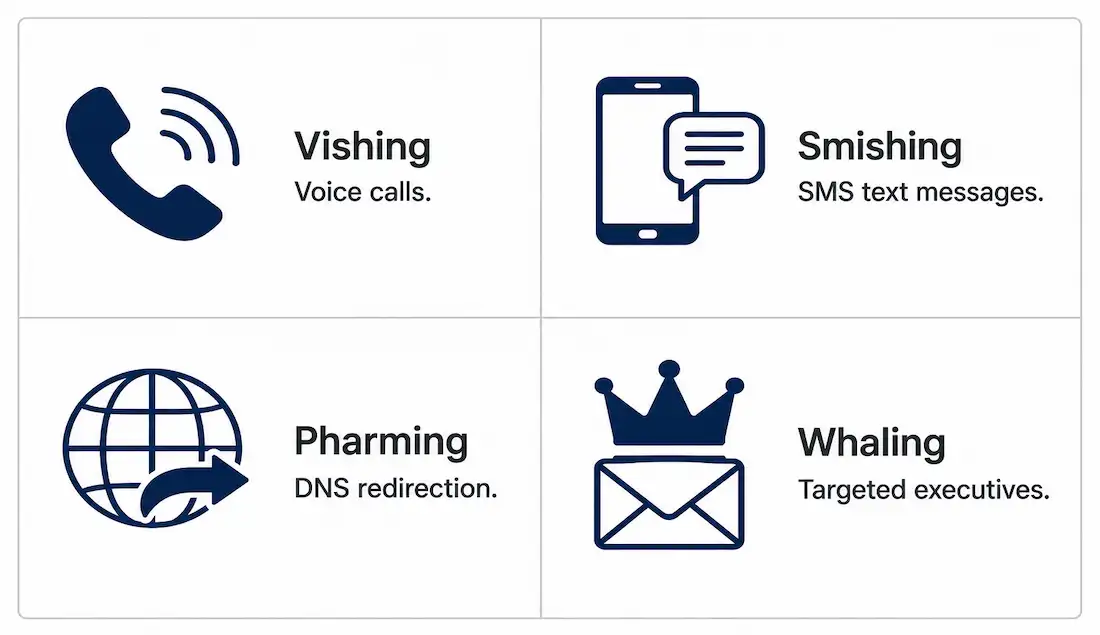
Phishing has diversified well beyond email. Voice calls, text messages, DNS-level redirection, and highly targeted executive-focused attacks each exploit trust through a different channel, and each requires a somewhat different defense. Understanding the specific mechanics behind vishing, smishing, pharming, and whaling — not just their names — is what makes it possible to actually defend against them rather than just recognize them after the fact.
This guide breaks down each attack type, how it exploits underlying network protocols, verified real-world context, and concrete prevention strategies.
Vishing (Voice Phishing)
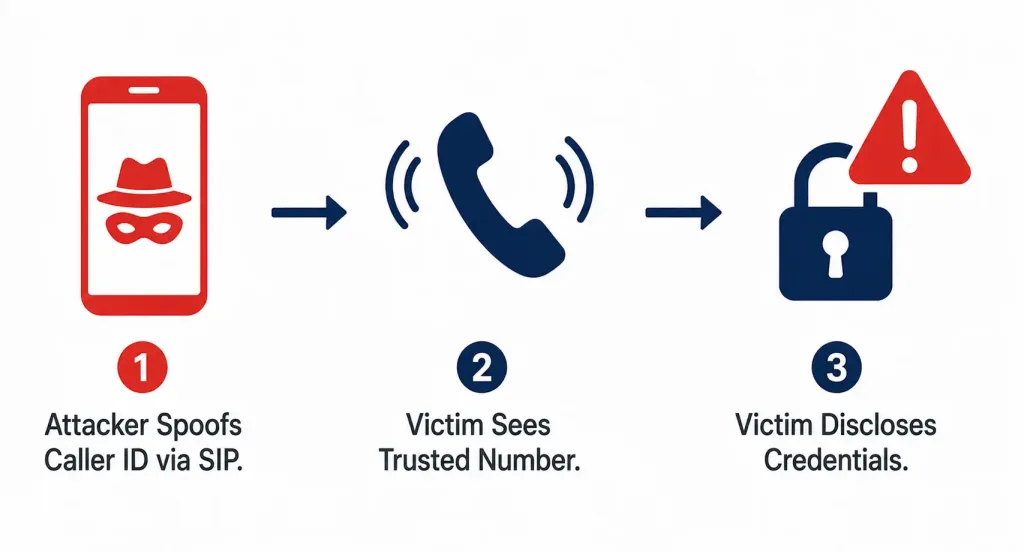
Vishing is a social engineering attack where fraudsters use phone calls or voice messages to impersonate trusted entities and extract sensitive information — credit card details, login credentials, or one-time verification codes. Unlike email-based phishing, vishing leverages VoIP (Voice over IP) infrastructure to spoof caller ID, making calls appear to originate from legitimate sources like banks or government agencies.
The technical mechanism: vishing exploits unencrypted SIP (Session Initiation Protocol) signaling in VoIP systems, which historically allowed straightforward caller ID spoofing. Attackers commonly use automated robocalls or, increasingly, AI-generated deepfake audio to manufacture urgency — “Your account is compromised, provide your PIN now.”
Tracing vishing calls is genuinely difficult because of VoIP’s decentralized routing, and victims often trust phone calls more inherently than they trust emails, which amplifies vishing’s real-world success rate compared to email phishing alone.
Examples: a fraudster calls pretending to be from your bank, using a spoofed caller ID, and requests a verification code sent via SMS moments earlier — deliberately timed to exploit the victim’s own legitimate two-factor authentication flow. AI-generated deepfake voice technology has also enabled increasingly convincing executive-impersonation vishing, where attackers clone a real CEO’s voice from publicly available audio (earnings calls, interviews) to authorize fraudulent transfers over the phone.
Prevention: enable STIR/SHAKEN protocols on VoIP networks to cryptographically verify caller ID authenticity, use call-blocking apps, and always verify unexpected calls through an independently-sourced number — never a callback number provided by the caller themselves. For network defense specifically, SIP-aware firewalls can detect anomalous signaling patterns consistent with spoofing.
Smishing (SMS Phishing)
Smishing uses fraudulent text messages masquerading as legitimate sources to trick users into clicking malicious links, downloading malware, or revealing personal information. It exploits the inherent trust people place in text messages, often prompting immediate action: “Your package couldn’t be delivered — click here to reschedule.”
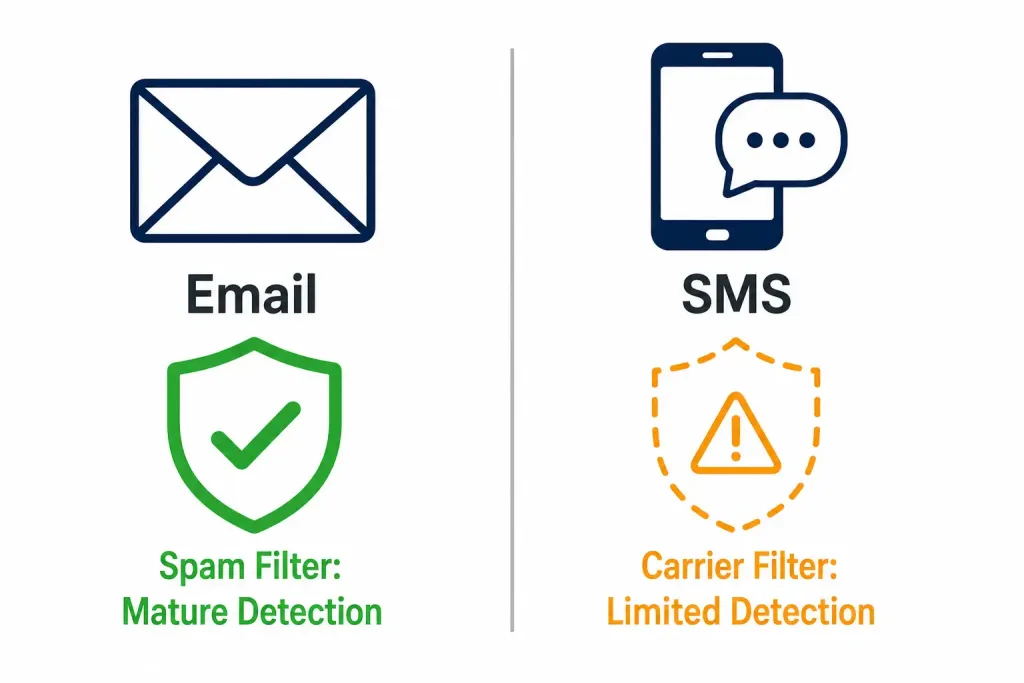
The technical mechanism: smishing bypasses email-based spam filtering entirely by routing through cellular SMS gateways, which historically lack the mature spam-detection infrastructure that email providers have built up over decades. A link that would be flagged instantly by an email filter can arrive completely unfiltered via SMS.
Examples: a text claiming “Your package is delayed — track here” leads to a fake tracking site designed to harvest credentials or payment information. AI-generated smishing content, personalized using details harvested from prior data breaches, has made these messages meaningfully more convincing than the generic, often typo-laden smishing texts of a few years ago.
Prevention: enable carrier-level SMS filtering where available, avoid clicking links in unexpected texts entirely — navigate directly to the official app or website instead — and for organizations, deploy mobile device management (MDM) to monitor and filter SMS traffic on corporate devices.
Pharming (DNS Redirection Phishing)
Pharming redirects users from legitimate websites to fraudulent ones without their knowledge or any action beyond simply trying to visit the real site. Unlike phishing, it doesn’t require the victim to click a suspicious link — the redirection happens automatically at the network level.
Methods:
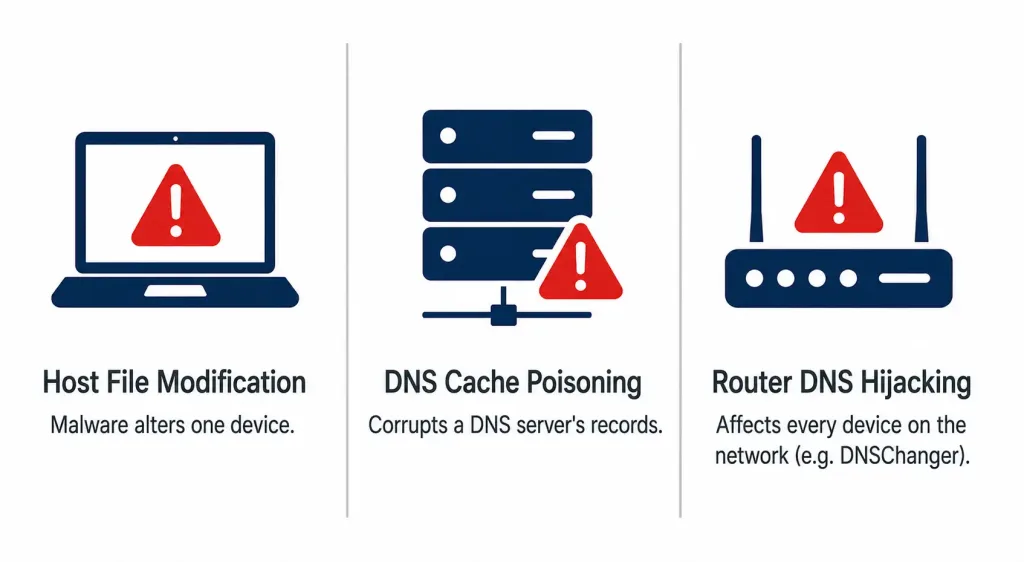
- Local host file modification: malware, often delivered via email, alters the victim’s own device to redirect specific domain lookups to attacker-controlled IP addresses.
- DNS cache poisoning: attackers corrupt a DNS server’s cached records, causing it to return a fraudulent IP address for a legitimate domain (e.g., a bank’s website) to every user querying that server.
- Router-level DNS hijacking: malware that reconfigures a router’s DNS settings, affecting every device on that network simultaneously — DNSChanger is a well-documented real-world example of this technique, having infected millions of devices and routers globally by altering their DNS configuration to route traffic through attacker-controlled servers before its infrastructure was eventually seized by law enforcement.
Why it’s hard to detect: pharming exploits fundamental weaknesses in the DNS protocol itself, which is UDP-based and, without additional protections, includes no built-in authentication of responses. Critically, endpoint anti-spyware tools generally can’t detect server-side or router-level pharming, since the user’s own device may be entirely uncompromised — the redirection happens upstream, outside what local security software can see.
Prevention: implement DNSSEC (DNS Security Extensions) to cryptographically validate DNS responses and detect tampering. Use encrypted, security-focused DNS resolvers like Cloudflare (1.1.1.1) or Google Public DNS (8.8.8.8) with DNS-over-HTTPS or DNS-over-TLS enabled. Regularly update router firmware, since router-level DNS hijacking specifically depends on exploiting known, unpatched vulnerabilities in consumer router software.
Whaling (Executive Phishing)
Whaling is a highly targeted form of phishing aimed at high-profile individuals — executives, politicians, or other figures whose authorization carries outsized organizational weight. Attackers use carefully researched, personalized social engineering to authorize large transactions or extract sensitive corporate data.
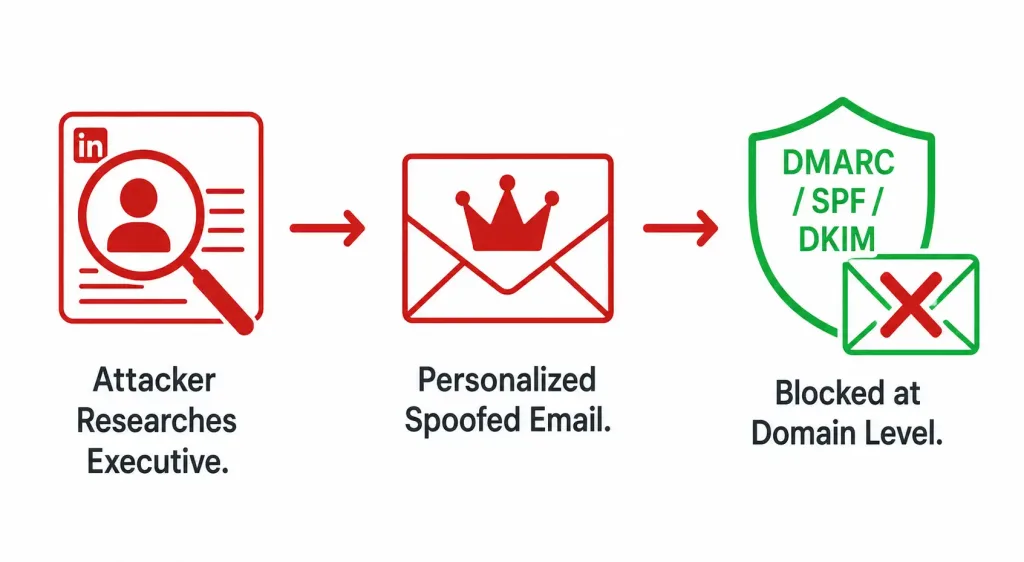
Tactics: spoofed emails carrying malicious links or attachments, built using researched personal details — name, title, reporting relationships, even recent public activity gathered from LinkedIn or company announcements. From a network protocol perspective, whaling exploits the SMTP email standard’s lack of built-in sender authentication, which is exactly what DMARC, SPF, and DKIM were designed to address.
A well-documented pattern worth understanding: Business Email Compromise (BEC) — a close relative of whaling — has consistently ranked among the costliest categories of cybercrime tracked by the FBI’s Internet Crime Complaint Center (IC3), with cumulative reported losses reaching well into the billions of dollars over the past decade. A typical scenario involves a spoofed or genuinely compromised executive email account requesting an urgent wire transfer, timed to exploit a moment when independent verification feels inconvenient or the request otherwise seems plausible given real organizational context the attacker has researched.
Prevention: enforce DMARC, DKIM, and SPF on organizational email servers to prevent domain spoofing at the protocol level. Train executives and finance staff specifically on verifying unusual requests through an out-of-band channel — a phone call to a known number, not a reply to the email itself. Deploy anomaly detection on email traffic patterns to flag unusual sending behavior, like a login from an unfamiliar location immediately followed by a financial request.
Key Differences at a Glance
| Attack | Medium | Target | Key Technique | Protocol Exploited |
|---|---|---|---|---|
| Vishing | Voice/Phone | General individuals | Spoofed calls, manufactured urgency | SIP (VoIP signaling) |
| Smishing | SMS/Text | Mobile users | Malicious links via text | SMS gateways, bypassing email filters |
| Pharming | Automatic redirection | Broad user base | DNS poisoning or host file manipulation | DNS (UDP-based, unauthenticated by default) |
| Whaling | Email/Social | High-profile individuals | Researched, personalized spoofing | SMTP (lacking built-in sender authentication) |
Prevention Strategies Across All Four
Network-level defenses: deploy firewalls capable of deep packet inspection for VoIP and SMS-adjacent traffic where applicable, enable DNSSEC organization-wide, and implement STIR/SHAKEN on any VoIP infrastructure you control.
User training: realistic simulated attacks — not just for email phishing, but covering vishing and smishing scenarios specifically — build genuine pattern-recognition skill that generic annual training alone doesn’t develop. The instinct to verify through an independent channel is the single highest-value habit across all four attack types.
Organizational tools: Secure Email Gateways (SEG) for filtering and quarantining suspicious email, and mobile device management (MDM) for monitoring and controlling SMS and app-level risk on corporate devices.
Security awareness training generally, applied consistently and reinforced through realistic simulation rather than one-off lectures, measurably reduces susceptibility to social engineering across all these attack categories over time — though exact effectiveness figures vary considerably by organization, program design, and measurement methodology, worth keeping in mind before citing any single precise percentage as a universal guarantee.
Verifying Your Own Defenses
Beyond recognizing an attack, it’s worth periodically confirming that the technical protections described above are actually configured correctly on infrastructure you control, rather than assuming they’re working.
Checking DMARC enforcement (relevant to whaling/BEC defense):
dig TXT _dmarc.yourdomain.comA policy of p=none only requests reporting on failures without actually blocking spoofed mail — moving to p=quarantine or p=reject, once you’ve confirmed legitimate mail passes SPF and DKIM reliably, closes this gap.
Checking DNSSEC status (relevant to pharming defense):
dig +dnssec yourdomain.comA response lacking RRSIG records indicates DNSSEC isn’t actually validating for that domain, even if it’s nominally been “enabled” at some point in the configuration process — worth confirming directly rather than trusting a settings page alone.
Testing STIR/SHAKEN attestation (relevant to vishing defense): most modern smartphones display a “Caller Verified” or similar indicator for calls that pass STIR/SHAKEN attestation. The absence of this indicator on a call claiming to be from a well-known institution — one that should reasonably be using verified VoIP infrastructure — is itself a useful, if imperfect, signal worth factoring into your overall assessment of a suspicious call.
None of these checks substitute for the human verification habit that remains the strongest defense across all four attack types, but they confirm the technical layer is actually doing its job rather than sitting unconfigured or partially implemented.
Conclusion
Vishing, smishing, pharming, and whaling each exploit a different channel — voice, text, DNS infrastructure, and carefully targeted email — but they share a common underlying principle: manipulating trust faster than a victim can pause to verify. Technical safeguards (STIR/SHAKEN, DNSSEC, DMARC) close specific protocol-level gaps, while genuine verification habits close the human gap none of those technical measures can fully cover on their own.
FAQs
What is vishing and how does it differ from traditional phishing?
Vishing uses phone calls, often over VoIP with spoofed caller ID, to trick victims into revealing sensitive information like credentials or payment details. Unlike email-based phishing, it exploits the trust people place in phone networks specifically, and its VoIP-based routing makes tracing the source genuinely more difficult than tracing a phishing email.
How does smishing work, and what risks does it pose?
Smishing delivers deceptive links via SMS text message, exploiting the fact that cellular SMS gateways historically lack the mature spam filtering that email providers have developed. Risks include credential theft, malware installation, and financial fraud, and prevention centers on never clicking links in unexpected texts — navigating directly to the official app or website instead.
What are the methods used in pharming attacks?
Pharming redirects users to fraudulent sites through DNS cache poisoning, local host file manipulation via malware, or router-level DNS hijacking (as seen in real malware like DNSChanger) — all without requiring the victim to click anything at all. Because the redirection happens at the network level rather than on the compromised device itself, standard endpoint anti-spyware often can’t detect server-side or router-level pharming.
How is whaling different from standard phishing attacks?
Whaling specifically targets high-profile individuals — executives, politicians, or similarly influential figures — using carefully researched, highly personalized messages designed to authorize large transactions or extract sensitive data. Its close relative, Business Email Compromise, has consistently ranked among the most financially damaging categories of cybercrime tracked by the FBI’s IC3, precisely because a single successful whaling attempt can authorize an enormous transfer in one step.
Why doesn’t pharming require clicking a malicious link the way other phishing variants do?
Pharming works by corrupting the DNS resolution process itself — the system that translates a domain name into an IP address — so that even correctly typing a legitimate website’s address can still route you to a fraudulent server. This is exactly why DNSSEC and encrypted DNS resolvers matter as defenses: they address the underlying trust problem in DNS resolution rather than relying on the user to spot anything suspicious in a link.
What’s the single most effective habit against all four of these attack types?
Verification through an independent channel — calling a number you already know to be legitimate, rather than one provided in the suspicious message itself — defeats the overwhelming majority of vishing, whaling, and BEC attempts specifically, since these attacks depend on the victim acting within the message’s own closed loop. Combined with DNSSEC and encrypted DNS resolvers to address pharming’s network-level redirection, this covers the core defense across all four categories.