Year: 2019
What is RSTP and Rapid PVST+: Exclusive Details
RSTP- IEEE 802.1w is the advanced version of STP, providing faster convergence than CST but holding with the same single root bridge in the topology. Most parameters in RSTP are the same as STP, so users who understand STP can effortlessly configure the RSTP. Rapid PVST+ is Cisco’s proprietary implementation of RSTP that operates on...
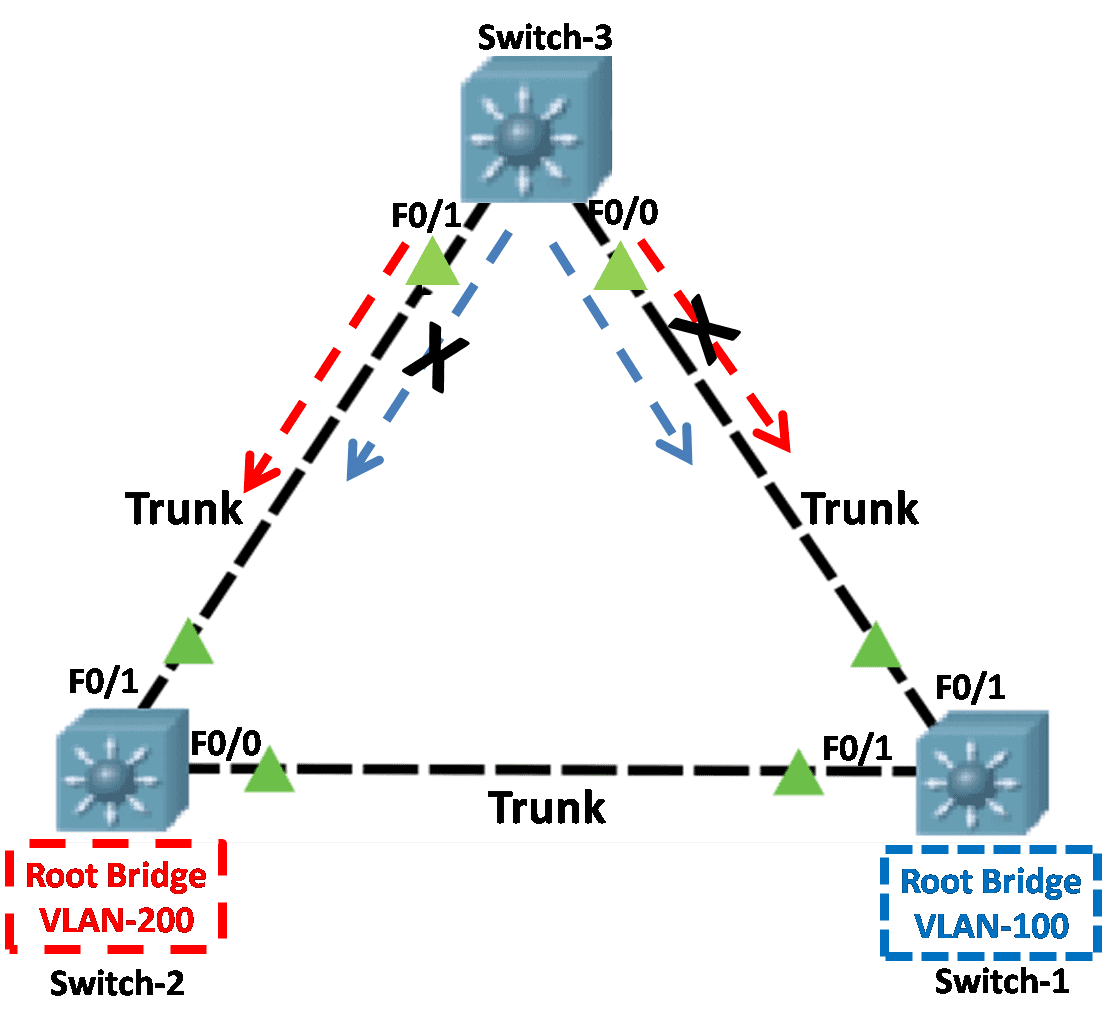
What is PVST+ – Revolutionize VLAN Load Balancing and Banish Network Loops Forever (Updated 2025)
The original IEEE 802.1D standard spanning tree protocol assumes only one spanning-tree instance for the entire switched network, regardless of the number of VLANs. A network running cannot ensure load balancing because one uplink must block all VLANs, but the CPU is free because there is only one instance of a spanning tree working. The...
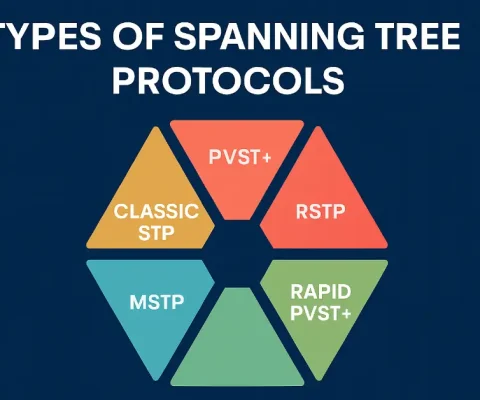
Master Types of Spanning Tree Protocols – Complete Guide (Updated November 2025)
Spanning Tree Protocol (STP) is enabled by default on every Cisco switch port to prevent Layer 2 bridging loops in redundant topologies. Without STP, a loop would cause broadcast storms, MAC table corruption, and complete network meltdown. Cisco and IEEE have evolved multiple STP flavors over the years. Here are the types of spanning tree...
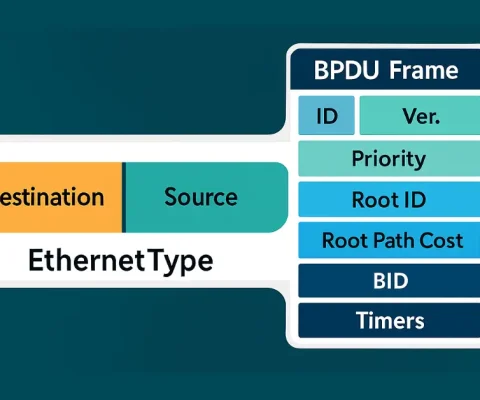
Master Bridge Protocol Data Unit (BPDU) Frame Format: Complete Guide to 802.1D STP (Updated November 2025)
In CCNA labs, spotting a BPDU storm can crash your network—understanding the frame format is your first line of defense.. The spanning tree algorithm exchanges the Bridge Protocol Data Unit (BPDU) to elect the Root Bridge. It is a frame containing 12 different fields with different information. The information in the BPDU is used to...
Master Spanning Tree Path Cost: Conquer Network Loops and Boost Efficiency Today! (Updated 2025)
When a loop occurs in the switched network, the STP uses path cost to resolve the port’s state. Path cost is obtained from the port’s speed. The spanning tree puts the lowest-numbered port into the forwarding state if all connected ports have the same path cost values. For CCNA students, understanding path cost is key...
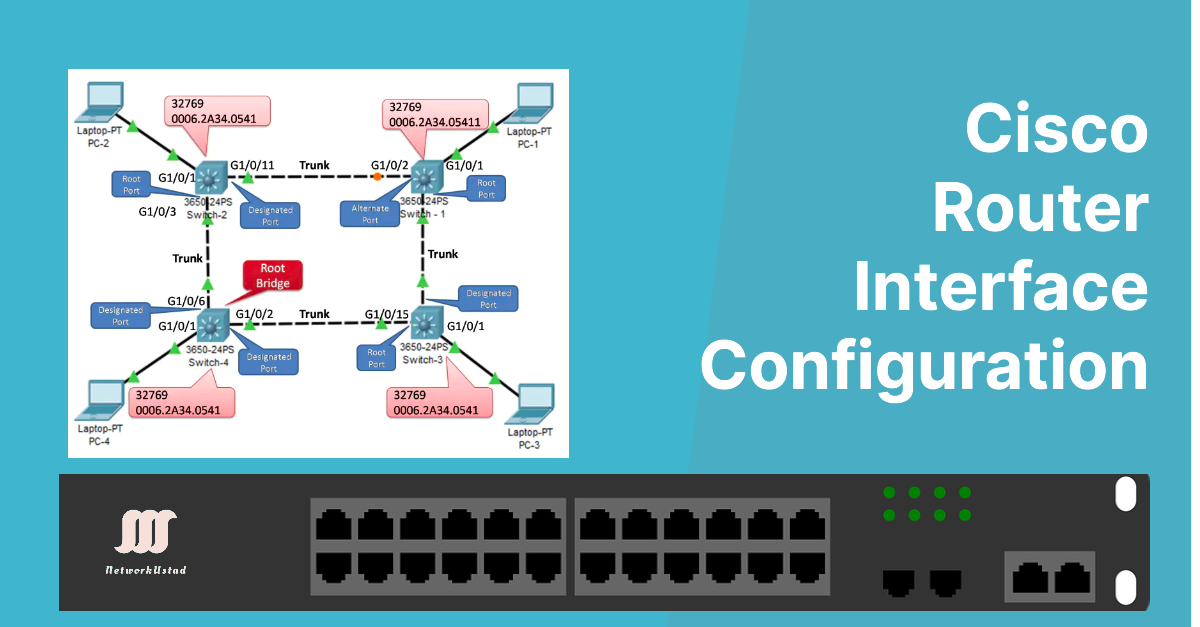
Master Spanning Tree Root Bridge: Unlock Loop-Free Networks Now! Updated 2025
Every spanning tree switched network or broadcast domain has a switch designated as the root bridge. It serves as the reference point for all spanning-tree-enabled switches. The spanning tree algorithm determines which redundant paths to block. It is selected as an election process. The figure below illustrates the bridge ID (BID) fields. BID is a...
Spanning Tree – Port Roles
IEEE 802.1D Spanning Tree Protocol (STP) and Rapid Spanning Tree Protocol (RSTP) use the Spanning Tree Algorithm (STA) to decide which switch ports on a network must be put in a blocking state to prevent loops. The Spanning Tree Algorithm designates one switch in the network as the root bridge. The root bridge is considered...
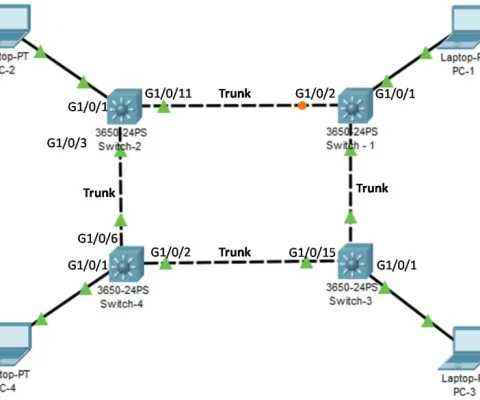
Master Spanning Tree Protocol: Ultimate Guide to Flawless Uptime (Updated 2025)
In the previous article, I have explained the redundancy. It increases the network availability by protecting the network from a single point of failure, such as a fault in a network cable or a fault in a switch. When engineers introduce physical redundancy in design, loops and duplicate frames happen. I have written in the...
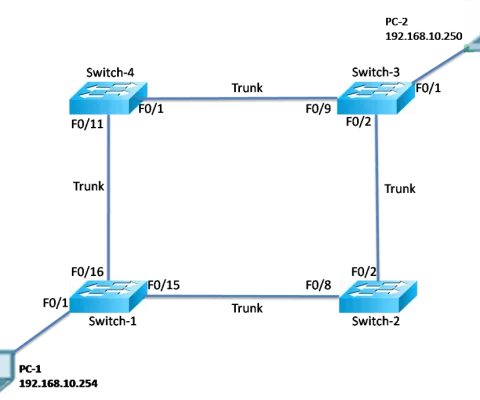
Network Redundancy Revolutionized: Achieve 99.999% Uptime
Network redundancy ensures high availability and reliability in modern networks by providing alternate paths for data transmission, allowing seamless failover if a link or device fails. In CCNA/CCNP contexts, it shares traffic loads, boosts capacity, and employs protocols like Spanning Tree Protocol (STP) for Layer 2 loop prevention, or First Hop Redundancy Protocols (FHRP) like...
IPv6 NAT Guide: NAT64 Config, ULA & Transitions
As IPv4 address exhaustion pushed NAT into every network, IPv6 flips the script with 128-bit addresses (3.4 × 10^38 possibilities). But during transitions, NAT evolves. This guide covers Unique Local Addresses (ULA) as IPv6’s ‘private’ space and translation tools like NAT64 — essential for CCNA 200-301 IPv6 topics. NAT’s ‘security’ myth? Busted—it’s not a firewall...