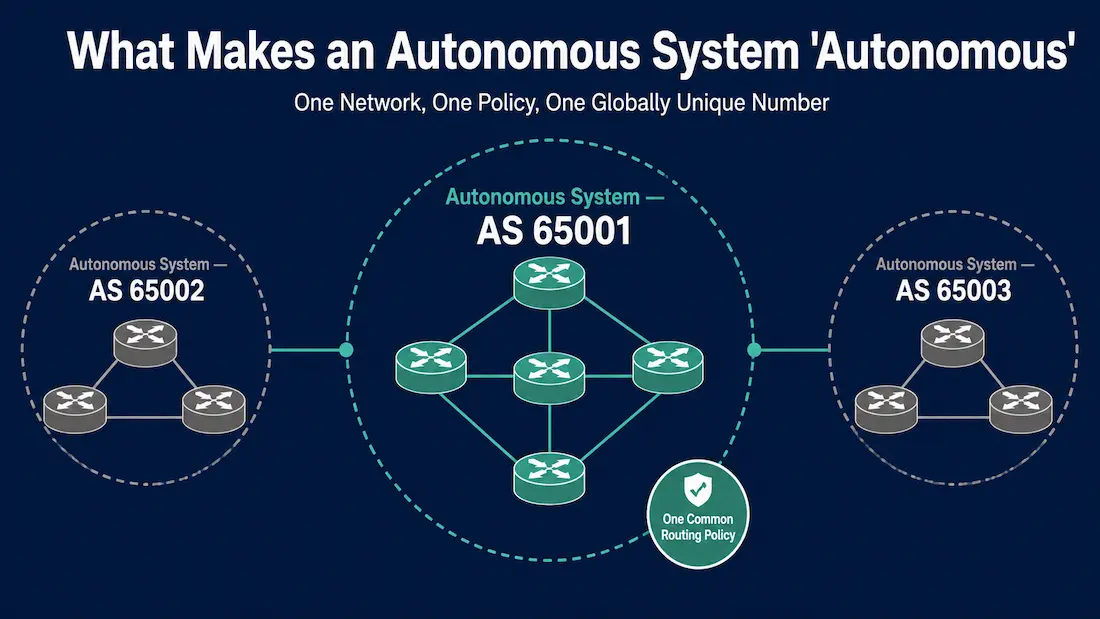
An Autonomous System Number (ASN) is a globally unique identifier assigned to an autonomous system — a group of networks under the administrative control of a single organization, presenting one common routing policy to the internet. The guidelines for creating, selecting, and registering an autonomous system are described in RFC 1930. This guide covers how ASNs are structured and assigned, the real distinction between BGP’s globally-registered AS numbers and EIGRP’s locally-significant use of the same term, and when an organization actually needs one of its own.
Who Assigns ASNs
Global ASNs are assigned by the Internet Assigned Numbers Authority (IANA), the same body responsible for allocating IP address space. In practice, IANA delegates blocks of ASNs to the five Regional Internet Registries (RIRs — ARIN, RIPE NCC, APNIC, LACNIC, and AFRINIC), and an organization requests its actual ASN from whichever RIR serves its region, not directly from IANA, following that registry’s own specific application and eligibility process.
Internet Service Providers (ISPs) are the most common users of publicly registered ASNs. They use them to control routing within their own networks and to exchange routing information with other ISPs, using the exterior gateway protocol Border Gateway Protocol (BGP) — the only widely deployed routing protocol whose configuration requires an ASN with real, globally-registered significance on the internet.
ASN Formats: 2-Byte and 4-Byte
ASNs come in two sizes:
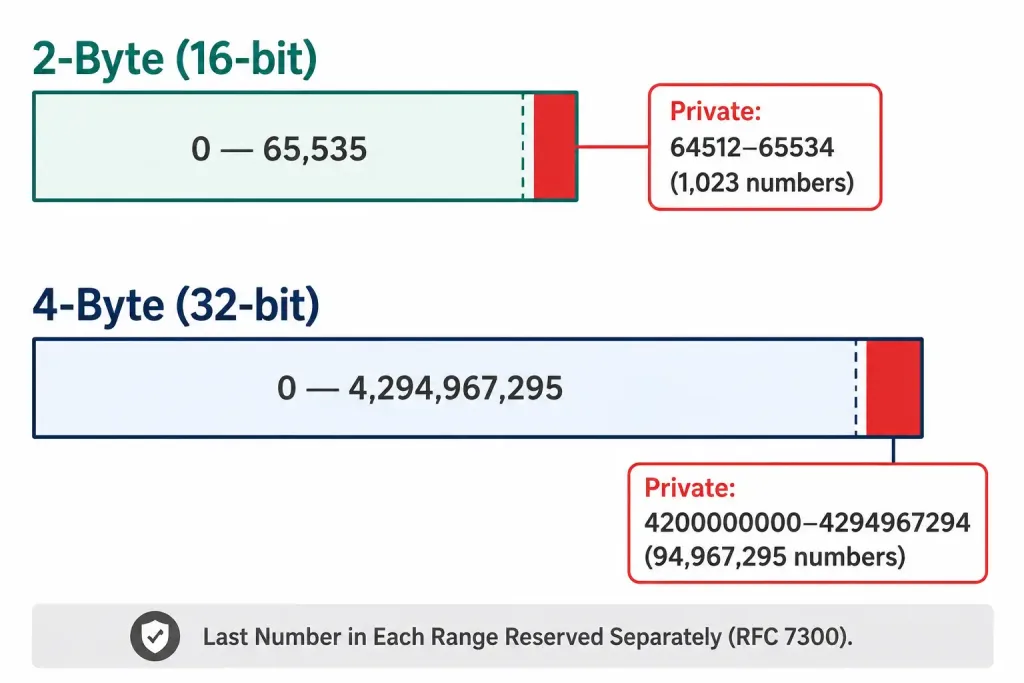
2-byte (16-bit) format provides 65,536 possible ASNs, numbered 0 through 65535. Per RFC 6996, IANA has reserved a contiguous block of 1,023 numbers (64512–65534) specifically for private use — meaning these numbers can be used internally but should never appear in the public, global routing table.
4-byte (32-bit) format, defined in RFC 6793, provides 4,294,967,296 possible ASNs, numbered 0 through 4294967295. This expansion exists because the original 16-bit pool was running low as more organizations and networks came online. Per RFC 6996, IANA has reserved a contiguous block of 94,967,295 numbers (4200000000–4294967294) for private use in this larger range.
A few additional details worth knowing: the very last number in each range — 65535 and 4294967295 — is specifically reserved as a “Last ASN” under RFC 7300, kept separate from the general private-use pool. And for anyone writing documentation, training material, or example configurations, RFC 5398 sets aside a small, dedicated range specifically for that purpose (64496–64511 and 65536–65551) — these numbers should never appear in an actual production BGP session, even an internal one, since they exist purely to avoid accidentally colliding with someone’s real ASN in written examples, the kind that might otherwise show up copied verbatim into a live configuration.
Backward Compatibility: AS_TRANS
Since 4-byte ASNs came after the original 16-bit format, older BGP routers that only understand 16-bit numbers need a way to handle a 4-byte ASN they can’t natively represent. IANA assigned a special placeholder value, AS23456 (“AS_TRANS”), for exactly this situation: when a newer, 4-byte-capable router communicates with an older router that only understands 16-bit ASNs, the older router sees AS23456 standing in for the actual 4-byte number it can’t display. ASNs are also sometimes written in “asdot” notation (x.y, where x and y are each 16-bit values) rather than the more common single-integer “asplain” notation — a 4-byte ASN like 65546 could be written in asdot form as 1.10, for example.
Autonomous System Numbers in EIGRP: A Different Meaning Entirely
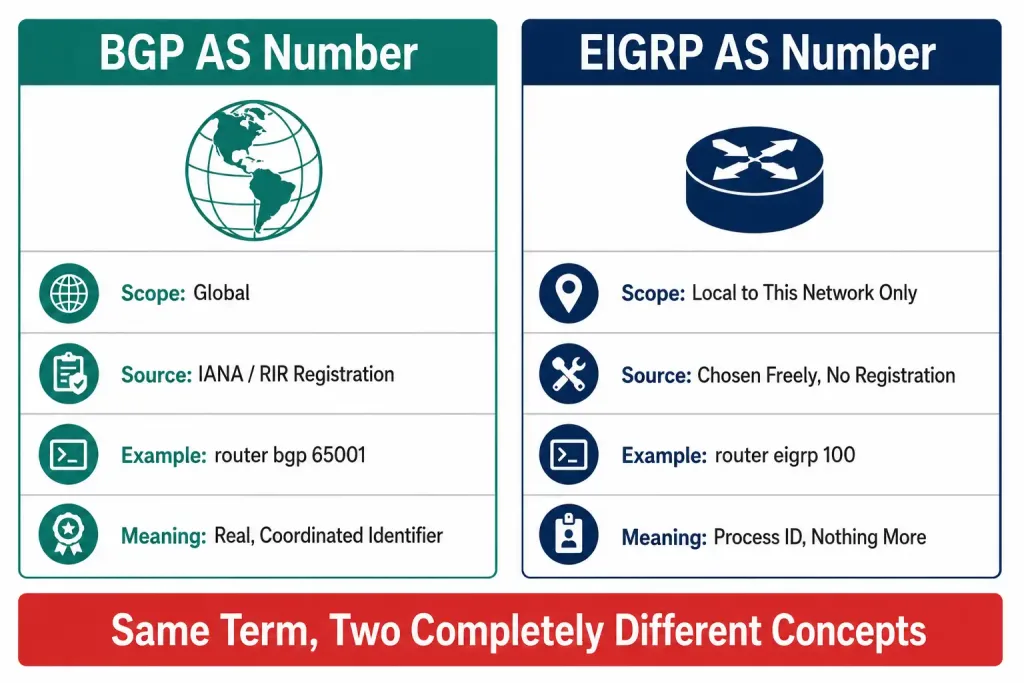
It’s worth being precise about a point that trips a lot of people up: BGP is the only widely used protocol whose configured AS number must correspond to a real, IANA/RIR-assigned ASN with actual internet-routing significance — but that doesn’t mean it’s the only protocol that uses the term “autonomous system number.” EIGRP also uses an “autonomous system number,” configured with the router eigrp <autonomous-system> command in global configuration mode — but this number means something entirely different from BGP’s.
EIGRP’s autonomous system number has no connection to IANA at all. It’s a purely locally-significant value, used only to let routers running EIGRP tell different EIGRP processes apart from each other. This matters because a single network can legitimately run more than one instance of EIGRP simultaneously — each configured to support and exchange routing updates for a different set of networks — and the AS number is simply how routers know which routing updates belong to which EIGRP process. Two EIGRP routers must use the same AS number to form an adjacency with each other, but that shared number carries no meaning whatsoever outside that specific EIGRP domain, and there’s no registry, RIR, or IANA record involved anywhere in choosing it.
So the accurate framing is: BGP’s AS number is a real, globally-coordinated identifier tracked in an official registry; EIGRP’s AS number is really just a process ID that happens to share the same name, chosen freely by whoever configures the network with no external coordination required at all.
Why Organizations Need a Real ASN in the First Place
A publicly registered ASN becomes necessary specifically when an organization needs to run BGP with more than one upstream connection to the internet — a scenario called multi-homing. A network with only a single ISP connection typically doesn’t need its own ASN at all; it can simply receive a default route from that one provider. Once an organization connects to two or more separate upstream providers and wants control over how traffic enters and leaves its network across those connections, BGP (and therefore a real ASN) becomes the standard tool for expressing that routing policy to the rest of the internet.
This is also why private ASNs exist as a distinct category: an organization might want to run BGP internally — between its own routers, or with a single upstream provider that requires BGP peering even without true multi-homing — without needing (or being eligible for) a publicly registered number. A private ASN satisfies BGP’s configuration requirements without consuming a scarce, globally unique number that provides no benefit in a context where it will never be seen outside that one relationship, freeing up the limited public pool for organizations that genuinely need global uniqueness.
Regional Internet Registries at a Glance
The five RIRs each serve a specific geographic region, and an organization requests its ASN from whichever one covers its location:
- ARIN — United States, Canada, and parts of the Caribbean
- RIPE NCC — Europe, the Middle East, and parts of Central Asia
- APNIC — Asia-Pacific region
- LACNIC — Latin America and parts of the Caribbean
- AFRINIC — Africa
Each RIR maintains its own registration database and allocation policy within the overall framework IANA establishes, which is why the actual application process, fees, and requirements can differ somewhat depending on which RIR an organization falls under.
Configuring an ASN in BGP vs. EIGRP
Seeing the two side by side in actual configuration syntax makes the distinction concrete:
! BGP — the AS number here must be a real, registered ASN
Router(config)# router bgp 65001
Router(config-router)# neighbor 203.0.113.1 remote-as 65002
! EIGRP — the AS number here is purely a local process tag
Router(config)# router eigrp 100
Router(config-router)# network 10.0.0.0 0.0.0.255In the BGP example, 65001 would need to be an ASN actually assigned to this organization (or, in a lab/training context, drawn from the documentation range) — it has meaning to the rest of the internet. In the EIGRP example, 100 is arbitrary; it could just as easily be 1, 500, or any other number, as long as every router meant to participate in this specific EIGRP domain uses that same value. Two networks could both use EIGRP AS number 100 completely independently, on completely unrelated networks, with zero conflict — something that would be a serious problem if it happened with a real BGP ASN.
Verifying ASN Configuration
For BGP, show ip bgp summary displays the locally configured AS number alongside each neighbor’s remote AS, making it straightforward to confirm both sides of a peering session agree on the expected numbers:
Router# show ip bgp summary
BGP router identifier 10.0.0.1, local AS number 65001
Neighbor        V    AS  MsgRcvd  MsgSent  ...  State/PfxRcd
203.0.113.1     4    65002    142      140  ...  4
For EIGRP, show ip protocols or show ip eigrp neighbors both surface the locally configured AS number, useful for confirming a router is actually part of the intended EIGRP domain rather than accidentally running a mismatched process:
Router# show ip eigrp neighbors
EIGRP-IPv4 Neighbors for AS(100)
A mismatched AS number between two EIGRP routers is a common, easy-to-overlook cause of adjacencies never forming at all — since the AS number effectively partitions the network into separate, non-communicating EIGRP domains by design, and there’s no error message pointing directly at “AS number mismatch” the way there might be for other misconfigurations.
Frequently Asked Questions
Do I need to register for an ASN to use EIGRP?
No. EIGRP’s AS number is entirely local to your own network and requires no registration with IANA, an RIR, or anyone else. You can choose essentially any number (commonly kept within the 16-bit range for simplicity) as long as every router meant to be part of that EIGRP domain uses the matching value.
How do I get a real, publicly registered ASN?
Through your region’s RIR (ARIN for North America, RIPE NCC for Europe, APNIC for Asia-Pacific, LACNIC for Latin America, or AFRINIC for Africa), typically as part of setting up BGP peering with one or more upstream ISPs. This is a formal registration process, distinct from simply picking a number the way you would for an internal EIGRP process.
Can I use a private ASN for real internet routing?
No. Private-use ASNs (64512–65534 for 16-bit, 4200000000–4294967294 for 32-bit) are explicitly reserved for internal use only and must never appear in routes advertised to the global internet. Upstream providers typically strip or reject any route path containing a private ASN before it reaches the public routing table.
What’s the difference between “asplain” and “asdot” notation?
Asplain writes an ASN as a single integer (for example, 65546). Asdot writes it as two 16-bit numbers separated by a period (1.10 for that same value). Both represent identical numbers; asplain is the more commonly used and generally preferred format today, per RFC 5396.
Why does EIGRP need an AS number if it’s not globally significant?
Because a router can run multiple independent EIGRP processes at once, each handling a different set of networks. The AS number is what lets routers correctly associate incoming routing updates with the right EIGRP process, and lets two routers confirm they’re actually supposed to be neighbors within the same EIGRP domain before forming an adjacency.
Does every network need a BGP ASN?
No — only networks that are multi-homed to more than one upstream provider, or that otherwise need to run BGP to control their own routing policy, actually need one. A network with a single internet connection can typically rely on a default route from its provider without ever needing an ASN of its own, public or private.
Conclusion
An Autonomous System Number identifies a network (or group of networks) under unified administrative control, and its meaning depends heavily on which protocol is using it. BGP’s ASN is a real, IANA/RIR-coordinated identifier with actual significance on the global internet, available in both 2-byte and 4-byte formats with specific ranges reserved for private and documentation use. EIGRP borrows the same terminology for something conceptually much simpler — a locally-significant process identifier with no relationship to IANA whatsoever. Keeping that distinction clear avoids a common point of confusion when moving between BGP and EIGRP configuration.