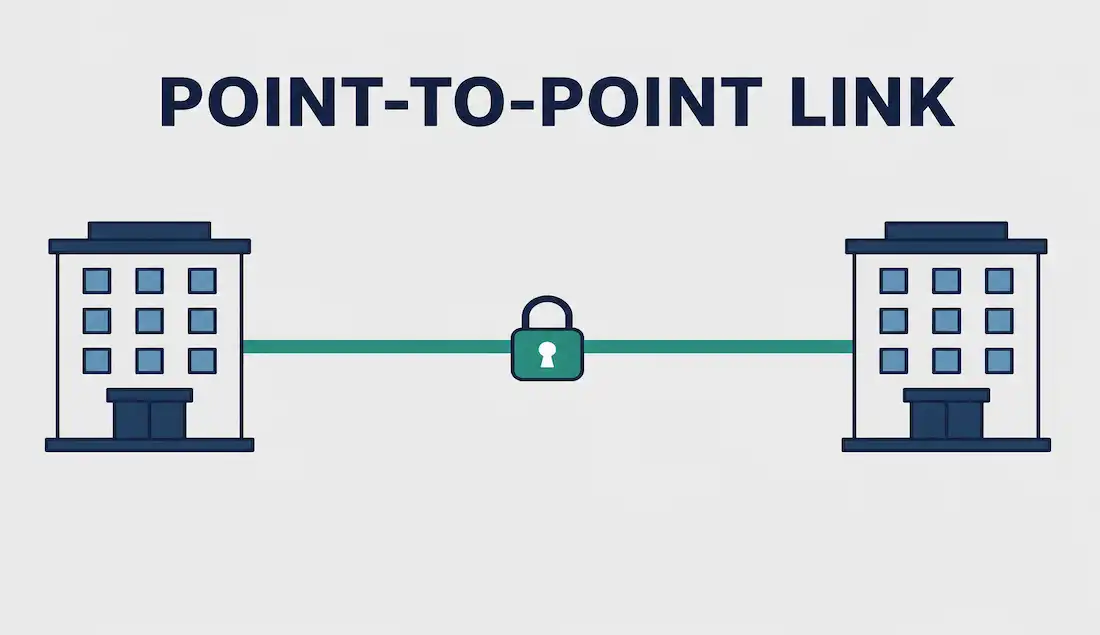
A point-to-point link is used when a permanent, dedicated connection is required between two locations. It’s a pre-established WAN communications path that securely connects two or more locations for private data services, without sharing that specific physical or logical path with other customers’ traffic.
Point-to-point links are also commonly known by other names in the industry: Private Line, Leased Line, or Data Line. Regardless of the name used, the core concept is the same — a dedicated, always-available connection between two fixed endpoints.
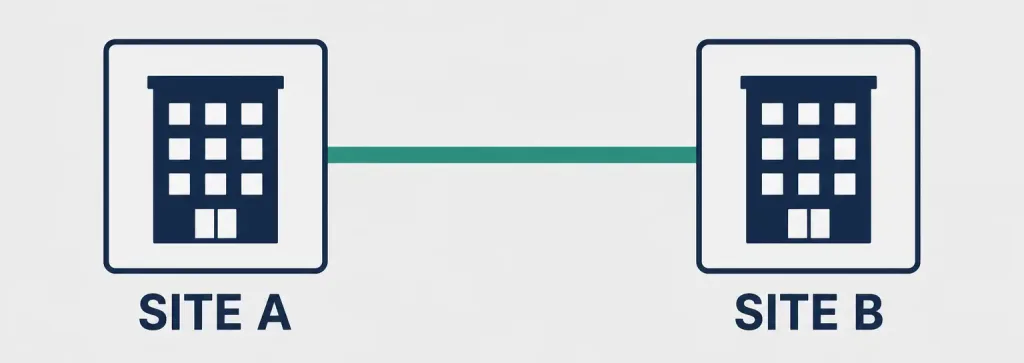
Point-to-Point Link Standards and Speeds
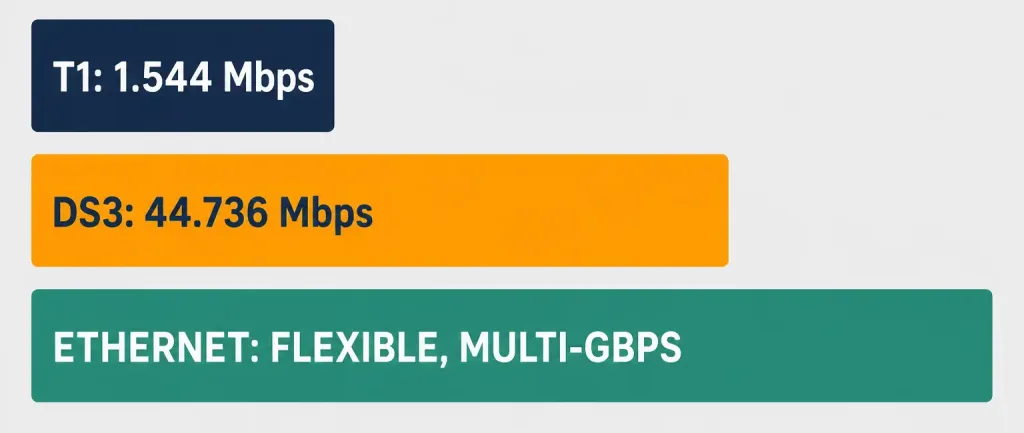
Point-to-point links are available across a range of standards and speeds, including:
- T1 lines: 1.544 Mbps, a common entry-level point-to-point option historically used for voice trunking and moderate data needs.
- Ethernet: Increasingly the dominant point-to-point standard today, offering flexible speeds from a few megabits per second up into multi-gigabit territory.
- DS3 (T3): 44.736 Mbps, suited to higher-bandwidth needs like connecting a large office or aggregating traffic from multiple smaller sites.
The right choice among these depends on the bandwidth actually needed, the distance between sites, and what a given service provider offers in a particular area — a decision very similar to the leased-line and Ethernet WAN capacity-planning tradeoffs covered in related WAN technology guides.
How Enterprises Use Point-to-Point Links
Enterprises typically use point-to-point links to provide reliable, secure data service for applications including credit card processing, file sharing, data backup, VoIP, and video conferencing. All of these services can be configured together over the same point-to-point connection, since the dedicated nature of the link means bandwidth doesn’t need to be renegotiated or shared with unrelated traffic from other customers.
Point-to-point connections can carry audio or video over vast distances while maintaining high quality and consistency throughout a call or transmission session. This reliability is precisely why point-to-point links remain a preferred choice for applications where connection quality genuinely matters — a dropped or degraded VoIP call or a corrupted credit card transaction has real business consequences that a shared, best-effort connection is more likely to risk.
Worked Example: Undersea Fiber-Optic Cables
The clearest large-scale example of a point-to-point link is the network of undersea fiber-optic cables connecting countries and continents across thousands of miles of ocean floor. Each cable runs from one landing station to another — genuinely point-to-point in the most literal sense — carrying enormous volumes of Internet, voice, and data traffic between two fixed geographic endpoints. A single modern transoceanic cable can carry many terabits per second of aggregate capacity, illustrating that “point-to-point” doesn’t imply low capacity; it simply means the connection runs between two specific endpoints rather than being shared across a mesh or multipoint topology serving many different destinations.

Worked Example: Estimating Cost Tradeoffs at Different Site Counts
To make the point-to-point-versus-multipoint decision concrete, imagine a rough cost model where each individual point-to-point link between two sites costs a fixed amount, while a multipoint service charges primarily per site connected to the shared network rather than per pair of sites. Connecting 2 sites requires exactly 1 point-to-point link — clearly the simplest option.
Connecting 5 sites in a full mesh using only point-to-point links would require 10 separate links (following the n(n-1)/2 formula for full mesh connections), while a multipoint service would only need 5 individual connections into the shared network. By the time an organization reaches even a modest number of sites needing full interconnectivity, the multipoint approach’s cost and complexity advantage becomes substantial, which is exactly why point-to-point links remain most attractive specifically for two-site (or a small handful of highest-priority) connections rather than for connecting an entire multi-site enterprise.
Real-World Deployment Context
Consider a regional hospital network with a main campus and a single dedicated imaging center a few miles away. Large medical imaging files need to move reliably and quickly between the two sites, and any interruption or quality degradation could delay patient care. A point-to-point Ethernet link between the two locations is a natural fit here: only two sites are involved, the traffic is sensitive enough to justify dedicated bandwidth, and the distance is short enough that a point-to-point circuit is straightforward and cost-effective to provision.
Now contrast this with a national retail chain connecting 150 stores to a central data center. Provisioning 150 individual point-to-point links back to headquarters would be technically possible but extremely expensive and operationally unwieldy compared to a multipoint MPLS or SD-WAN solution designed specifically for many-site connectivity. This contrast is exactly why point-to-point links and multipoint technologies coexist in the real world rather than one replacing the other: each is the right tool for a different shape of connectivity problem, and choosing between them comes down to how many locations actually need to talk to each other, not just about a general size or budget cutoff.
Point-to-Point vs. Other WAN Topologies
Understanding how point-to-point links differ from other WAN connectivity models clarifies when they’re the right choice:
| Factor | Point-to-Point | Multipoint (e.g., MPLS, VPLS) | Shared Internet (VPN) |
|---|---|---|---|
| Number of endpoints | Exactly two | Many sites in a mesh | Many sites over shared infrastructure |
| Bandwidth guarantee | Fully dedicated | Often shared/contended | Shared, variable |
| Cost | Higher per site pair | Efficient at scale | Lowest |
| Best fit | Two specific sites needing guaranteed connectivity | Many geographically dispersed sites | Cost-sensitive connectivity |
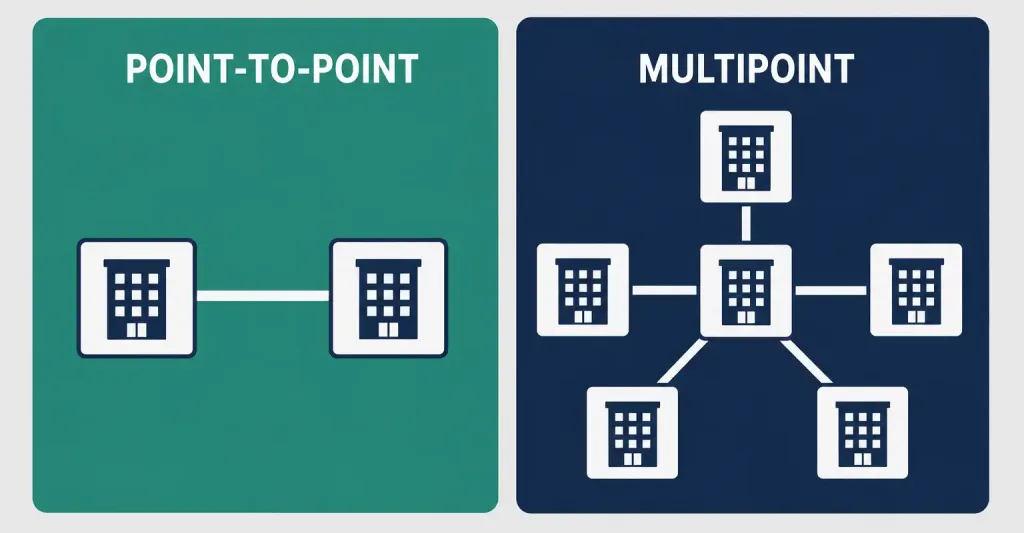
A point to point link makes the most sense when exactly two locations need to communicate with guaranteed, dedicated bandwidth — a headquarters and a single data center, for example. Once an organization needs to connect many sites to each other efficiently, multipoint technologies like MPLS or VPLS generally become more practical than provisioning a separate point to point link between every pair of sites.
Advantages of Point-to-Point Links
- Guaranteed dedicated bandwidth: Because the link isn’t shared with other customers, capacity is consistently available rather than contended for during peak usage.
- High reliability and quality: Point to point links support consistent, high-quality audio and video transmission over long distances, making them well suited to latency- and quality-sensitive applications.
- Simplicity for two-site connectivity: When only two locations need to connect, a point to point link avoids the routing and configuration complexity of multipoint topologies.
- Strong security posture: Traffic travels over a dedicated path rather than a shared network, reducing (though not eliminating) certain classes of exposure compared to shared infrastructure — encryption should still be added separately for sensitive data.
- Flexible speed options: From T1-class connections up through high-capacity Ethernet and DS3 circuits, point-to-point links scale to a wide range of bandwidth needs.
Disadvantages of Point-to-Point Links
- Cost scales poorly with site count: Connecting many locations pairwise with individual point-to-point links becomes expensive and operationally complex compared to multipoint alternatives designed for many-site connectivity.
- Less flexible than shared infrastructure: Adding a new site or changing an endpoint typically requires provisioning an entirely new circuit rather than simply adding a connection to existing shared infrastructure.
- Fixed capacity: Like other dedicated circuits, a point to point link’s bandwidth is set by contract, meaning organizations either pay for unused headroom or must upgrade the circuit as needs grow.
Security Considerations for Point-to-Point Links
Because point-to-point traffic travels over a dedicated path rather than a shared network, it avoids certain exposure that shared infrastructure faces by default — but as with leased lines, “dedicated” doesn’t automatically mean “encrypted.” A point to point circuit’s data typically travels without encryption unless the organization deliberately adds it, so a dedicated path should be treated as one layer of a broader security strategy rather than a complete solution by itself. Organizations with strict compliance requirements often layer IPsec or similar encryption on top of a point to point link, particularly for the most sensitive traffic types like credit card processing or healthcare imaging data.
Troubleshooting and Exam Tips
- Remember the core definition: a point-to-point link connects exactly two locations with a dedicated, pre-established path — this is the key distinction from multipoint topologies.
- Know the common synonyms: Private Line, Leased Line, and Data Line all refer to the same underlying concept as a point-to-point link.
- If a question describes connecting many geographically dispersed sites efficiently, that scenario usually points toward a multipoint technology like MPLS or VPLS rather than point to point links between every pair of sites.
- Undersea fiber-optic cables are a commonly cited real-world example of point to point links operating at a global scale.
- Remember that point to point links can run over multiple underlying technologies (T1, Ethernet, DS3), so “point to point” describes a topology and dedication model, not a single specific protocol or speed. This distinction matters because a question might test whether you understand point to point as a connectivity pattern that different physical technologies can implement, rather than testing knowledge of one specific standard.
Conclusion
A point-to-point link provides a dedicated, pre-established connection between exactly two locations, delivered over standards like T1, Ethernet, or DS3 depending on the bandwidth needed. Enterprises rely on point to point links for applications demanding consistent quality and guaranteed bandwidth — credit card processing, VoIP, video conferencing, and data backup among them — precisely because the link isn’t shared with other customers’ traffic. While point to point connectivity doesn’t scale efficiently to many sites the way multipoint technologies do, its simplicity and reliability make it the right choice whenever exactly two locations need dedicated, high-quality connectivity that they can depend on day after day.
Frequently Asked Questions
What is a point-to-point link in networking?
A point to point link is a dedicated, pre-established WAN connection between exactly two locations, providing guaranteed bandwidth that isn’t shared with other customers’ traffic. It’s also known as a Private Line, Leased Line, or Data Line.
What speeds are available for point-to-point links?
Common options include T1 (1.544 Mbps), Ethernet (ranging from a few Mbps to multi-gigabit speeds), and DS3/T3 (44.736 Mbps). The right choice depends on bandwidth needs, distance, and provider availability.
What is an example of a point-to-point link?
Undersea fiber-optic cables connecting countries and continents are a large-scale real-world example — each cable runs between two specific landing stations, carrying massive volumes of traffic over a genuinely point-to-point path.
What is the difference between a point-to-point link and a multipoint connection?
A point-to-point link connects exactly two locations with a dedicated path. A multipoint connection, such as MPLS or VPLS, connects many sites to each other efficiently through a shared provider network, which scales better than provisioning individual point to point links between every pair of sites.
Why do enterprises use point-to-point links for VoIP and video conferencing?
Because the dedicated bandwidth isn’t shared with other traffic, point-to-point links deliver the consistent, high-quality connection that latency- and quality-sensitive applications like VoIP and video conferencing need, without the variability that shared or best-effort connections can introduce.
Is a point-to-point link the same as a leased line?
Yes, essentially. “Point-to-point link,” “Private Line,” “Leased Line,” and “Data Line” are all industry terms describing the same underlying concept: a dedicated, pre-established connection between exactly two locations.