
A Limited Liability Partnership (LLP) remains one of the most practical business structures for small and mid-sized partnerships in India, combining a partnership’s operational flexibility with a company’s limited-liability protection. Here’s what an LLP actually is under Indian law, its real advantages and limitations, and the annual compliance obligations that come with it.
What Governs an LLP in India
An LLP in India is governed by the Limited Liability Partnership Act, 2008, along with the LLP Rules, 2009 — not the Companies Act, 2013, which governs private and public companies instead. This distinction matters because it determines which set of compliance rules, forms, and regulatory filings actually apply.
The Indian Partnership Act, 1932 generally does not apply to LLPs themselves, since the LLP Act, 2008 was specifically created to give partnerships a separate legal structure with limited liability protection that the older Partnership Act never provided.
Structure and Basic Requirements
- Minimum two partners, with no upper limit on the maximum number — a genuine advantage over a private limited company, which caps shareholders at 200.
- At least one designated partner must be a resident of India, responsible for ensuring compliance with filing and regulatory obligations.
- Limited liability — each partner’s liability is limited to their agreed contribution to the LLP, protecting personal assets from the LLP’s business debts in most circumstances (this protection can be pierced in cases of fraud or improper conduct, as with most limited-liability structures).
- Separate legal existence from its partners, meaning the LLP can own property, enter contracts, and sue or be sued in its own name, independent of any individual partner’s involvement.
Real Advantages of the LLP Structure
- No minimum capital requirement — partners can start an LLP with whatever contribution they agree on, unlike some company structures that historically required a minimum paid-up capital.
- No mandatory statutory audit below certain thresholds — an LLP only needs its accounts audited if its annual turnover exceeds ₹40 lakh, or if total partner contribution exceeds ₹25 lakh. Below both thresholds, audit is optional, which meaningfully reduces compliance overhead for smaller LLPs.
- Comparatively lighter ongoing compliance than a private limited company, though “lighter” doesn’t mean “none” — the annual filing obligations below are still mandatory regardless of size.
- Flexible internal management — partners can structure decision-making, profit-sharing, and meeting requirements through the LLP agreement itself, rather than following the more rigid board-meeting and shareholder-resolution requirements that apply to companies.
Annual Compliance Obligations
Every LLP registered in India, active or dormant, has mandatory annual filing obligations regardless of whether it did any business during the year:
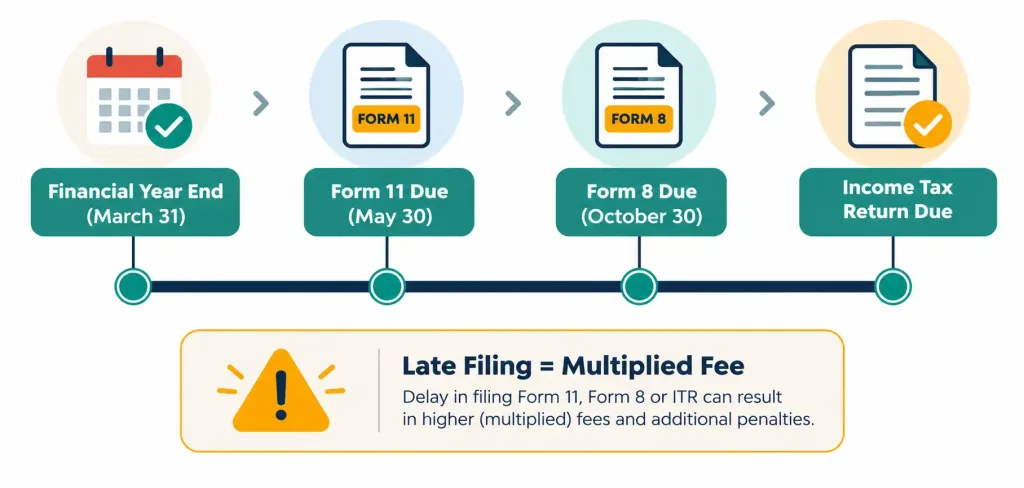
- Form 11 (Annual Return) — due within 60 days of the financial year’s end (by May 30 for a financial year ending March 31), covering details of partners and their contributions.
- Form 8 (Statement of Account and Solvency) — due by October 30, covering the LLP’s financial position and a solvency declaration.
- Income tax return filing — required annually regardless of turnover, with the applicable due date depending on whether the LLP’s accounts require a tax audit (audited LLPs generally get a later filing deadline than non-audited ones — confirm the current year’s specific dates against the Income Tax Department’s official notifications, since due dates have shifted in recent years).
- Books of account — must be maintained on a cash or accrual basis as prescribed under the LLP Rules, forming the basis for both Form 8 and the income tax return.
Late filing has real financial consequences. Since April 2022, late Form 8 and Form 11 filings incur an additional fee calculated as a multiple of the normal filing fee, scaling up the longer the delay continues — filing even a few weeks late can mean paying several times the standard fee, and a delay beyond a year adds a further daily charge on top of that multiple. Separately, an adjudicating officer can impose a penalty of ₹100 per day under the LLP Act for ongoing non-compliance, capped at ₹1 lakh for the LLP itself and ₹50,000 per designated partner — unless the LLP files within 30 days of receiving an official notice.
Taxation: What Actually Applies
LLPs in India are taxed as a separate entity, broadly similar to how a partnership firm is taxed — not under the individual income tax slab system that applies to a sole proprietorship:
- Flat income tax rate of 30% on the LLP’s total income.
- Surcharge of 12% applies only when the LLP’s total income exceeds ₹1 crore, with marginal relief available to prevent a disproportionate jump at that threshold.
- Health and Education Cess of 4% applies on top of the income tax plus any applicable surcharge.
One outdated point worth correcting directly: profit distributed to partners from an LLP is not subject to a separate Dividend Distribution Tax, because DDT itself was abolished for all entities starting April 2020 — it isn’t an LLP-specific exemption, as older articles sometimes imply. The broader point still holds, though: profit share received by a partner from an LLP is generally exempt from further tax in the partner’s hands, since the LLP itself has already been taxed on that income.
Tax rates, surcharge thresholds, and filing deadlines are set by the annual Finance Act and can change from year to year — always confirm the applicable figures for the specific assessment year against the Income Tax Department’s current notifications before filing, rather than relying on a figure from a prior year’s guide.
What to Actually Check Before Registering
- Confirm the current MCA registration fees and timeline directly on the Ministry of Corporate Affairs portal, since fee structures are updated periodically and vary by authorized capital contribution.
- Draft the LLP agreement carefully, since it’s what actually governs profit-sharing, decision rights, and partner responsibilities — the LLP Act sets the outer legal framework, but the agreement fills in the operational details that matter day to day.
- Plan for the designated-partner compliance burden — since at least one designated partner is personally responsible for ensuring filings happen on time, that role shouldn’t be assigned casually.
- Budget for the audit threshold, since crossing ₹40 lakh turnover or ₹25 lakh contribution triggers a mandatory audit requirement that adds real ongoing cost.
The Bottom Line
An LLP remains a genuinely practical structure for Indian partnerships that want limited liability without the full compliance burden of a private limited company — but “lighter compliance” is relative, not an exemption. Form 11, Form 8, and income tax filings are mandatory every year regardless of business activity, and late filing penalties scale quickly the longer a delay continues. Getting the governing law right (the LLP Act, 2008, not the Companies Act) and checking current tax and filing figures against official sources each year are the two most common points where outdated guidance leads partners astray.
Frequently Asked Questions
What law governs LLPs in India?
The Limited Liability Partnership Act, 2008, along with the LLP Rules, 2009 — not the Companies Act, 2013, which governs companies instead.
Does every LLP need its accounts audited?
No. Audit is mandatory only if annual turnover exceeds ₹40 lakh or total partner contribution exceeds ₹25 lakh. Below both thresholds, audit is optional.
What happens if an LLP files Form 8 or Form 11 late?
Since April 2022, late filing triggers an additional fee calculated as a multiple of the standard filing fee, scaling up with the length of the delay — and a separate ₹100-per-day penalty can apply under the LLP Act for continued non-compliance, capped at ₹1 lakh for the LLP and ₹50,000 per designated partner.
Is LLP profit taxed twice, once at the entity level and again for partners?
No. The LLP pays tax on its total income at the entity level, and profit share distributed to partners is generally exempt from further tax in the partner’s hands, since it’s already been taxed once.