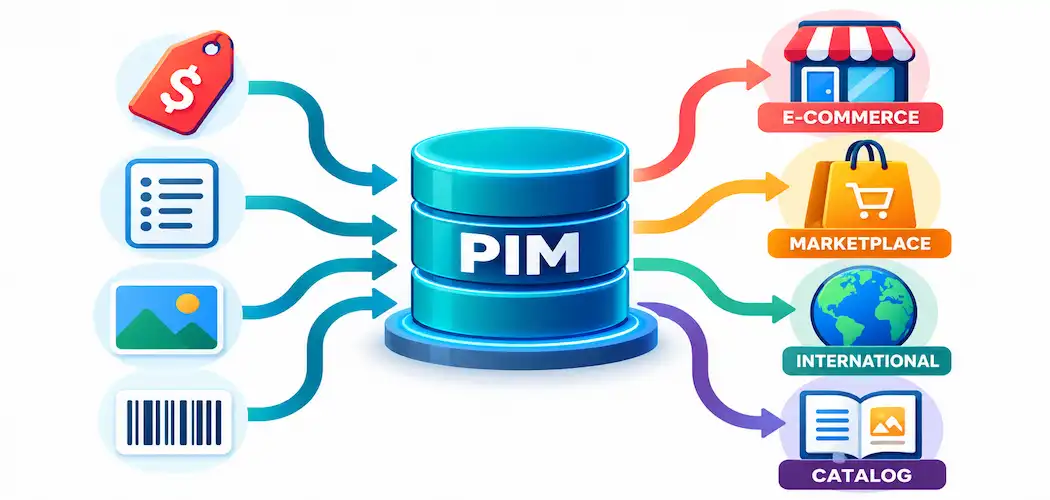
Picture a mid-sized retailer selling the same 2,000 products across its own website, Amazon, a wholesale catalog, and a handful of regional distributors. Now picture updating a single product’s dimensions, and that update needing to land correctly in six different places, each with its own formatting rules, language requirements, and field names. Multiply that by every product change, every new SKU, every seasonal update, and the scale of the problem becomes obvious fast. This is precisely the gap a Product Information Management (PIM) system exists to close.
What a PIM Actually Is
A PIM is a centralized system for storing, managing, and distributing product data — descriptions, technical specifications, pricing, images, dimensions, compliance information, and anything else that describes what a product is and how it should be presented. Instead of maintaining that information separately in spreadsheets, a website’s CMS, a supplier’s catalog file, and a sales team’s slide decks, a PIM holds one authoritative version and pushes it out, correctly formatted, to every channel that needs it.
It’s worth distinguishing a PIM from two systems it often gets confused with. A DAM (Digital Asset Management) system specifically handles media files — images, videos, PDFs — and is frequently used alongside a PIM rather than instead of it. An MDM (Master Data Management) system is broader still, governing core business data across an entire organization, of which product data is only one slice. A PIM sits in a more focused lane: product data, specifically, built to serve the needs of catalog, marketing, and sales teams rather than IT infrastructure broadly.
The Problem a PIM Actually Solves
Fragmented, inconsistent data. Without a PIM, product information tends to live wherever it was last edited — a spreadsheet one team maintains, a different spreadsheet another team maintains, a CMS field that’s gone stale since the last website redesign. The inevitable result is inconsistency: the same product described slightly differently on the website versus the Amazon listing versus a printed catalog, which erodes customer trust and creates avoidable returns when expectations don’t match reality.
Slow onboarding of new products, suppliers, and channels. Bringing on a new supplier typically means absorbing their data in whatever format they provide it, which rarely matches your own systems cleanly. A PIM gives a business a structured place to import, clean, and standardize that data once, rather than re-formatting it by hand for every downstream system it needs to reach. The same logic applies to launching in a new sales channel — a new marketplace, a new regional storefront — since the channel’s formatting requirements can be mapped once rather than negotiated manually every time a product list changes.
Costly manual-entry errors. Hand-entering the same product data into multiple systems is exactly the kind of repetitive task where small mistakes compound — a transposed dimension, a missing compliance note, a price that didn’t get updated everywhere it needed to. Centralizing the data removes most of the opportunity for that kind of error, since there’s one place to update rather than several places to remember.
Multi-channel and multi-language complexity. For a business selling across borders or across a wide mix of channels — its own e-commerce store, a handful of marketplaces, print catalogs, social commerce — keeping product data accurate and properly localized across all of them by hand becomes genuinely unmanageable past a certain scale. A PIM is built specifically to manage that complexity: one source of truth, exported in whatever format and language each channel requires.
What a Good PIM Actually Stores
Beyond the basics (name, description, price), a capable PIM typically handles technical specifications, measurements and dimensions, compliance and safety documentation, SEO-relevant metadata, linked media assets (often in coordination with a DAM), usage instructions, and increasingly, the kind of narrative “product story” content that matters for marketing-driven categories like fashion or consumer electronics. The specific fields a business needs depend heavily on its industry — a hardware distributor cares about different attributes than an apparel brand does — which is part of why PIM platforms are typically configurable rather than one-size-fits-all.
The Vendor Landscape — Without Picking a Winner
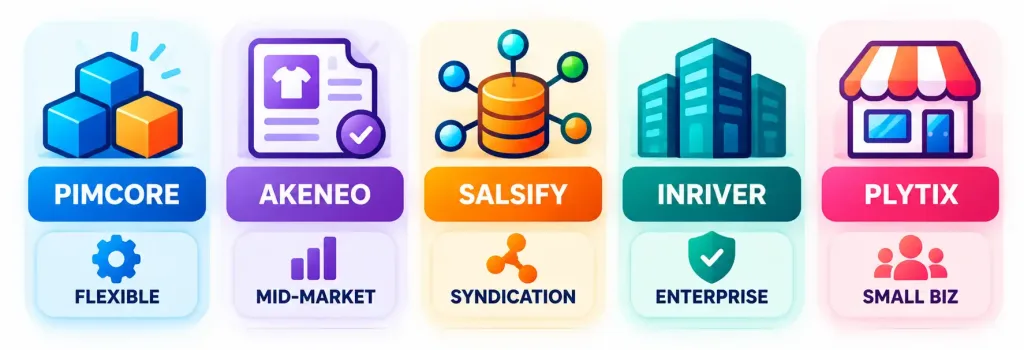
There are several established players in this space, each with different strengths, and the right choice depends heavily on a business’s specific needs rather than any universal “best” option:
- Pimcore is an open-source platform combining PIM, DAM, and digital experience management, popular with businesses that want flexibility and are comfortable with a more technical implementation.
- Akeneo is widely used in mid-market and enterprise retail, known for a strong open-source community edition alongside its paid enterprise tiers.
- Salsify leans heavily into syndication — getting product data formatted correctly for major retail and marketplace partners — and is popular with consumer brands selling through big-box retail.
- inRiver focuses on product content and experience management, often positioned toward mid-market and enterprise B2B and B2C brands.
- Plytix targets smaller businesses and e-commerce teams that need core PIM functionality without enterprise-level complexity or cost.
Independent comparisons between these platforms do exist, but it’s worth being skeptical of any comparison published by a vendor’s own implementation partner or consulting agency — those naturally favor whichever platform they’re paid to implement, and that bias isn’t always disclosed. A more reliable approach is checking software review aggregators (G2, Capterra) for verified user reviews across multiple platforms, and requesting a trial or demo directly from two or three vendors that seem to fit a business’s scale and industry before committing.
Signs a Business Is Ready for One
A PIM isn’t necessary for every business — a company with a few dozen SKUs sold through one channel probably doesn’t need one yet. The signals that it’s time to seriously evaluate one tend to cluster around scale and complexity: selling the same products across three or more channels with different formatting needs, onboarding new suppliers or SKUs frequently enough that manual entry has become a bottleneck, operating in multiple languages or regions, or simply noticing that product data errors (wrong specs, inconsistent descriptions, outdated pricing) have started showing up often enough to matter to customers.
Getting Started Without Overcommitting
Most PIM vendors offer a trial period or guided demo, which is worth using properly rather than rushing through. A useful evaluation includes importing a genuinely messy sample of real product data — not a cleaned-up demo dataset — to see how the platform actually handles the kind of inconsistency a business is trying to solve. It’s also worth asking directly about integration with existing systems (the e-commerce platform, ERP, CMS) before signing anything, since a PIM that doesn’t connect cleanly to what’s already in place creates a second data-silo problem instead of solving the first one.
The Bottom Line
A PIM system earns its place in a business’s tech stack by solving a specific, scaling problem: keeping product data accurate, consistent, and quickly distributable across however many channels a business actually sells through. It’s not a universal requirement for every company, but for one juggling multiple sales channels, frequent supplier onboarding, or multi-region operations, the alternative — manual data wrangling across disconnected spreadsheets — tends to become the more expensive option well before anyone notices the cost has crept up.
A PIM solves the accuracy side of the equation — making sure product data is correct and consistent everywhere it appears. The other half of the picture is understanding how customers actually interact with that data once it’s live, which is where product analytics tools come in. The two work well together: clean, centralized product data feeding into systems built to measure what customers actually do with it.
Frequently Asked Questions
What’s the difference between a PIM, a DAM, and an MDM system?
A PIM manages product data specifically — descriptions, specs, pricing. A DAM manages digital media assets like images and videos, often working alongside a PIM. An MDM is broader, governing core business data across an organization, of which product data is just one category.
Is PIM software only useful for large enterprises?
No. While enterprise-grade platforms like Pimcore and Akeneo serve large, complex catalogs, smaller platforms like Plytix are built specifically for smaller e-commerce businesses that need core PIM functionality without enterprise pricing or complexity.
How do I know if my business actually needs a PIM?
The clearest signals are selling across three or more channels with different data requirements, frequent new-supplier or new-SKU onboarding that’s become a bottleneck, multi-language or multi-region operations, or product data errors that have started affecting customers.
Should I trust a vendor comparison published by an implementation agency?
Treat it with caution. Agencies that implement a specific platform have a financial interest in recommending it, and that bias isn’t always disclosed. Independent review aggregators and direct trials with multiple vendors are a more reliable way to compare options.