Legal Disclaimer: This article is for informational purposes only and does not constitute legal advice. Canadian traffic laws vary significantly by province, territory, and municipality. If you have received a fine or are facing legal consequences related to pedestrian conduct, consult a qualified lawyer in your jurisdiction.
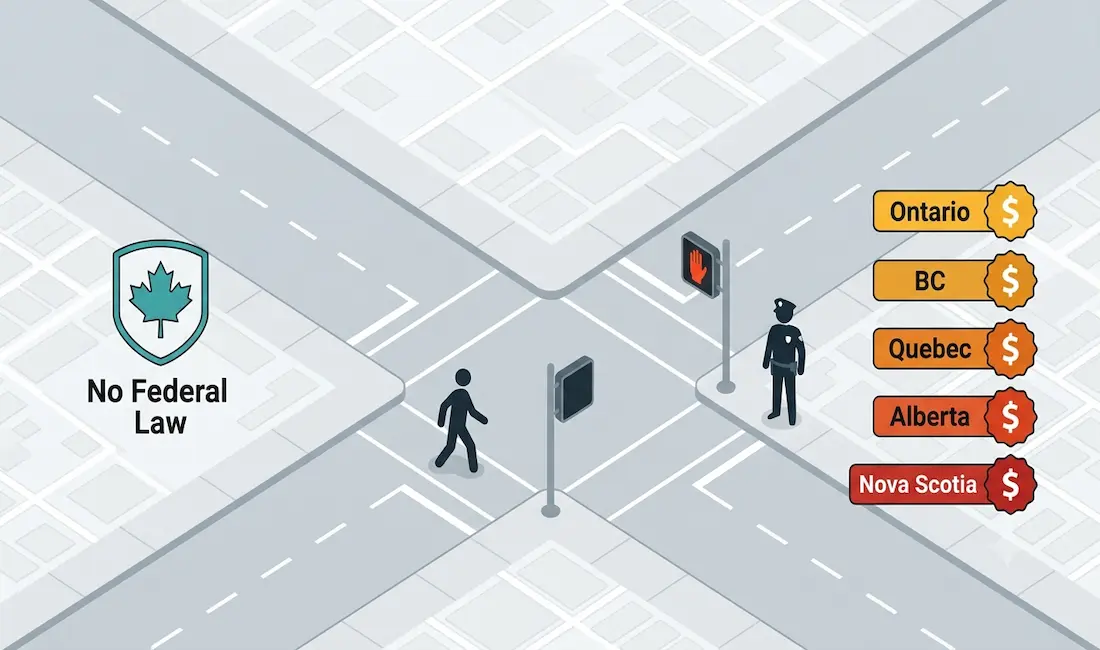
The short answer: jail for jaywalking alone is extremely unlikely in Canada. The longer answer is more nuanced — because Canada has no single federal jaywalking law. Whether crossing the road outside a designated crosswalk is illegal, what fine applies, and what enforcement looks like all depend on which province and city you are in.
This guide explains how jaywalking is treated under Canadian law, breaks down the rules by province, clarifies when a fine is realistic, explains the rare scenarios that could lead to arrest, and covers what happens legally when a pedestrian is injured or killed while jaywalking.
What Is Jaywalking?
Jaywalking is an informal term — not a legal term used in Canadian statutes — that describes crossing a roadway outside of a designated crosswalk, against a traffic signal, or in a way that interferes with vehicle traffic. The word “jay” historically referred to a naive or unsophisticated person (a rural newcomer unfamiliar with city traffic), and “jaywalking” implied crossing the street carelessly or without regard for the rules of the road.
In Canada, no provincial or federal statute uses the word “jaywalking” as a defined offence. Instead, pedestrian crossing behaviour is regulated through provincial Highway Traffic Acts, territorial traffic ordinances, and municipal bylaws — all of which use their own specific legal language for what constitutes an unlawful crossing.
The Legal Framework: No Federal Offence
Canada does not have a federal jaywalking offence in its Criminal Code. This is the most important starting point for understanding the question. Jaywalking is not a criminal matter at the federal level and cannot result in a criminal record.
Instead, pedestrian conduct on roads is governed by:
- Provincial and territorial Highway Traffic Acts — each province has its own act that defines pedestrian obligations at crosswalks, signals, and unmarked intersections
- Municipal bylaws — individual cities can add their own pedestrian crossing rules on top of provincial law, and often do in larger urban centres
This means the legality of crossing a road outside a designated crosswalk depends entirely on where in Canada you are standing, what signals and markings exist at that location, and whether your crossing interferes with traffic.
Is Jaywalking Legal in Canada?
The honest answer is: it depends on the province and circumstances.
At the federal level: There is no jaywalking offence. Crossing outside a marked crosswalk is not automatically illegal under Canadian federal law.
Under provincial law: Most provinces require pedestrians to obey traffic signals and to use marked crossings when one is reasonably available. Crossing against a red pedestrian signal, crossing in the middle of a block where a marked crosswalk is nearby, or crossing in a way that forces drivers to brake or swerve can all be ticketable offences under provincial Highway Traffic Acts.
Under municipal bylaws: Cities like Vancouver have stricter local rules that more explicitly define and penalize crossing outside designated areas. Smaller municipalities may have little or no enforcement of mid-block crossings.
The general rule across most of Canada: If no crosswalk is nearby and you cross safely by yielding to all traffic, enforcement is unlikely. If you cross against a signal, in front of traffic, or near a marked crosswalk you chose to ignore, you may be fined.
Provincial Breakdown: Jaywalking Rules Across Canada
| Province / City | Legal Framework | Approximate Fine Range |
|---|---|---|
| Ontario | Highway Traffic Act s.144 requires pedestrians to obey signals. Mid-block crossing is permitted if no crosswalk is nearby and you yield to traffic. Toronto’s general rule of thumb is 30 metres from a crosswalk. | $65–$110 |
| British Columbia | BC Motor Vehicle Act requires use of marked crosswalks where available. Vancouver’s municipal bylaws include explicit local crossing rules. | $100+ (Vancouver) |
| Quebec | Highway Safety Code regulates pedestrian conduct at intersections and crosswalks. | Up to $30 (lowest in Canada) |
| Alberta | Traffic Safety Act governs pedestrian crossing. Edmonton has fined pedestrians up to $250. | Up to $250 (Edmonton) |
| Nova Scotia | Motor Vehicle Act. Nova Scotia has the highest jaywalking fine in Canada — enacted to create parity between driver and pedestrian fines. | $697.50 |
| Manitoba / Saskatchewan | Provincial highway traffic acts apply. Enforcement is generally light outside major intersections. | Varies by municipality |
Fines are approximate and subject to change. Always check the current bylaws for your specific city and province.
Can You Go to Jail for Jaywalking in Canada?
Directly — no. Jaywalking itself does not carry a jail sentence under any Canadian provincial law or municipal bylaw. It is a ticketable infraction, not a criminal offence. A fine is the standard consequence.
The indirect scenarios where arrest becomes possible are narrow and require a chain of additional violations:
Scenario 1 — Refusing to identify yourself: In some provinces, a police officer can require a pedestrian to provide identification when issuing a ticket. Refusing to identify yourself or obstructing an officer in the course of their duties could lead to a separate charge under provincial or federal law — not for the jaywalking itself, but for the obstruction.
Scenario 2 — Refusing to pay fines repeatedly: Unpaid fines can escalate through the courts. If fines are ignored and court orders are not complied with, a judge could theoretically order enforcement measures in extreme cases — but this is an extraordinarily rare outcome for a jaywalking fine, not a routine consequence.
Scenario 3 — Jaywalking combined with another offence: If someone jaywalks while fleeing police, while intoxicated and creating a public safety hazard, or in combination with another more serious offence, the arrest is for the associated offence, not for the jaywalking.
In everyday life, a jaywalking encounter with police in Canada results in one of three outcomes: a verbal warning, a formal warning, or a fine. Jail is not a realistic or routine outcome for simply crossing a street outside a crosswalk.
When Is Jaywalking Legal in Canada?
There are situations across most provinces where crossing outside a marked crosswalk is entirely lawful:
- No crosswalk is nearby: In Ontario, the generally accepted guideline is that if you are more than approximately 30 metres from the nearest crosswalk, you may cross mid-block provided you yield to all traffic. Other provinces apply similar principles, though specific distances are not always codified in law.
- No traffic signals are present: On a residential street with no signals, no marked crosswalk, and no traffic, crossing anywhere on the block is typically lawful as long as it is safe.
- Rural and remote roads: Highways and rural roads rarely have crosswalks for long stretches. Pedestrians are expected to cross safely when gaps in traffic allow, and enforcement of pedestrian infractions is extremely rare on rural roads.
What is not lawful in any province is crossing against a pedestrian signal at a signalized intersection, or crossing in a way that forces drivers to take evasive action.
What Happens If a Pedestrian Is Injured While Jaywalking?
If a pedestrian is struck by a vehicle while jaywalking, the question of legal liability is more complex than it might appear.
Under Canadian tort law and provincial traffic acts, contributory negligence applies. This means fault can be shared between the driver and the pedestrian depending on the circumstances. A pedestrian who crosses against a signal or from a completely unexpected location may bear a significant portion of responsibility for the collision.
Suppose a pedestrian was killed while jaywalking in an unmarked area where they had a legal obligation to yield, and the driver had no reasonable opportunity to avoid the collision. In that scenario, the driver may face little or no legal liability if they were driving at the speed limit, were sober, and took all reasonable steps to avoid the accident.
However, contributory negligence rarely assigns 100% fault to the pedestrian. Courts look at all factors:
- Was the driver paying attention?
- Was the driver speeding?
- Was the driver impaired? Police will test blood alcohol content where impairment is suspected.
- Was the driver distracted (mobile phone use)?
- What were the lighting and visibility conditions?
- Was the pedestrian crossing at a recognized gap in traffic or darting into traffic unpredictably?
Even if a pedestrian is found partially at fault for jaywalking, a driver who was speeding, impaired, or distracted at the time of the collision will face criminal or civil liability independent of the pedestrian’s crossing behaviour. The two questions — whether the pedestrian was jaywalking, and whether the driver was negligent — are evaluated separately.
Safety Considerations: Why Jaywalking Is Dangerous Regardless of Legality
Even where jaywalking is technically lawful, it carries real risk. Pedestrian fatalities in Canada are disproportionately concentrated at mid-block crossings and locations where pedestrians cross outside marked crosswalks. Drivers are conditioned to expect pedestrians at crosswalks and signals — an unexpected mid-block crossing gives drivers significantly less reaction time.
Practical safety guidance regardless of province:
- Always make eye contact with drivers before stepping into the roadway
- Cross at a wide, well-lit location with clear sightlines in both directions
- Wait for a safe, substantial gap in traffic — not just the first gap
- Never cross between parked vehicles without checking for oncoming traffic
- On multi-lane roads, ensure all lanes are clear before crossing — a stopped vehicle in one lane may be blocking another driver’s view of you
Comparison: Jaywalking Laws in Other Countries
For context, Canada’s approach to jaywalking is considerably more permissive than some other jurisdictions:
- United States: Rules vary significantly by state and city. Many US cities have formal jaywalking laws with fines, though enforcement is inconsistent. California decriminalized jaywalking at the state level in 2023.
- United Kingdom: Jaywalking is not illegal anywhere in the UK. Pedestrians can cross roads anywhere, and drivers are expected to yield.
- Germany: Crossing against a pedestrian signal (“red man”) is an offence with fines up to €5. Enforcement is more consistent than in Canada.
- Australia: Jaywalking rules vary by state. Fines can be significant in major cities.
- UAE: As of 2024, fines for crossing outside designated areas can reach AED 10,000 in serious cases.
Canada sits in a middle position — no federal criminalisation, but provincial and municipal rules that make some forms of jaywalking ticketable, with fines ranging from the lowest in the developed world (Quebec’s $30 maximum) to the highest in Canada (Nova Scotia’s $697.50).
Key Takeaways
- There is no federal jaywalking offence in Canada’s Criminal Code
- Pedestrian crossing rules are set by provincial Highway Traffic Acts and municipal bylaws
- Most provinces allow mid-block crossing if you yield to traffic and are not near a designated crosswalk
- Fines for unlawful crossing range from $30 (Quebec) to $697.50 (Nova Scotia) depending on province and city
- Jail is not a direct consequence of jaywalking — it is an extremely unlikely outcome tied to compounding violations, not the crossing itself
- If a pedestrian is struck while jaywalking, contributory negligence applies — both the pedestrian’s and driver’s conduct are assessed
- Driver impairment, distraction, or speeding remains independently prosecutable regardless of a pedestrian’s crossing behaviour
Conclusion
Jaywalking in Canada will not land you in jail. It may get you a fine depending on your province and city, where you crossed, and whether your crossing interfered with traffic or disobeyed a signal. The legal framework is provincial and municipal rather than federal, meaning the rules are not uniform across the country — what is acceptable in a rural Ontario road may be a ticketable offence in downtown Vancouver.
The most important thing to understand is that the absence of a criminal penalty does not mean jaywalking is without risk. The legal consequences are minor; the physical consequences of being struck by a vehicle are not. Use crosswalks when they are available, obey pedestrian signals, and when crossing outside marked locations, yield completely to all traffic before stepping off the curb.
This article is informational only and does not constitute legal advice. Consult a qualified lawyer in your province for guidance on your specific situation.
Frequently Asked Questions
Is jaywalking illegal in Canada?
There is no single federal jaywalking law in Canada. The Criminal Code does not contain a jaywalking offence. However, pedestrian crossing behaviour is regulated by provincial Highway Traffic Acts and municipal bylaws, which vary significantly by jurisdiction. In most provinces, crossing against a pedestrian signal or mid-block near a marked crosswalk can result in a fine. In many situations — such as crossing mid-block on a quiet street with no nearby crosswalk — crossing outside a marked area is entirely lawful as long as you yield to traffic. The legality depends on your specific province, city, and the circumstances of the crossing.
What is the fine for jaywalking in Canada?
Jaywalking fines vary dramatically by province and municipality. Quebec has the lowest maximum fine at approximately $30. Ontario’s range is typically $65–$110. Edmonton fines can reach $250. Nova Scotia has the highest fine in Canada at $697.50, having legislated parity between driver and pedestrian fines. Some municipalities issue warnings rather than fines, particularly for first-time or low-risk crossings. Always check the current bylaws for your specific city and province, as fine amounts are subject to change.
Can jaywalking result in arrest in Canada?
Arrest specifically for jaywalking is not a realistic outcome in Canada. Jaywalking is a provincial infraction carrying a fine, not a criminal offence. However, refusing to identify yourself to a police officer who is issuing a ticket, obstructing an officer, or combining jaywalking with another offence could lead to charges under separate laws — not for the jaywalking itself. In ordinary circumstances, a jaywalking encounter with police results in a warning or a fine.
Who is at fault if a pedestrian is hit while jaywalking?
Canadian law applies contributory negligence, meaning fault can be shared between the driver and the pedestrian depending on the circumstances. A pedestrian crossing against a signal or from an unexpected location may bear significant responsibility. However, driver behaviour is assessed independently — a driver who was speeding, impaired, distracted, or otherwise negligent can face criminal or civil liability regardless of the pedestrian’s crossing behaviour. Courts examine all factors, including road conditions, visibility, vehicle speed, and driver sobriety, before assigning fault.
Is jaywalking safer in some provinces than others?
The safety risk of jaywalking does not change by province — road physics are the same everywhere. What changes is the legal risk (the fine amount and likelihood of enforcement) and the legal framework governing liability if an accident occurs. Nova Scotia’s high fine ($697.50) reflects a legislative intent to treat pedestrian and driver infractions with equal seriousness. Regardless of where in Canada you are, the physical risk of crossing outside a marked crosswalk is the same: drivers are less likely to anticipate pedestrians at unmarked locations, and reaction times are reduced.