If you’ve searched for “Queenslandmax review” or “is Queenslandmax a scam,” you’ve probably already noticed something strange: nearly every article that comes up says almost the same thing, in almost the same words, and somehow still manages to contradict itself along the way. That pattern is worth taking seriously — not necessarily as proof the site is dangerous, but as a sign that most of what’s been written about it isn’t actually independent reporting. This review looks past the copy-pasted verdicts and tries to work out what the evidence genuinely supports, rather than adding one more entry to the pile of near-identical articles already out there.
The Strange Thing About Queenslandmax’s Reviews
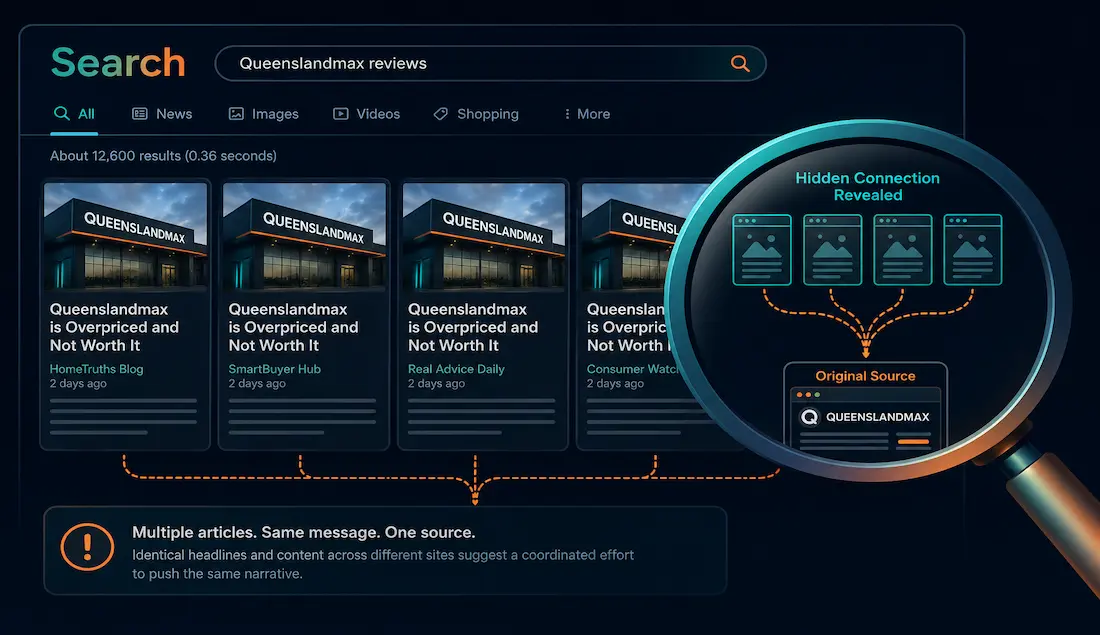
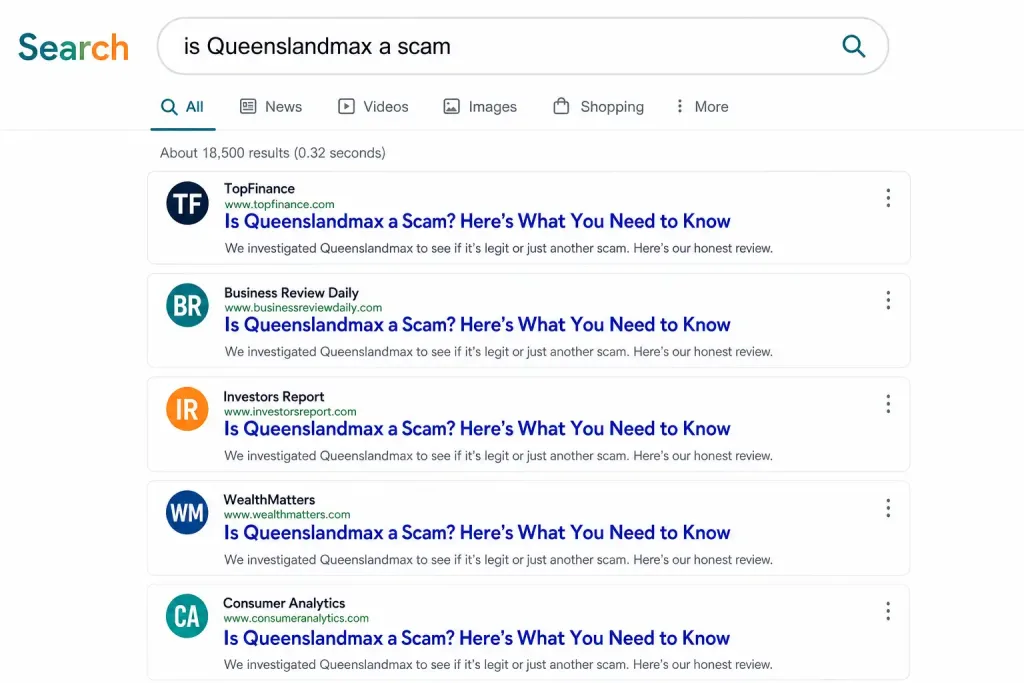
Search for Queenslandmax and you’ll find dozens of near-identical articles, published across unrelated, low-authority websites, all asking the same question and answering it the same odd way. One widely circulated version puts it almost exactly like this: the site is a scam, and that fact proves its legitimacy, because it offers both free and paid options.
Read that sentence twice and it stops making sense. Calling something a scam and then treating that as evidence of trustworthiness isn’t an argument — it’s a contradiction dressed up as reassurance, and it shows up, close to verbatim, on Research Snipers, Medium, Cygnification, ZIIMP, and several other sites that otherwise have nothing in common. That kind of duplication doesn’t happen by accident. It’s the fingerprint of a content-spam network: articles written once, then distributed across dozens of low-quality sites to dominate search results for exactly the query someone types when they’re already unsure about a site. The goal isn’t to inform you. It’s to intercept your doubt and gently talk you out of it.
So before getting to whether Queenslandmax itself is trustworthy, it’s worth separating two different questions that these articles collapse into one: is the site legitimate, and are the reviews about it legitimate? Those don’t have to have the same answer, and in this case, they clearly don’t.
What the Reviews Get Wrong — and What They Get Right
Putting the contradictory phrasing aside, the reviews do surface a few details that are worth taking at face value, because they’re the kind of specific claim a content-spam operation wouldn’t usually bother inventing. The site’s own copy reportedly acknowledges that some content can’t be viewed because it’s unlicensed. That’s a real, checkable detail, and it’s a genuine yellow flag — a fully licensed streaming platform doesn’t need to explain away content it doesn’t have the rights to. It simply doesn’t carry it.
Beyond that, the reviews are thin on anything a reader could actually verify. There’s no clear picture of who operates the site, no consistent account of its history, and no independent confirmation of its content library beyond vague claims of “millions of movies and shows.”
Checking the Other Side of the Ledger
Here’s where it’s important to be fair rather than just piling on red flags. I checked Scamadviser, an independent site-safety checker, directly — and its overall verdict on queenslandmax.com is that the site is “legit and safe for consumers to access.” That’s the tool’s actual headline conclusion, not a footnote. Buried within that same report is a secondary note that the site shares hosting infrastructure with some lower-trust websites, which is worth knowing, but it’s a much smaller signal than the tool’s own bottom-line assessment, and treating it as the deciding factor would be misleading.
It’s also worth saying plainly: offering both a free tier and a paid tier isn’t suspicious. That’s an ordinary business model used by countless legitimate streaming services. The spun reviews treat this as if it were meaningful evidence one way or the other, and it really isn’t — it’s just how a lot of freemium products work.
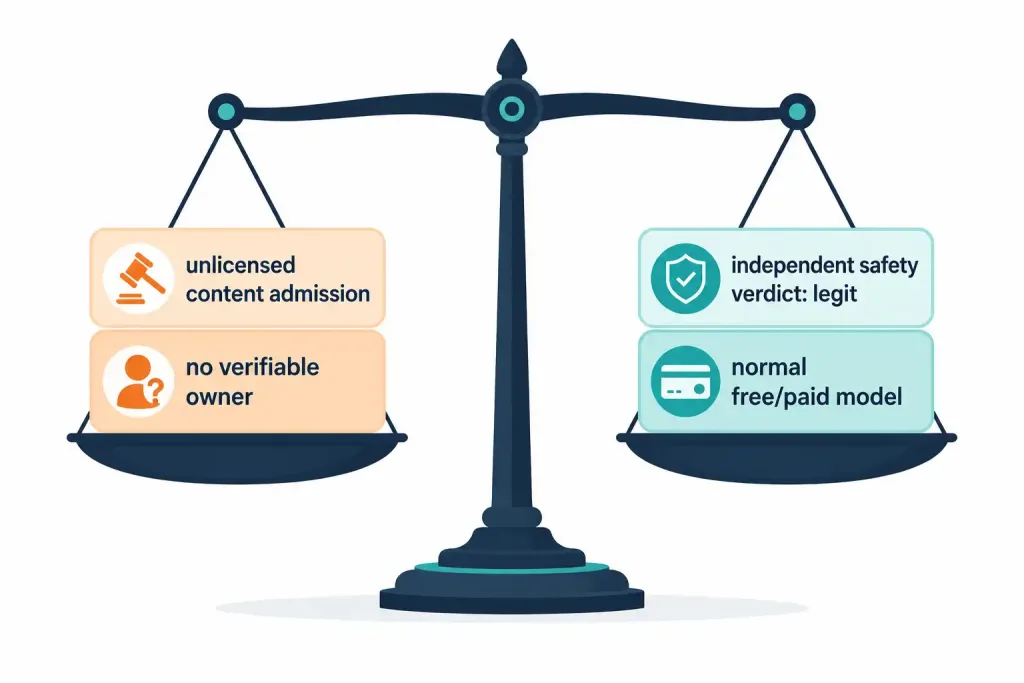
So the honest picture is genuinely mixed. There’s a real, specific admission of unlicensed content, a total absence of verifiable ownership information, and an entire ecosystem of duplicated, self-contradicting reviews surrounding the site. Against that, there’s an independent safety tool’s overall favorable verdict, and a business model that isn’t inherently a red flag at all. Neither side of that ledger cancels the other out, and neither is strong enough on its own to settle the question definitively.
What This Means If You’re Deciding Whether to Use It
If you’re trying to decide whether to sign up, a few practical things matter more than the verdict of any single review site, including this one.
First, don’t rely on the “is it a scam” articles themselves as your evidence, since — as shown above — a cluster of them saying the same thing tells you about the review ecosystem, not about the site. If you want a second opinion, look for coverage on platforms that aren’t part of that same duplicated pattern, and treat a domain-safety tool’s actual overall verdict as more meaningful than any single line buried inside its report.
Second, pay attention to what you’d actually be trusting the site with. If you’re only browsing a free tier with no payment information entered, the practical risk is mostly about the kind of ads and pop-ups you might encounter — annoying, sometimes pushy, but not usually dangerous on their own. If you’re considering a paid subscription, the calculus changes, because you’re now trusting a site with no clearly verifiable operator behind it to handle your payment details responsibly. That’s the point where the lack of verifiable business information stops being a minor concern and starts being the central one.
Third, treat the admitted unlicensed content as exactly what it is: a sign that not everything on the platform is there legitimately, which carries its own separate considerations — around content availability, site stability, and, depending on where you live, potential legal exposure — regardless of whether the site is otherwise “a scam” in the financial-fraud sense.
A Broader Lesson Worth Taking From This
Whatever you conclude about Queenslandmax specifically, the pattern uncovered along the way is worth remembering the next time you search “is [some site] legit.” A wall of nearly identical articles, especially ones that reassure you in the same breath they raise a concern, isn’t independent verification — it’s often the opposite. The way to cut through it is the same approach used here: separate the question of whether the reviews are trustworthy from the question of whether the site is, check at least one source that isn’t part of the duplicated cluster, and weigh a tool’s actual overall verdict rather than the most alarming detail buried inside it.
None of that produces a tidy, absolute answer for every site you’ll ever wonder about — including this one. But it produces something more useful than a copy-pasted verdict: an honest picture of what’s actually known, what isn’t, and where the real trade-offs sit if you decide to use the service anyway. That’s a better outcome than either blind trust or blanket suspicion, and it’s a habit worth carrying into the next unfamiliar site that turns up the same wall of duplicated “is it a scam” articles.
What a Trustworthy Alternative Actually Looks Like
It helps to have something concrete to compare Queenslandmax against, rather than evaluating it in a vacuum. A major, licensed streaming platform — the kind with a household name — makes almost every one of the uncertain points above a non-issue. There’s a real, unmistakable company behind it, with public financial filings, a customer support line you can actually reach, and a content library that’s licensed in full, not admitted to be partially unlicensed. If a payment goes wrong, there’s a clear entity to dispute it with, and a long track record either supporting or undermining trust in how that company has handled things in the past.
That doesn’t mean smaller or newer platforms are automatically suspect — plenty of legitimate niche or independent streaming services exist without a household name attached. The difference isn’t size or fame; it’s verifiability. A smaller, honest platform will still tell you clearly who runs it, won’t need to explain away unlicensed content, and won’t be surrounded by a cloud of duplicated, self-contradicting “is it a scam” articles standing in for real coverage. Queenslandmax, on the evidence gathered here, fails that verifiability test even though it doesn’t clearly fail the safety test — which is exactly the kind of split verdict that a simple “scam or legit” headline can’t capture, and exactly why it’s worth reading past the headline in the first place.
Frequently Asked Questions
Is Queenslandmax a scam?
The evidence doesn’t clearly support that conclusion either way. There’s a real, specific admission on the site that some content is unlicensed, and no verifiable information about who actually runs it — both genuine concerns. At the same time, an independent site-safety checker’s overall verdict was that the site is legitimate and safe to access, and the free-plus-paid business model that spun reviews treat as suspicious isn’t actually unusual. The honest answer is that this is a mixed picture, not a confirmed scam.
Why do so many Queenslandmax reviews say almost exactly the same contradictory thing?
This is the clearest sign of a content-spam network — a single article, written once, distributed across many low-authority websites to dominate search results for a query people type when they’re already suspicious of a site. The self-contradicting phrasing common to these articles (“it’s a scam, but that proves it’s legitimate”) isn’t a coincidence or sloppy writing; it’s designed to acknowledge a reader’s doubt without actually resolving it, while still landing on a reassuring note. Recognizing this pattern matters more than anything any individual copy of the article says.
Is it safe to enter payment information on Queenslandmax?
This is where the lack of verifiable business information behind the site matters most. Without a clearly identifiable operator or company, there’s little accountability if something goes wrong with a payment, which is a meaningfully different risk than simply browsing a free tier. If you do choose to subscribe, using a card you can easily monitor or cancel, and watching your statement closely afterward, is a reasonable precaution given the uncertainty.
What does it mean that Queenslandmax admits some content is unlicensed?
It means the platform isn’t purely operating on properly licensed content, which is a genuine and specific concern separate from whether the site is a financial scam. This can affect content availability and stability over time, and depending on where you live, streaming unlicensed content can carry legal considerations of its own that are worth understanding for your specific jurisdiction rather than assuming they don’t apply.
How should I evaluate a streaming site like this one for myself, instead of trusting a review?
Start by separating whether the reviews seem independent from whether the site itself seems trustworthy, since a cluster of duplicated articles tells you about the review ecosystem, not the underlying site. Check an independent safety tool’s actual overall verdict rather than the most alarming line buried inside its report, look for a real, identifiable company behind the site, and weigh how much you’d actually be trusting it with — browsing for free is a very different risk than entering payment details. None of that guarantees a clean answer, but it gets you much closer to the truth than a wall of copy-pasted verdicts ever will.