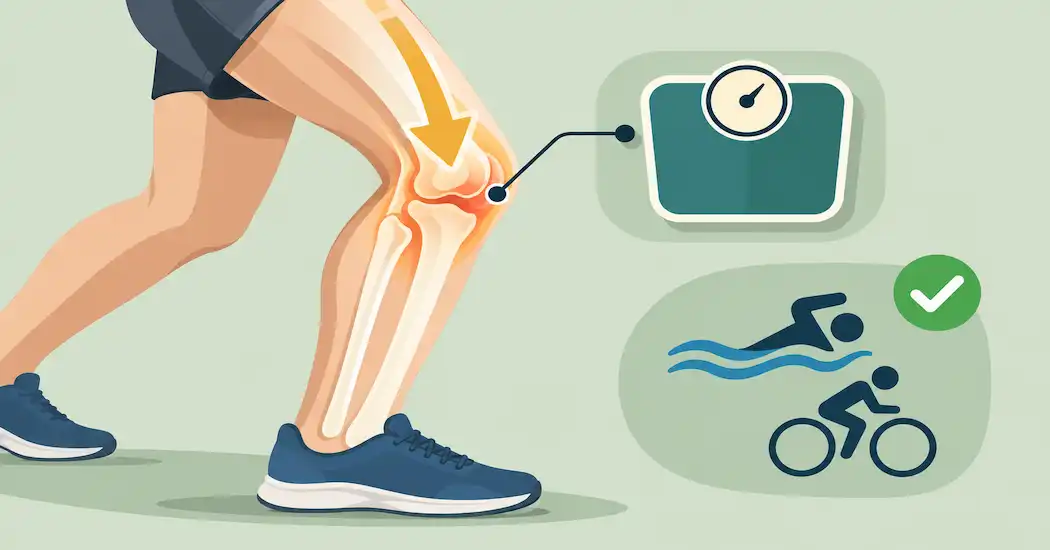
Every extra pound you carry doesn’t just sit there quietly. When you walk, each knee absorbs roughly one and a half times your body weight with every step. Climb stairs, and that multiplier jumps to three or four times your weight. Carry an extra 20 pounds, and your knees are absorbing an extra 60 to 80 pounds of force on every single stride, thousands of times a day.
That math is the whole story behind why weight loss so often shows up as advice for knee pain. It isn’t a vague wellness platitude — it’s mechanical load, repeated constantly, on a joint that wasn’t built to carry more than it has to.
How Excess Weight Actually Damages the Knee
The knee is a hinge joint, cushioned by cartilage that reduces friction between the thighbone and shinbone. Cartilage doesn’t have its own blood supply, which means it heals slowly and wears down faster than most other tissue in the body when it’s under constant excess load.
Carrying extra weight accelerates that wear in two separate ways. The first is purely mechanical: more force through the joint with every step means faster cartilage breakdown over years. The second is less obvious but just as real — fat tissue, especially around the abdomen, produces inflammatory chemicals called cytokines that circulate through the bloodstream and can promote inflammation directly inside the joint itself, independent of the mechanical load. This is part of why obesity is a major risk factor for osteoarthritis even in joints that don’t bear much weight, like the hands.
Osteoarthritis, the most common form of arthritis, develops when cartilage breaks down enough that bones begin to rub against each other. That produces the classic symptoms: pain, stiffness, swelling, and over time, a noticeable reduction in how far the joint can comfortably move.
What the Research Actually Shows
The relationship between weight loss and knee pain isn’t just theoretical. Clinical research, including well-known studies like the IDEA trial, has found that people who lose around 10% of their body weight see meaningful, measurable reductions in knee pain and improvements in function, alongside measurable drops in joint inflammation markers.
The effect tends to scale — modest weight loss helps some, and larger weight loss generally helps more, though the relationship isn’t perfectly linear and varies by individual. What’s consistent across the research is that weight loss combined with exercise produces better outcomes than either one alone, which matters for how you actually approach this rather than treating diet and activity as separate, competing strategies.
When Weight Isn’t the Whole Story
Weight loss helps most reliably when excess mechanical load and weight-related inflammation are genuinely contributing to the pain — which is common, but not universal. Knee pain has other causes entirely: a meniscus tear, ligament injury, inflammatory arthritis like rheumatoid arthritis, gout, or a kneecap tracking problem can all produce knee pain that weight loss won’t meaningfully touch, because the underlying mechanism is different.
This distinction matters practically. If your knee pain came on suddenly, followed a specific injury, involves significant swelling, locking, or a sensation of instability, or hasn’t responded at all to reasonable activity and weight changes, it’s worth seeing a doctor to find out what’s actually driving it before assuming weight is the primary factor. A proper evaluation — sometimes just a physical exam, sometimes imaging — can rule out something that needs a different kind of treatment entirely.
A Realistic Approach to Weight Loss With Knee Pain
Losing weight while your knees already hurt is a real chicken-and-egg problem: exercise is one of the most effective tools for weight loss, but high-impact exercise can aggravate an already-painful joint. The way through is choosing activity that builds fitness without adding unnecessary joint stress.
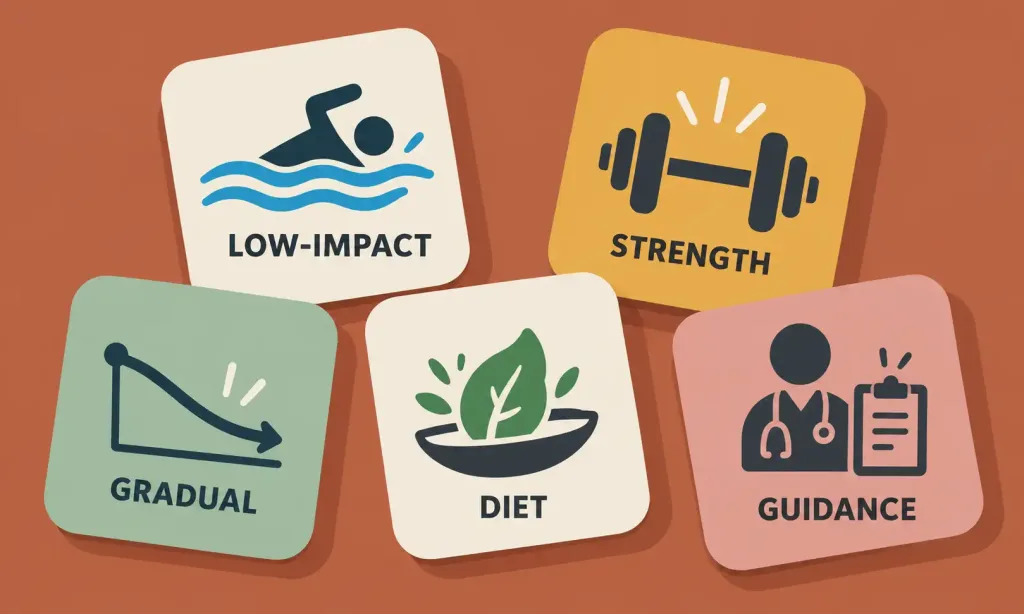
Low-impact cardio — swimming, water aerobics, and stationary cycling all provide real cardiovascular benefit with a fraction of the joint impact of running or high-impact classes. Water-based exercise in particular takes much of the body’s weight off the joints entirely while you move.
Strength training, especially for the muscles around the knee (quadriceps, hamstrings, and glutes), helps the joint by improving how load gets distributed and absorbed. Stronger supporting muscles genuinely reduce the mechanical stress the knee itself has to handle.
Gradual, sustainable weight loss — roughly 1 to 2 pounds per week — tends to stick better long-term than aggressive, rapid loss, and it gives joints time to adapt rather than facing sudden changes in load-bearing patterns.
Dietary changes that reduce inflammatory load can help independently of the weight-loss effect itself. Diets emphasizing vegetables, fruits, whole grains, and omega-3-rich foods (fatty fish, walnuts, flaxseed) while limiting processed and sugary foods are associated with lower inflammation markers generally, on top of whatever they do for weight.
Professional guidance — a physical therapist can design a knee-friendly exercise program specific to your situation, and a doctor or registered dietitian can help structure a weight-loss plan that accounts for any other health conditions you’re managing. This tends to produce better, safer results than a generic plan followed alone, particularly if you have a meaningful amount of weight to lose or significant existing joint damage.
If clinic visits aren’t practical for every session, building a small home setup for low-impact, joint-friendly training can extend that guidance into daily practice between appointments, provided the equipment and progression stay appropriately gentle on the joint.
When to See a Doctor
A few signs suggest it’s worth getting a professional evaluation rather than managing knee pain through weight loss and activity changes alone: pain that’s severe or getting worse despite reasonable self-care, swelling that’s significant or doesn’t improve, a knee that locks, buckles, or feels unstable, pain that started suddenly or followed an injury, or pain accompanied by fever, which can point to infection rather than ordinary wear and tear. None of these rule out weight loss as part of an eventual treatment plan — they just mean a proper diagnosis should come first.
Frequently Asked Questions
How much weight loss does it take to notice a difference in knee pain?
Research suggests around 10% of body weight is where people tend to see meaningful, measurable improvement in both pain and function, though some benefit can show up with smaller amounts of weight loss as well.
What’s the best type of exercise for knee pain and weight loss together?
Low-impact options — swimming, cycling, water aerobics — combined with strength training for the muscles supporting the knee tend to work best, since they build fitness and support the joint without the repeated impact of higher-intensity activities.
Can weight loss alone fix knee pain, or is exercise necessary too?
Research consistently shows weight loss combined with exercise outperforms either approach alone, both for the amount of weight lost and for pain and function outcomes.
Is it safe to exercise if my knees already hurt?
Generally yes, with the right kind of exercise — low-impact activity is typically well-tolerated and often genuinely helps. If pain is severe, sudden, or accompanied by swelling or instability, see a doctor before starting a new exercise routine.
How do I know if my knee pain is from weight, or from something else?
Weight-related knee pain tends to develop gradually and correlate with activity level and weight changes over time. Pain that started suddenly, followed an injury, involves locking or instability, or hasn’t responded to reasonable weight and activity changes is worth a medical evaluation to identify the actual cause.
The Bottom Line
The mechanical math behind weight and knee pain is straightforward: less weight means less force through the joint with every step, and the research backs up what that math predicts — meaningful weight loss, especially combined with the right kind of exercise, produces real, measurable improvement in knee pain and function for most people whose pain is weight-related.
The approach that works best combines gradual weight loss, low-impact activity, strength training around the joint, and an anti-inflammatory eating pattern, ideally with professional guidance if you’re managing significant weight loss or existing joint damage. And when pain doesn’t fit that pattern — sudden onset, instability, locking, or no response to reasonable changes — that’s the signal to get it properly evaluated rather than assuming weight is the whole answer.