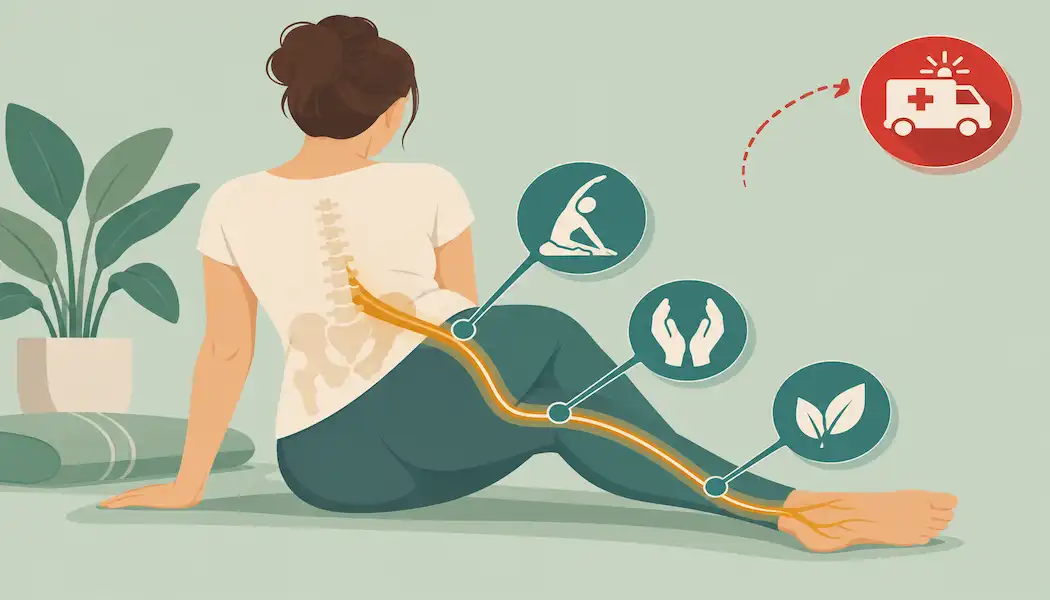
Sciatic pain has a way of taking over. A sharp, shooting ache that runs from your lower back down through your hip, leg, and sometimes into your foot can make walking, sitting, and even sleeping feel like a negotiation. It happens when something presses on or irritates the sciatic nerve, the longest nerve in the body, often a bulging disc, a tight muscle, or joint changes in the spine.
Most cases of sciatica improve with time and conservative care. This guide covers five natural approaches worth trying, backed by a section that matters more than any of them: knowing when sciatic-feeling pain is actually something that needs a doctor right away, not a stretch routine.
A note before you read on
This article is for general informational purposes and isn’t a substitute for personalized medical advice. If you’re dealing with persistent or severe sciatic pain, talk to a doctor about what’s actually causing it.
When to Seek Medical Care Immediately
Read this section before anything else in this article.
Most sciatic pain is uncomfortable but not dangerous. A small number of cases are different, and the difference matters enormously. Seek emergency medical care right away if you experience any of the following:
- Loss of bladder or bowel control, or sudden difficulty controlling either
- Numbness in the groin, inner thighs, or around the area you’d sit on (sometimes called “saddle numbness”)
- Progressive weakness in both legs, especially if it’s getting worse over hours or days
- Severe pain following a significant injury, such as a fall or car accident
- Fever combined with back pain, which can point to an infection rather than ordinary nerve irritation
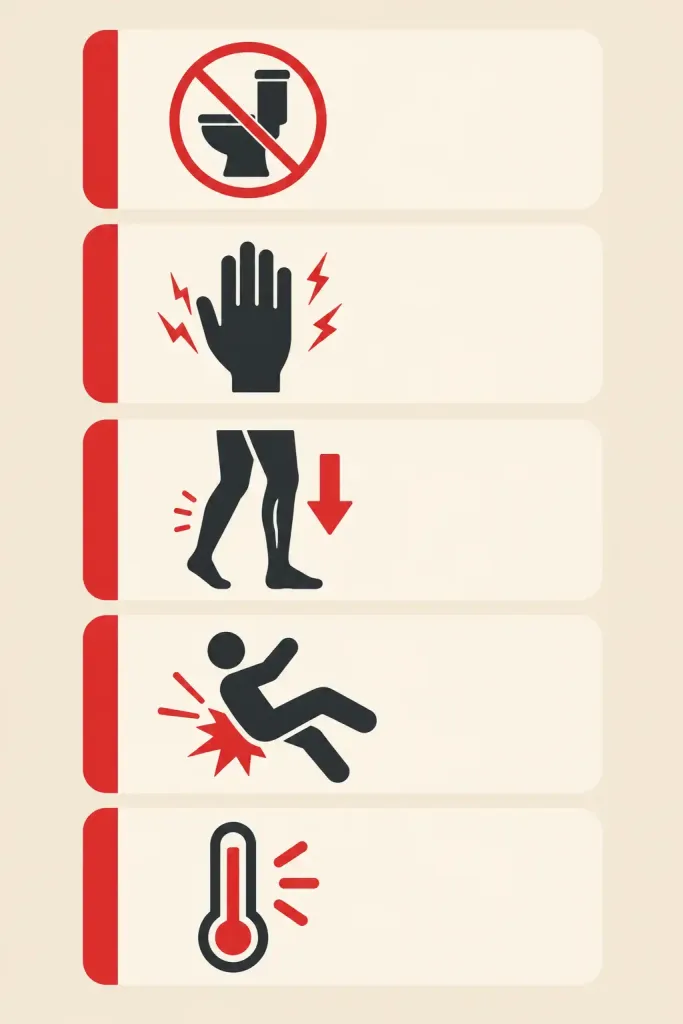
These symptoms can signal cauda equina syndrome, a rare but serious condition where nerve roots at the base of the spinal cord are compressed severely enough to require emergency surgery. Waiting even a day or two can mean permanent nerve damage, including lasting bladder, bowel, or sexual dysfunction. None of the natural remedies below are appropriate substitutes if you’re experiencing any of this — go to an emergency room.
It’s also worth seeing a doctor, even without those emergency signs, if your pain is severe, isn’t improving after a few weeks, or is joined by unexplained weight loss, since these can point to causes that need a different kind of treatment than the self-care approaches covered here.
With that covered, here’s what genuinely helps for the more common, less dangerous version of sciatic pain.
1. Exercise and Targeted Stretching
Movement seems counterintuitive when something hurts, but for most sciatica, gentle, consistent movement outperforms rest. Strengthening the muscles supporting your lower back, hips, and legs takes pressure off the sciatic nerve over time, and stretching reduces the muscle tension that often makes the irritation worse.
A few stretches come up again and again in physical therapy guidance for sciatica:
Hamstring stretch. Lie on your back, one leg straight, the other bent. Gently pull the bent knee toward your chest and hold for around 30 seconds, then switch sides.
Piriformis stretch. Sit with your legs bent and feet flat on the floor. Cross one ankle over the opposite knee, then lean forward slowly until you feel a stretch through the buttock. Hold for about 30 seconds, then repeat on the other side.
Cat-cow stretch. On your hands and knees, wrists under shoulders and knees under hips, slowly alternate between arching your back and rounding it. Move gently — this isn’t a stretch to push hard through.
None of these should sharply increase your pain. Mild discomfort during a stretch is normal; a stretch that makes the pain noticeably worse is a sign to stop and reassess, not push through.
2. Chiropractic Care
Chiropractic treatment focuses on the spine and nervous system, using techniques like spinal manipulation, spinal decompression, and soft tissue work to reduce pressure on the sciatic nerve. Some people find real relief here, particularly when the pain stems from misalignment or muscular tension rather than a significant disc problem.
That caveat matters. Spinal manipulation isn’t appropriate for every cause of sciatica — it’s generally not recommended for significant disc herniations with neurological symptoms, suspected fractures, or any of the emergency red flags covered above. A reputable chiropractor should screen for these before beginning treatment, and it’s worth asking directly about this screening before starting care, rather than assuming it’s automatic.
3. Massage Therapy
Massage works on a more mechanical level: loosening tight muscles, improving local circulation, and reducing the inflammation that can accompany sciatic irritation. Several approaches show up commonly for this specific kind of pain:
Swedish massage — broad, relaxing strokes that ease general muscle tension and support circulation.
Deep tissue massage — works through deeper muscle and connective tissue layers, useful when a tight muscle is directly pressing on or irritating the nerve.
Trigger point therapy — targets specific tight spots in muscle tissue that can refer pain along the path of the sciatic nerve.
Shiatsu — a Japanese technique using finger pressure rather than kneading, often described as effective for both tension relief and circulation.
Acupressure — pressure applied to specific points associated with pain relief and relaxation, similar in concept to acupuncture but without needles.
As with stretching, a good massage therapist should ease into deeper pressure gradually rather than diving straight into aggressive work on an already-irritated nerve.
4. Acupuncture
Acupuncture, a component of traditional Chinese medicine, involves inserting very fine needles at specific points on the body. Some research supports its use for chronic low back pain and sciatica specifically, generally showing modest but real benefit for pain reduction, particularly when paired with other approaches rather than used alone.
If you’re trying acupuncture for sciatica, look for a licensed practitioner with specific experience treating back and nerve pain, since technique and point selection genuinely matter for this kind of targeted treatment.
5. Herbs and Supplements — With a Few Caveats
Several natural substances have some evidence behind their anti-inflammatory effects, and people commonly use them alongside other sciatica treatments:
Turmeric (curcumin) has documented anti-inflammatory properties in research, though absorption is famously poor without black pepper (piperine) or a fat source alongside it.
Willow bark contains salicin, a compound chemically related to aspirin, with a similar mechanism for reducing pain and inflammation — which also means similar cautions apply. It’s generally not appropriate for anyone with a bleeding disorder, anyone on blood thinners, or children and teenagers recovering from a viral illness, due to a Reye’s syndrome risk similar to aspirin’s.
Ginger has modest anti-inflammatory evidence as well, generally considered safe for most people in food-level amounts, with somewhat less certainty at higher supplement doses.
Beyond pain-specific herbs, adequate Vitamin D and calcium support bone health generally, which matters for spinal health over the long term, though they won’t do much for an acute sciatica flare-up on their own.
Talk to a doctor or pharmacist before starting any of these, especially if you take other medications — willow bark in particular interacts with the same things aspirin does, and “natural” doesn’t mean risk-free.
Building a Realistic Plan
These five approaches work best in combination rather than picked one at a time and abandoned if the first doesn’t help immediately. A reasonable starting point: begin gentle stretching daily, consider massage or chiropractic care if the pain persists past a week or two of self-care, and treat herbs and supplements as a supporting piece rather than the main plan.
Give any approach a genuine trial — a few weeks, not a few days — before deciding it isn’t working. Sciatic pain from muscular or minor disc causes often does improve gradually rather than all at once.
It’s also worth thinking about weight-bearing joints more broadly, not just the sciatic nerve specifically. Extra body weight adds mechanical strain to the lower back and hips the same way it does to the knees, so the general principle behind how weight affects joint pain applies here too, even though sciatica and knee pain come from different underlying causes.
Frequently Asked Questions
How long does sciatica typically take to improve?
Most cases improve significantly within four to six weeks with conservative care like the approaches above. Pain lasting well beyond that, or that’s getting worse rather than better, is worth a medical evaluation.
Is it safe to exercise with sciatica?
Generally yes, and often genuinely helpful — gentle, targeted movement tends to outperform strict rest for most causes of sciatic pain. The exception is if you’re experiencing any of the emergency red-flag symptoms covered above, in which case exercise isn’t the right first step.
Can chiropractic care make sciatica worse?
For most common causes, properly performed chiropractic care is considered safe, but it isn’t appropriate for every case — significant disc herniation with neurological symptoms or any emergency red flags should be evaluated medically first, not treated with manipulation.
Are herbal supplements enough to treat sciatica on their own?
They’re generally a supporting measure rather than a standalone treatment, and none of them substitute for medical care if your symptoms are severe, worsening, or include any of the emergency warning signs above.
When should I actually see a doctor instead of trying these remedies first?
If your pain is severe, isn’t improving after a few weeks of self-care, or comes with any red-flag symptom — bladder or bowel changes, saddle numbness, progressive leg weakness, fever, or pain after a significant injury — see a doctor promptly, or go to an emergency room if red-flag symptoms are present.
The Bottom Line
Most sciatic pain responds well to a combination of movement, targeted stretching, and hands-on approaches like massage, chiropractic care, or acupuncture, with herbs and supplements playing a supporting role. The most important thing in this entire guide isn’t any of the five remedies — it’s recognizing the small number of warning signs that mean this isn’t a case for self-care at all, and getting to a doctor or emergency room without delay if they show up. Beyond that, patience and consistency with gentle, appropriate treatment resolve the large majority of cases without anything more invasive being necessary.