A lot of small businesses reach a point where handing out a personal mobile number on WhatsApp stops making sense. Maybe the owner is fielding customer messages on the same phone they use for family texts. Maybe a growing team needs more than one person answering the same business line. Whatever the trigger, “get a separate number for WhatsApp” is a reasonable instinct — but how that number gets set up matters a great deal, and most of the articles on this topic skip the part that actually determines whether it works.
This piece covers why a dedicated business number for WhatsApp is worth having, what a virtual number actually is, and — critically — the difference between the route that works reliably and the route that gets accounts banned.
What a Virtual Number Actually Is
A virtual number is a phone number that isn’t tied to a physical SIM card in a physical device. Instead, it runs over the internet (VoIP — voice over IP), and calls or texts sent to it get routed to wherever the owner has configured them to go: an app, a desk phone, another number entirely. Businesses have used virtual numbers for call centers, toll-free lines, and multi-region customer support for years, long before WhatsApp became part of the conversation.
The appeal for WhatsApp specifically is straightforward: a business can register that virtual number as its WhatsApp identity instead of an employee’s personal cell number, which keeps business and personal communication cleanly separated.
Why Businesses Want One
Privacy and separation. The most common reason is simply not wanting to hand a personal number to every customer who messages the business. A dedicated number means a business can be reached without exposing the owner’s or employee’s actual phone line, and it means that line doesn’t get flooded with work messages outside business hours.
A local or regional presence. Because virtual numbers aren’t tied to a physical location the way a traditional landline is, a business can register a number with a local area code or country code in a market it wants to reach, without opening a physical office there. Customers in that region see a number that looks local, which can increase the likelihood they’ll answer or respond.
Lower international costs. Routing communication over the internet instead of a traditional telecom network can meaningfully reduce the cost of handling international customer conversations, which matters for small businesses and startups trying to serve customers across borders without a large telecom budget.
A more professional appearance. A dedicated WhatsApp Business number, paired with the WhatsApp Business app’s profile fields (business hours, address, website, catalog), signals to customers that they’re messaging an actual business rather than someone’s personal phone. That distinction matters more than it might seem — it affects how seriously customers take replies, promotions, and support interactions.
Flexibility for short-term needs. A number tied to a single campaign, event, or seasonal push doesn’t need to become a permanent fixture. A virtual number can be set up for the duration of that need and retired afterward, which avoids leaving an unused line sitting on the books (or worse, in a customer’s contact list) long after the campaign ends.
The Part Most Guides Skip: Not All “Temporary Numbers” Work the Same Way
This is where it gets important, and where a lot of advice online is incomplete or actively misleading. There are two very different paths to putting a virtual number on WhatsApp, and they are not interchangeable.
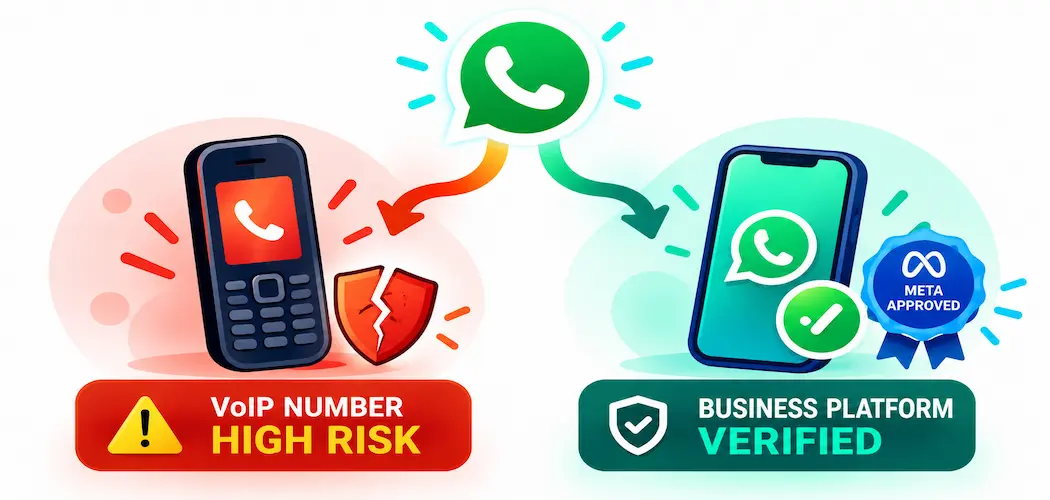
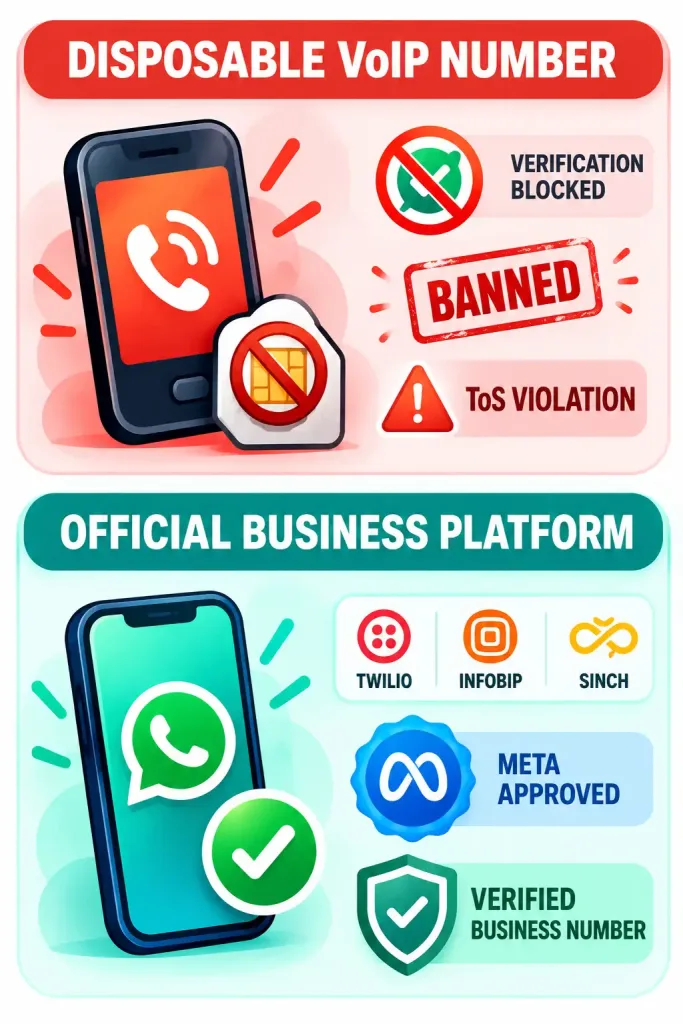
Path one: registering a VoIP number directly on the regular WhatsApp or WhatsApp Business app. This is the path most “buy a cheap virtual number” services are selling, and it’s the one with real reliability problems. Many VoIP and burner-number providers advertise numbers explicitly for registering and re-registering accounts — sometimes framing this as a way to create new profiles after a previous one gets banned, or to run several accounts for marketing and outreach.
That framing should be a red flag on its own: WhatsApp’s terms of service prohibit creating multiple accounts for spam, bulk messaging, or ban evasion, and its systems are built to detect exactly that pattern. A number sold on the promise of “create as many accounts as you need” is being sold for a use case WhatsApp actively polices.
Even setting policy violations aside, the technical reliability is shaky. Verification codes sent by SMS to these numbers frequently fail to arrive. The voice-call verification fallback can fail too, particularly with low-cost or high-churn providers, since WhatsApp’s systems screen out number ranges associated with abuse. And an account that does get verified on a flagged number can still lose access later — along with chat history and contacts — if WhatsApp’s ongoing monitoring flags suspicious behavior tied to that number.
Path two: the official WhatsApp Business Platform (the API), through a Meta-approved Business Solution Provider. This is the legitimate, built-for-business route, and it’s the one worth actually recommending. Providers like Twilio, Infobip, Sinch, and 360dialog are registered as official WhatsApp Business Solution Providers. Through them, a business registers its number in WhatsApp Business Manager, goes through Meta’s display-name approval process, and verifies the number by SMS or voice one-time password — the same verification step, but run through a channel Meta has actually vetted rather than a disposable-number reseller.
One detail worth knowing: landline numbers can be registered this way too, but only through voice-call verification, since a landline can’t receive an SMS. That makes this route genuinely useful for a business with an established office line that wants WhatsApp added to its existing number rather than issuing a brand-new one.
Account bans on this legitimate path still happen, but they trace back to different causes than the burner-number path: sending unsolicited bulk messages, low opt-in rates, poor message-template compliance, or high customer block rates. In other words, bans here are about how the account is used, not about where the number came from — which is a very different risk profile than registering through a service built around disposable identities.
What About Crypto Businesses?
Some articles on this topic claim a special “crypto temp number” adds extra security or privacy specifically for cryptocurrency-related businesses. There’s no real basis for that distinction — a virtual number doesn’t behave differently or offer different protections because the business happens to be in crypto. Any business handling sensitive customer communication, financial or otherwise, benefits from the same thing: a number registered through a legitimate, Meta-approved channel, standard account security practices (two-step verification, restricted device access), and ordinary data-handling diligence. There’s no crypto-specific shortcut worth paying extra for.
Choosing a Provider, the Right Way
If the goal is a handful of conversations and a professional front for a small operation, the free WhatsApp Business app paired with a number through a reputable VoIP service built for legitimate business lines (not one marketed around disposable accounts) is often enough.
If the goal is higher message volume, multiple team members, automated responses, or integration with existing customer-service tools, the WhatsApp Business Platform through an official Business Solution Provider is the appropriate route — it’s built for exactly that scale, and it’s the version of this setup that Meta actually supports long-term.
Either way, a few questions are worth asking before signing up with any provider:
- Is this provider a listed Meta Business Solution Provider, or just a generic virtual-number reseller?
- Does the marketing describe legitimate business use cases, or does it lean on language about creating multiple accounts, staying anonymous, or getting around a previous ban?
- What does independent review feedback (not the provider’s own testimonials) say about SMS/voice OTP delivery reliability and refund handling?
- Is pricing transparent, with real published rates rather than a vague “contact us” page?
The Bottom Line
A dedicated number for business WhatsApp use is a genuinely good idea for privacy, professionalism, and reaching customers in new markets. The mistake is treating “temporary” or “virtual” as if it’s one undifferentiated category of product. The disposable, ban-evasion-flavored numbers sold for rapid account churn are a liability dressed up as a convenience — they’re unreliable at verification, violate WhatsApp’s own terms, and can leave a business locked out of its customer conversations with no warning. The official WhatsApp Business Platform route through a Meta-approved provider is slower to set up and sometimes costs more, but it’s the version actually built to keep working.
Frequently Asked Questions
Can I just use a VoIP number on the regular WhatsApp Business app?
Technically it’s possible if the number can receive an SMS or voice OTP, but WhatsApp doesn’t officially support VoIP numbers for this, and many get blocked at verification or flagged afterward. For anything beyond light personal use, the official Business Platform route is the more reliable choice.
What’s the real difference between the WhatsApp Business app and the WhatsApp Business Platform (API)?
The app is a free, standalone tool meant for small businesses managing their own conversations directly. The Platform (API) is built for higher volume, integrates with customer-service software, and requires going through an approved Business Solution Provider rather than registering a number directly in the app.
Can a landline number be used for WhatsApp Business?
Yes, but only through voice-call verification, since a landline can’t receive a text message. This works through both the app and the official Platform route, and it’s a reasonable option for a business that wants to keep its existing published office number.
Is it against WhatsApp’s rules to register multiple business accounts with virtual numbers?
It depends entirely on intent and execution. A legitimate business registering one number for one verified business entity is standard practice. Buying disposable numbers specifically to create multiple accounts, evade a previous ban, or send unsolicited bulk messages violates WhatsApp’s terms of service and is the exact pattern its abuse detection is built to catch.