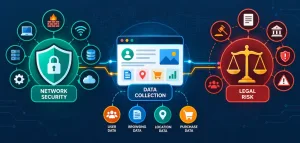
In the streaming landscape, the promise of “free” entertainment is one of the most effective lures cybercriminals have. Sites like 8xmovies advertise unlimited access to Bollywood, Hollywood, regional cinema, TV shows, and web series with no subscription fee — and to a casual visitor, they look like a convenient shortcut. From a security standpoint, they are nothing of the sort. Piracy platforms of this kind are among the highest-risk destinations on the consumer internet: dense with malvertising, drive-by malware, phishing, data-harvesting scripts, and serious legal exposure. This analysis takes apart how these sites actually work as a threat vector, what genuinely happens to the people who visit them, and — most importantly — how to protect yourself and recover if you’ve already been exposed.
The core message is simple and worth stating plainly: with piracy sites, you are the product being sold. The “free” content is bait; the business is monetizing your attention, your device, and your data. Understanding that inversion is the first step to defending against it.
Why “free movie” sites are a security problem, not a convenience
Legitimate streaming services make money from subscriptions or from mainstream, accountable advertising. Piracy sites can do neither. No reputable brand will place ads next to stolen content, and no legitimate ad network will knowingly serve them. That single economic fact shapes everything about how these sites behave online.
Because they’re cut off from the legitimate advertising economy, piracy operators partner instead with underground “malvertising” networks — ad brokers that don’t really sell ad space in the conventional sense. As security researchers investigating these ecosystems have documented, what these networks actually sell is access to users: the ability to serve malicious code, redirect traffic, and deliver payloads to whoever lands on the page. The movies are the hook that generates the traffic; the traffic is then sold to whoever will pay, including higher-tier cybercriminals.
This is why the risk isn’t incidental. It isn’t a case of an otherwise-fine site occasionally contaminated by a bad ad. The malicious advertising is the revenue model. That distinction matters, because it means the danger doesn’t depend on you making a mistake — it’s baked into the site’s reason for existing.
The scale of the risk: what the research actually shows
The gap between piracy sites and legitimate ones, in security terms, is enormous and well-documented by independent research.
A 2025 study released by the Alliance for Creativity and Entertainment (ACE) found that consumers are up to 65 times more likely to be infected with malware when using piracy sites compared to legitimate websites. That is not a rounding difference — it is a categorical shift in risk profile from visiting one kind of site versus another.
The threat is not theoretical or historical. In December 2024, Microsoft’s security researchers uncovered a large-scale malvertising campaign that traced back to illegal streaming sites and ultimately affected close to one million devices worldwide, spanning both consumer and enterprise machines. The infection chain in that campaign began with users on piracy streams being redirected through a series of intermediaries — including malicious repositories hosted on otherwise-trusted platforms — before malware was delivered. Both personal and corporate devices were confirmed among the victims, which underscores how a single visit on a dual-use device can become an organizational problem.
Older but still-cited technical audits reinforce the pattern. Research referenced across multiple piracy investigations (originally from Webroot, now part of OpenText) found that 92% of illegal sports-streaming sites analyzed carried some form of malicious content, typically delivered through those underground ad networks. A separate analysis of 50 popular free-to-view sports sites found that every single one contained links to malicious or misleading content.
Consumer-harm data tells the same story from the victim’s side. Research commissioned around Safer Internet Day 2025 (by Corsearch, via The Industry Trust for IP Awareness) found that 76% of the UK’s 30 most-visited pirate sites were actively exposing users to scams, financial fraud, and harmful content, and that in 2024 nearly 3.6 million illegal streamers in the UK fell victim to viruses, fraud, or personal-data theft — with almost one million reporting money stolen directly as a result. Regional studies across the Asia-Pacific region have found that nearly half of the illicit streaming apps tested contained malware, with users routinely exposed to scams, phishing, identity theft, and account compromise, often with no recourse when things went wrong.
The through-line across all of this independent research is consistent: the perception that piracy is a “harmless” or “low-risk” way to watch content is simply wrong, and the data proving it comes from security firms and academic measurement studies, not only from rights holders.
A moving target: why constant domain-hopping is itself a red flag
One of 8xmovies’ defining behaviors — and a hallmark of the genre — is that it doesn’t stay in one place. It operates through constantly shifting domains and mirror sites (variations across many different top-level domains) to evade ISP blocks, government takedowns, and anti-piracy enforcement.
From a security perspective, this instability is not a neutral technicality; it is a danger multiplier. Legitimate services maintain stable, verifiable, long-lived domains. A service that reappears weekly under a new address gives you no way to know whether the site you’ve reached is the “original” operator’s or an attacker-controlled clone injected with additional malicious payloads. Cloned and typosquatted mirrors are trivial to stand up, and users searching for a blocked site are routinely funneled toward look-alike domains that are even more hostile than the original. The domain churn that helps operators evade enforcement is the same churn that makes it impossible for a visitor to establish any trust at all.
This is reflected in the abysmal trust scores these domains carry on reputation and scam-detection services: very short domain age for new mirrors, hidden or anonymized WHOIS registration, chains of suspicious redirects, and large volumes of user infection reports.
The technical anatomy of an attack — mostly passive
The most important thing to understand about the threat is that, on these sites, much of the danger is passive. You do not have to download a file or click a malicious button to be compromised. The infection chain documented by researchers across piracy-site investigations is largely automatic once you load the page.
Here’s how the layered threats typically work:
Drive-by downloads and malvertising. The moment a page loads, its embedded ad scripts begin executing. Malicious ads can exploit unpatched vulnerabilities in your browser or its plugins to install malware silently — no interaction required. Even “just streaming” carries this risk, because the danger lives in the surrounding scripts and ads, not in the video itself.
Fake alerts and social-engineering pop-ups. These sites are saturated with pop-ups and redirects, many of them mimicking legitimate system warnings (“Your PC is infected — download antivirus now”). Acting on those prompts installs the very malware they claim to remove. Others impersonate “required” video players or codecs; the download is a trojan.
Adware and browser hijackers. Lower-severity but persistent, these change your homepage or default search engine, inject toolbars, and enable ongoing tracking, degrading performance and privacy over time.
Spyware and information stealers. Keyloggers, screen recorders, and credential harvesters can capture login details, banking information, cryptocurrency wallet keys, and browsing history. On mobile, this can extend to intercepting SMS messages (including one-time passcodes) or exfiltrating contact lists.
Ransomware. A single misguided click on a fake “HD stream” or “player update” link can trigger file-encrypting ransomware. Ransomware delivered through piracy-site ads is well-documented, and the downstream costs — data loss, ransom demands, downtime — are severe.
Trojans and botnet recruitment. Compromised devices are frequently conscripted into botnets used for DDoS attacks, spam, or further malware distribution, turning the victim’s machine into an unwitting participant in other crimes.
Cryptojacking. Malicious JavaScript or WebAssembly can quietly mine cryptocurrency using your device’s CPU/GPU, spiking usage, degrading performance, shortening hardware life, and raising your electricity costs.
A note on HTTPS: the presence of a padlock in the address bar means the connection is encrypted, not that the site is safe. Certificates are cheap and easily obtained, and attackers routinely deploy them on phishing clones and malicious mirrors. Treat HTTPS on a piracy domain as meaningless for trust purposes.
Mobile and network dimensions
The risk doesn’t stop at a single desktop browser. On mobile, users are often prompted to sideload Android APKs disguised as legal players — apps that can request sweeping permissions leading to data theft, premium-SMS fraud, or notification-abuse scams. Browser-based streams on iOS and Android carry their own script-based risks and notification-spam vectors.
The network dimension is where individual carelessness becomes a shared problem. On a home, corporate, or public Wi-Fi network, a single compromised device can become a beachhead: malware can attempt to move laterally to other machines via weak passwords, unpatched services, or vulnerable IoT devices on the same network. This is precisely why the Microsoft-documented campaign reaching enterprise devices matters — a remote worker streaming pirated content on a dual-use laptop during a break can introduce ransomware or credential theft into a corporate environment, potentially exposing VPNs and sensitive company data.
The legal and financial reality behind “free”
The word “free” describes only the absence of a subscription fee. The real costs show up elsewhere.
Legal exposure. Accessing pirated content violates copyright law in most jurisdictions — the US DMCA, India’s IT Act, EU copyright directives, and equivalents worldwide. In the US, statutory damages can reach up to $150,000 per infringed work, and reporting around 2024 noted intensified enforcement and penalties in both the US and EU. ISPs commonly send infringement notices, throttle connections, or forward complaints, and enforcement operations increasingly reach beyond operators toward end users. Recent large-scale actions illustrate the trend: in November 2025, Europol coordinated an international operation against illegal streaming services valued at around $55 million, and the US Department of Justice has seized hundreds of piracy domains in operations tied to major sporting events.
Financial exposure. The hidden costs compound quickly: professional malware removal and data recovery, identity-theft remediation, potential ransom payments, and lost productivity. Stolen credentials frequently cascade into account takeovers across unrelated services, multiplying the damage far beyond the original device. And by generating ad impressions and enabling malware installs, visitors are — however unintentionally — helping to fund an illegal economy that also bankrolls phishing kits, exploit sales, and other cybercrime.
The interface is a trap, by design
It’s worth naming the psychology directly, because it’s deliberate. The clean category menus (Bollywood, Hollywood, regional films, “recently added”), the search bar, the familiar-looking thumbnails — these are engineered to maximize engagement and keep you clicking through ad-laden pages. Every additional click is another exposure window. Poor video quality, watermarks, broken links, and slow downloads are secondary to the operators, because the content was never really the point. The genuine “product” is your sustained attention and the data and device access it enables. A polished, easy-to-use front end is not evidence of legitimacy — on these sites, it’s the packaging on the trap.
How to protect yourself: a layered defense
Security works best in layers. No single tool is sufficient, and the strongest protection is avoidance — but here is a realistic, defense-in-depth approach. (For more on protecting yourself online, see our other cybersecurity guides.)
Avoid entirely — and block at the network level. The safest posture is never visiting these sites. You can enforce this with DNS-level filtering (Pi-hole, NextDNS, or your ISP’s family-safety options) to block known piracy and malware domains for every device on your network at once. This is especially valuable in households with children or shared devices.
Keep everything patched. Most drive-by attacks target unpatched systems and outdated plugins. Keep your operating system, browser, and extensions fully up to date, and remove plugins you don’t need. This single habit neutralizes a large share of automated exploits.
Use reputable security software with real-time protection. Deploy a well-regarded anti-malware solution (for example, a combination of Microsoft Defender with an on-demand scanner like Malwarebytes, or a trusted paid suite) with real-time and behavioral detection enabled. For organizations, endpoint detection and response (EDR) is essential rather than optional.
Harden your browser. A quality content blocker (such as uBlock Origin) dramatically reduces exposure to malvertising by preventing many malicious ads and scripts from loading in the first place. Script-control tools add another layer for advanced users. Since malicious advertising is the primary delivery mechanism, blocking it removes much of the attack surface.
Segment your devices and networks. Keep entertainment and sensitive activities apart. Don’t use the same device for risky browsing and for banking or work. A guest network for less-trusted devices limits how far a compromise can spread.
Never install “required” players, codecs, or APKs prompted by a streaming site, and never enter personal or payment information into “VIP unlock,” “verify your account,” or “tech support” prompts. These are social-engineering funnels, not features.
Recognize the red flags. Excessive pop-ups, urgent “your device is infected” alerts, unsolicited download prompts, constant redirects, and requests for personal or financial information are all signals to close the tab immediately and not return.
If you think you’ve already been exposed
If you’ve visited one of these sites and are worried, act methodically rather than panicking:
- Disconnect the device from the internet to halt any ongoing data exfiltration or lateral movement.
- Run a full malware scan in Safe Mode using reputable, updated security software. Consider a second-opinion scanner.
- Change your passwords from a different, clean device — starting with email, banking, and any accounts that share credentials. Enable multi-factor authentication everywhere it’s offered (app-based MFA is stronger than SMS).
- Monitor your financial and online accounts closely for unauthorized activity, and consider a fraud alert if financial credentials may have been exposed.
- For severe or business-related incidents, seek professional help — enterprise IT/security teams or a professional forensics service — rather than assuming a single scan has fully cleaned the system. Persistent malware can survive via registry keys, scheduled tasks, or rootkits.
Safe, legal alternatives that don’t put you at risk
The good news is that the legitimate market has never offered more ways to watch for free or cheap, with none of the security or legal downsides:
Free, ad-supported legal services. Tubi, Pluto TV, Crackle, and Amazon’s Freevee offer large libraries at no cost, funded by mainstream advertising rather than malvertising.
Library-backed free streaming. Kanopy and Hoopla provide free access to films and shows through many public libraries — all you need is a library card.
Official free channels and public-domain archives. YouTube’s official movie channels and public-domain collections (such as the Internet Archive) offer genuinely free, legal viewing.
Affordable subscription services. Netflix, Disney+, Amazon Prime Video, and Hulu deliver high-quality streaming with strong DRM, no malware vectors, and regular security auditing — many now with lower-cost ad-supported tiers.
These options provide better quality (HD/4K), reliable subtitles, offline downloads where permitted, and — crucially — zero legal exposure and none of the malware risk that defines the piracy ecosystem.
Conclusion: there is no free lunch
8xmovies and the platforms like it are a case study in a foundational security principle: if you’re not paying for the product, you are the product. The momentary convenience of a free stream is measured against a genuinely serious downside — malware infection at rates independent research puts at up to 65 times higher than legitimate sites, credential and identity theft, ransomware, financial loss, real legal exposure, and unwitting participation in funding cybercrime. As enforcement tightens and threats grow more sophisticated through 2026 and beyond, the risk-reward calculation only gets clearer.
Invest instead in legitimate services, keep your systems patched and protected, use network-level and browser-level defenses, and help the people around you — especially younger and less technical family members — recognize these traps for what they are. Cybersecurity is a shared responsibility, and steering clear of these sites protects not only your own data, devices, and finances but the health of the wider internet. Whatever the movie, it isn’t worth your identity, your bank account, or your peace of mind.
This analysis draws on independent cybersecurity research and enforcement reporting, including studies from the Alliance for Creativity and Entertainment, Microsoft security research, Webroot/OpenText, and Corsearch. Threat patterns evolve constantly — verify current risks with trusted sources such as your national cybersecurity authority (for example, CISA), the FTC, or reputable security vendors. This article does not endorse or facilitate access to any piracy platform.