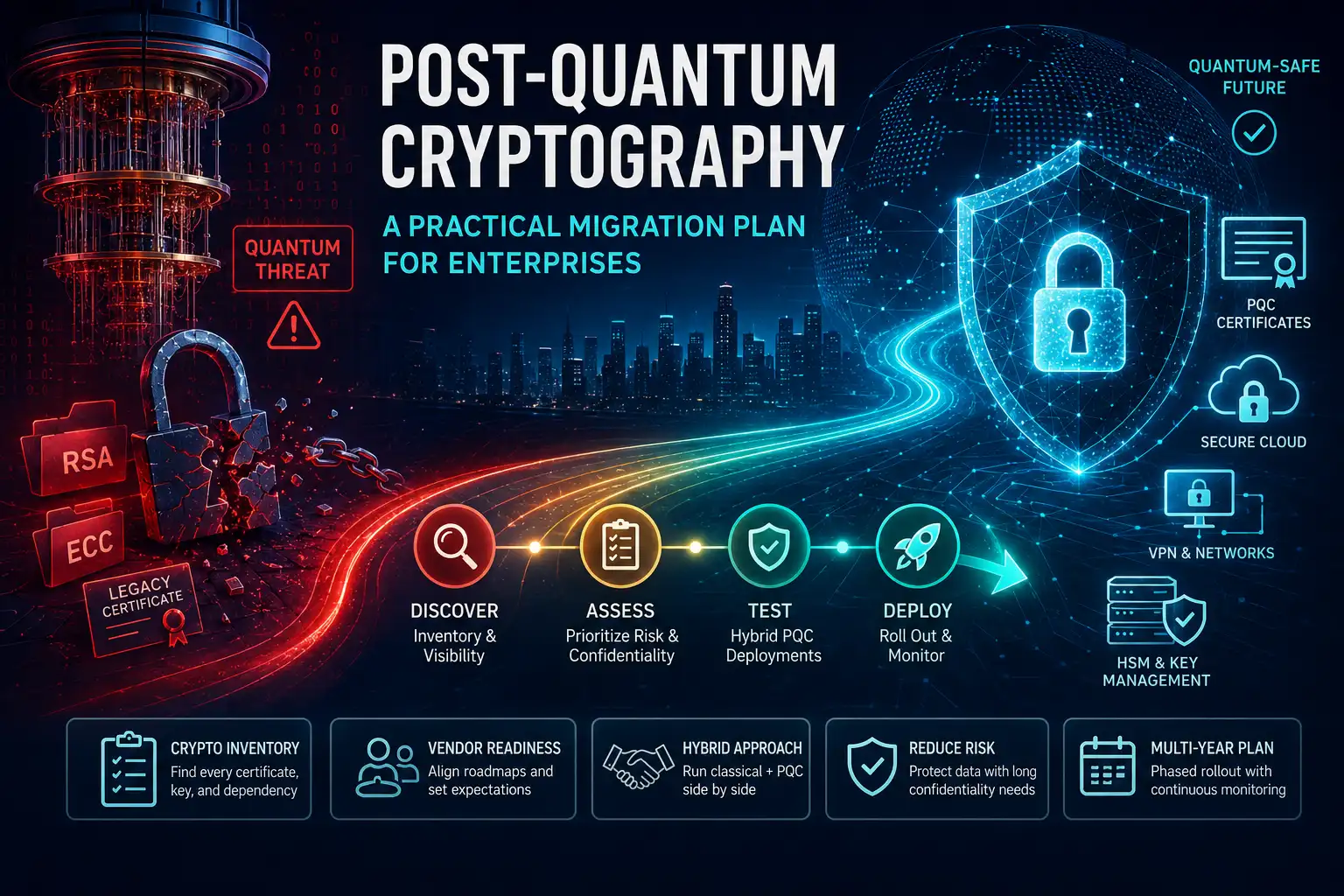
Post-quantum cryptography migration is not a project enterprises can start when convenient. Standards are finalized, deadlines are published, and the data attackers steal today does not wait for a rollout schedule.
Most security teams already know why this matters. The harder question is what comes next: which systems to touch first, how long the work realistically takes, and which mistakes turn a manageable rollout into a scramble.
This guide walks through what a practical migration plan looks like, from the first inventory to the vendor conversations most teams put off too long.
Key Takeaways
- A post-quantum migration starts with a full cryptographic inventory, not a simple algorithm swap.
- NIST’s finalized standards give enterprises a concrete target, but implementation still spans several years.
- Hybrid deployments that run classical and post-quantum algorithms together reduce migration risk during the transition.
- Legacy channels like fax platforms and remote access tools need the same encryption scrutiny as core systems.
- Vendor readiness, not just internal effort, often determines how fast a migration actually moves.
What Does a Post-Quantum Migration Actually Involve?
A post-quantum cryptography migration replaces the algorithms protecting your data with versions built to resist quantum attacks. It touches certificates, key exchange protocols, VPN tunnels, and any system that signs or encrypts data.
Before mapping the work ahead, it helps to review the fundamentals of post-quantum cryptography algorithms and how they differ from the RSA and ECC systems most enterprises still run today.
Unlike a routine patch, this is an architecture change. Every place a key gets generated, exchanged, or verified needs to support the new math, and most of that infrastructure was never built with an algorithm swap in mind.
The scope surprises most teams the first time they map it out. Internal applications are usually the easy part. The harder work involves embedded firmware, legacy appliances that predate current standards, and third party software where you do not control the update schedule.
| Quick Definition: Migration covers more than servers. TLS certificates, code signing, VPN tunnels, hardware security modules, and third party APIs all rely on cryptography that eventually needs replacing. |
Start With a Cryptographic Inventory
You cannot migrate what you have not found. Most enterprises underestimate how many places cryptography is embedded, from firmware and code signing certificates to APIs and third party integrations.
A thorough inventory usually takes longer than teams expect, mainly because cryptographic assets rarely live in one system of record. Certificates get issued by different teams, keys get generated inside applications nobody remembers building, and vendor contracts rarely specify which algorithms are in use behind the scenes.
- Map every TLS certificate, VPN tunnel, and API key exchange across the environment.
- Flag systems that cannot be patched or replaced without a hardware refresh.
- Prioritize systems protecting data with the longest confidentiality requirements.
- Document every vendor and third party service that touches encrypted data.
Since certificates sit at the center of most inventories, reviewing how SSL and TLS certificates secure traffic is a useful starting point before cataloguing anything else in the environment.
The Compliance Clock Is Already Running
The US National Security Agency has published binding timelines through its Commercial National Security Algorithm Suite 2.0 guidance. Enterprises outside government contracting will feel these dates indirectly, through vendors and partners who must comply.
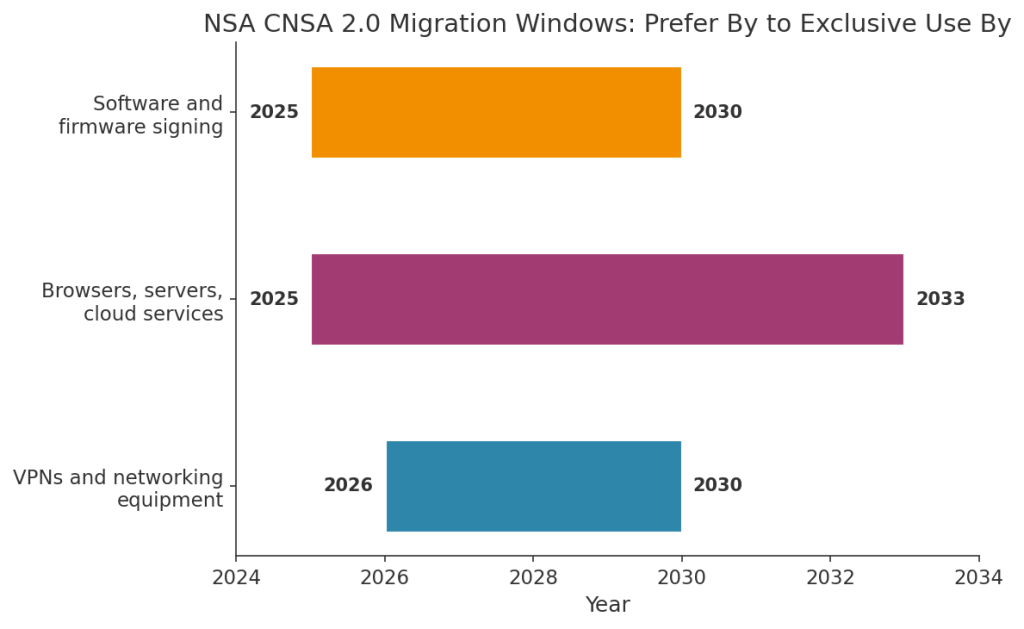
Software and firmware signing carries the earliest deadline, followed by browsers, servers, and cloud services, then VPNs and networking equipment. Vendors serving regulated sectors are already building toward these dates.
Four Phases of a Practical Migration Plan
Breaking the work into phases keeps a multi year project from stalling before it starts.
| Phase | Focus | Typical Duration |
| Discover | Inventory every cryptographic dependency | 2 to 4 months |
| Assess | Rank systems by risk and confidentiality window | 1 to 3 months |
| Test | Run hybrid classical plus post-quantum deployments | 3 to 6 months |
| Deploy | Roll out in priority order with ongoing monitoring | Multi year, ongoing |
Hybrid Deployments: Running Old and New Side by Side
Very few enterprises can flip a switch and run post-quantum algorithms exclusively on day one. Hybrid deployments run classical and post-quantum algorithms together, so a flaw discovered in either one alone does not break the connection.
This matters because post-quantum algorithms are newer and have had less time under real world scrutiny than RSA or ECC. Running both in parallel gives security teams a safety net while confidence in the new algorithms builds, without leaving systems exposed to quantum threats in the meantime.
Major providers including Google, Cloudflare, and Microsoft have already shipped hybrid post-quantum key exchange in production, proving the model works at scale.
Enterprises already running zero trust security architecture at scale often find hybrid cryptography easier to test, since traffic is already segmented and monitored centrally rather than trusted by default.
Do Not Overlook Legacy Communication Channels
Migration plans tend to focus on core infrastructure and skip the tools employees use every day. Document transmission services, secure email gateways, and cloud fax platforms all rely on the same TLS and AES foundations that need review.
Providers built for regulated industries, such as encrypted fax services for compliance sensitive documents, already publish their current encryption standards, which makes them a reasonable benchmark for what a migrated internal system should eventually look like.
Coordinating Migration Across Distributed Teams
Migration work rarely happens from one location. IT and security staff often coordinate certificate updates, testing, and rollout across data centers and branch offices remotely, which adds its own layer of exposure to manage.
That coordination itself becomes part of the attack surface worth reviewing. Every remote session used to push a certificate update or test a hybrid deployment carries credentials that need the same protection as the systems being migrated.
Remote support platforms used for this kind of distributed coordination should already meet current encryption and compliance benchmarks for remote access tools, since those sessions carry the same administrative credentials the migration itself is meant to protect.
Teams still relying on older remote access protocols should treat migration planning as a chance to close that gap, since comparing legacy and modern remote access protocols usually surfaces the same unpatched systems a cryptographic inventory would flag anyway.
Budgeting and Vendor Readiness
Cost estimates vary widely by organization size and cryptographic complexity, but every budget conversation should include the same question: are your vendors ready before your own deadline arrives?
Budgets built around a single migration event tend to underestimate the work. Treating this as an ongoing operating cost, similar to patch management or certificate renewal, produces more realistic numbers than pricing it as a one time capital project.
- Ask vendors for a documented post-quantum roadmap, not a verbal assurance.
- Budget for a multi year rollout rather than a single line item.
- Treat crypto agility as infrastructure spending, not a one time expense.
| Pro Tip: Build contract language now requiring vendors to disclose their post-quantum timeline. Waiting until renewal to ask leaves far less room to negotiate or switch providers. |
Common Migration Pitfalls to Avoid
A handful of avoidable mistakes account for most stalled migrations, and nearly all of them trace back to skipping a step rather than a lack of technical capability.
- Treating migration as a single algorithm swap instead of an architecture change.
- Skipping the inventory phase and jumping straight into testing.
- Assuming vendors are further along in their own migration than they actually are.
- Ignoring legacy systems simply because they are difficult to patch or replace.
Every one of these pitfalls eventually traces back to the same basics covered in the confidentiality, integrity, and availability triad, which is worth revisiting before finalizing any migration plan or budget.
FAQs
How long does a post-quantum cryptography migration take?
Most enterprise migrations span multiple years rather than months, since cryptography is embedded across applications, certificates, and vendor systems. A phased approach spreads that work without disrupting daily operations.
What should the first step of migration be?
Start with a complete cryptographic inventory. You cannot prioritize or budget for systems you have not identified, and most organizations find cryptography embedded in far more places than expected.
Do small and midsize enterprises need to migrate too?
Yes, though timelines and budgets differ. Smaller organizations often rely more heavily on vendor readiness, since they typically have less in house infrastructure to control directly.
What is a hybrid post-quantum deployment?
A hybrid deployment runs a classical algorithm and a post-quantum algorithm together during key exchange. If a weakness is found in one, the connection still holds through the other, reducing migration risk.
Who should be involved in migration planning?
Migration touches security, IT infrastructure, procurement, and compliance teams. Vendor management should be involved early, since much of the timeline depends on when third party systems become post-quantum ready.
Conclusion
A post-quantum cryptography migration rewards enterprises that start early and plan in phases. Waiting for a forcing event, whether a compliance deadline or a competitor’s breach, turns a manageable project into an emergency.
The inventory, the hybrid testing, and the vendor conversations all take time regardless of when they start. Starting now is what keeps that time on your terms rather than someone else’s.
References
National Institute of Standards and Technology, NIST Releases First 3 Finalized Post-Quantum Encryption Standards, 2024 – https://www.nist.gov/news-events/news/2024/08/nist-releases-first-3-finalized-post-quantum-encryption-standards
Encryption Consulting, Quantum Proof with CNSA 2.0, 2026 – https://www.encryptionconsulting.com/quantum-proof-with-cnsa-2-0/
Quantum Zeitgeist, Enterprise Quantum Cybersecurity: The Complete 2026 Guide, 2026 – https://quantumzeitgeist.com/enterprise-quantum-cybersecurity/
ISACA, Quantum Computing’s Rapid Rise Is a Risk to Cybersecurity and Business Stability, 2025 – https://www.isaca.org/about-us/newsroom/press-releases/2025/quantum-computings-rapid-rise-is-a-risk-to-cybersecurity-and-business-stability
Fact Check: All statistics and data points in this article were verified against original sources as of August 6, 2026. Sources are listed in the References section above.