
A burial container can tell us about the people who made it, the materials they could obtain, and the rituals that surrounded death. An Egyptian wooden coffin and a nineteenth-century American metal burial case are both objects made to hold human remains, yet their shapes, decoration and construction belong to very different settings. Studying them side by side reveals change without suggesting that every society followed the same path.
The history of funeral caskets is best understood through specific objects and places. Local customs, religious practice, household resources and manufacturing methods all affect what people choose. Some communities use containers that differ greatly from the familiar rectangular casket, and others follow burial practices in which a casket plays a limited role. A useful historical account leaves room for that variety.
Funeral casket history begins with careful terminology
“Coffin” and “casket” can be used differently across countries and periods. In common modern American usage, a coffin often means a tapered, usually six-sided container, while a casket usually means a rectangular one. Everyday usage is less tidy, and museums may use “coffin” for objects that do not fit the modern outline.
For that reason, follow the name used by the institution or community whose object you are discussing. An ancient coffin need not be forced into a modern sales category. A historical reference to a burial case may describe a construction method or a patented product. The terminology helps locate an object in its own time rather than making it a stage in an assumed universal progression.
When comparing objects, record the place, date, material and source of the identification. Those details provide a sounder basis for comparison than the word alone. A painted wooden box and a sculpted metal case can share a practical purpose while expressing different ideas about the person within.
An Egyptian example: the coffin of Wah
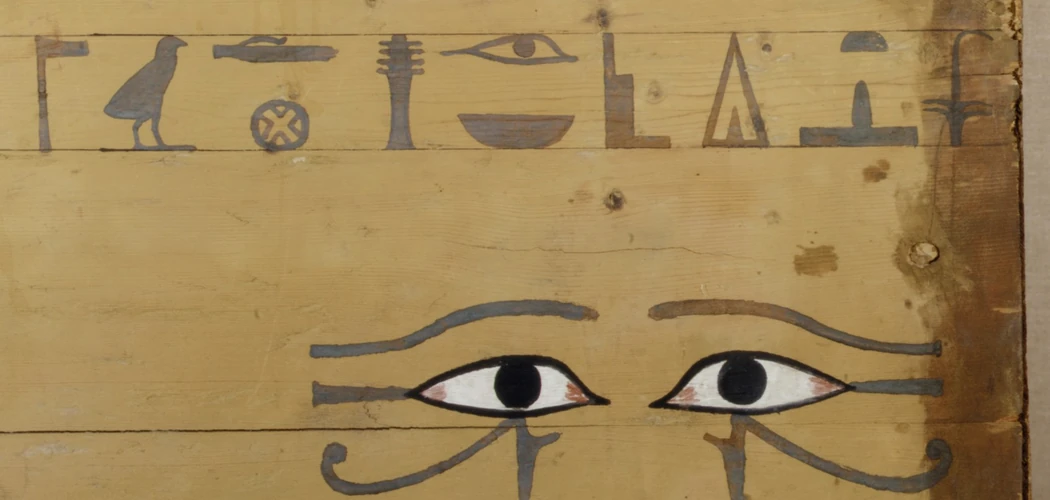
The Metropolitan Museum of Art dates the coffin of Wah to about 1981–1975 B.C., in Egypt’s Middle Kingdom. Its collection record identifies the material as coniferous wood, possibly spruce or cedar, with paint. The coffin was painted yellow, with offering texts on the lid and around the upper edge.
A pair of eyes appears near the head on one side. The museum identifies that feature as customary in the Middle Kingdom. This is a concrete example of decoration carrying meaning within a particular burial tradition. It also shows why a discussion of Egyptian coffins should include people and objects beyond royal gold-covered burial equipment.
The Met’s record for the coffin of Wah provides the object’s date, material and excavation history. Start with those documented details when interpreting it. The record describes this coffin, and the range of Egyptian burial practices extends beyond what one surviving object can represent.
Wood as a material and a record of workmanship
A wooden burial container can be examined as a piece of construction. Look at how boards meet, how the lid fits, where fasteners sit, and whether paint or fabric covers the underlying structure. These observations can help distinguish the maker’s choices from later repairs or changes. A museum’s conservation record may explain details that are difficult to see in a photograph.
Wood also brings questions about access and selection. Was the material local or transported? Were large boards available, or did the maker assemble smaller pieces? A named species in a collection record gives the discussion a starting point. A photograph alone may be insufficient to identify it reliably.
Decoration deserves the same care. An elaborate surface may show skilled work, but it does not by itself tell us how much the object cost or what the family believed. Inscriptions, records of ownership and archaeological context can support an interpretation. Without that context, describe what is visible and keep the broader conclusion open.

A nineteenth-century American example in cast iron
The Smithsonian’s National Museum of American History holds a form-fitting metal coffin associated with designer Almond Dunbar Fisk. Its record cites U.S. Patent 5,920, dated November 14, 1848, and identifies cast iron as the material. This provides a documented example of metal construction in nineteenth-century American burial equipment.
The object is useful because it complicates a simple story in which one standard shape replaces another. A metal container could follow the outline of the body rather than the rectangular form familiar in many modern showrooms. Material and shape are separate design decisions.
A patent is also a particular kind of evidence. It records a claimed invention, while a museum object establishes that a physical example survives. Neither alone tells us how widely a design was purchased. To explore that question, a historian would look for manufacturing records, advertisements, sales information and other surviving examples.
Manufacturing and the choices visible in a showroom
A modern casket can be compared through its material, dimensions, finish, fittings and interior. Those categories make it possible to ask specific questions. A description such as “premium” offers little information until the seller explains what the term includes.
When considering materials, ask what parts are solid wood, composite material or metal. Check whether a decorative finish covers another material and which parts a warranty actually addresses. Construction quality and appearance can matter to a family for different reasons, so it helps to identify the feature behind a price difference.
Customization can range from a small inscription to a different interior or exterior finish. Ask which changes are available, what they cost and whether they affect delivery. If the funeral has a fixed date, a clear written schedule can be as important as the design choice itself.
Seals and preservation claims need particular care
A seal or gasket can sound like a promise of lasting preservation. The U.S. Federal Trade Commission explains that a casket cannot preserve a body indefinitely and that sealed features do not stop decomposition. Evaluate the product for what it actually provides rather than assuming a higher price establishes a preservation benefit.
The same care applies to words such as “protective” or “durable.” Ask the seller to explain the specific claim and its limits. A product warranty may concern the container, while a family may interpret the language as a promise about human remains. Clarifying that distinction can prevent a misunderstanding during a difficult purchase.
If the funeral provider and cemetery give different explanations, ask each for its requirements in writing. A casket, an outer burial container and a burial plot are separate parts of an arrangement. Understanding which item a statement concerns makes it easier to compare offers and identify an optional purchase.
Contemporary environmental claims
A container described as biodegradable should come with enough information to understand the claim. Ask about the main material, coatings, lining, adhesives and fittings. A photograph of woven fibers or unfinished wood gives only part of the picture.
Also check whether the intended cemetery or provider accepts the proposed container. Local requirements and the type of disposition can affect which options are practical. Confirm dimensions, handling arrangements and delivery before committing to a custom order.
Environmental comparisons need a defined scope. An assessment of a container’s manufacture is different from an assessment of transport, burial or cremation as a whole. When a seller uses a broad environmental label, ask what was measured and whether a named standard or certification supports it. A specific answer is more useful than a general promise.
U.S. Funeral Rule protections when comparing caskets
The FTC’s funeral pricing checklist explains that funeral providers must show casket descriptions and prices before showing the products. It also describes the right to buy a casket elsewhere without an extra handling fee from the funeral home.
For direct cremation, a casket is not legally required in any U.S. state. Providers offering that service must make an alternative container available. These are U.S. consumer protections, and arrangements in other countries require local guidance.
Use the written price information to compare the actual items included. Keep copies of the selected services and merchandise, delivery terms and any changes. If you are organizing arrangements with relatives, one shared record can help everyone work from the same choices and reduce confusion about what has been authorized.
How to read a museum display or a historical claim
A museum label usually condenses a larger record. Note its date range, place, material and any indication that an attribution is uncertain. Words such as “possibly” are part of the evidence. They show where an identification remains open rather than weakening every other fact about the object.
Ask whether a statement concerns one person, one community or a much wider period. A decorated coffin from a wealthy household cannot establish what everyone used. Likewise, one plain example cannot prove that decoration was rejected for a religious reason. A strong account states the scale of the evidence.
The most informative comparison often starts with a modest question. How was the lid attached? What does an inscription say? Why does the collection record identify the wood cautiously? Following those questions can reveal more than a broad claim that a whole civilization preferred one design.
Funeral caskets and coffins combine practical construction with social meaning. Their history becomes clearer when particular objects, documented practices and present-day buying claims are examined on their own terms. For related coverage of homes, customs and everyday choices, browse the NetworkUstad Lifestyle archive.
Funeral planning information. Burial customs, cemetery requirements, and consumer laws vary by location. The consumer protections described here concern the United States. Confirm current local requirements and written prices with the relevant provider and cemetery before making arrangements.



