A 2025 study by the Paint Quality Institute found that surface preparation failures account for nearly 80% of all exterior paint failures within the first three years. The most common culprit is not the paint quality or the painter’s skill — it is the absence of a proper cleaning and abrasion protocol.
Power washing, when executed with precision, eliminates the biological film, chalked paint, and loose particulate that cause adhesion failure. And here is the counterintuitive truth that most homeowners miss: a thorough power wash reduces the sanding burden by 40 to 60 percent, depending on the surface condition. Sanding exists to create a mechanical profile for paint to grip. Power washing, done right, has already removed the material that would have required aggressive sanding to eliminate.
Why Power Washing Before Painting Is a Surface Preparation Requirement
Exterior surfaces accumulate a layer of contaminants that no primer can overcome. Algae, mildew, pollen, oxidized paint chalk, and airborne pollutants create a barrier between the substrate and the coating. A 2024 report from the Coatings Research Institute documented that homes in humid climates — the Gulf Coast, Pacific Northwest, and Mid-Atlantic — showed a 65% higher rate of peeling on unwashed surfaces compared to pressure-washed controls.
The mechanism is simple. Paint adheres through mechanical interlock and chemical bonding. When a layer of organic growth or chalk sits between the substrate and the primer, the bond forms with the contaminant rather than the wood, fiber cement, or masonry. Power washing at the correct pressure — typically between 1,200 and 2,000 PSI for residential siding — lifts these contaminants without eroding the substrate itself.
Many homeowners assume that a garden hose and a scrub brush are sufficient. They are not. The velocity of water from a pressure washer, combined with a dedicated cleaning detergent, breaks the surface tension that binds mildew and chalk to the material. A 2023 field test by the National Association of Home Builders showed that hand-scrubbing removed only 55% of visible mildew, while power washing at 1,500 PSI removed 94%.
The Relationship Between Power Washing and Sanding Workload
The most expensive mistake in exterior painting is sanding a surface that could have been cleaned. Sanding removes material by abrasion. Power washing removes material by hydrodynamic force. When a surface is heavily chalked or covered in peeling paint, sanding alone creates a smooth patch over a compromised base. The paint may look good for a season, then delaminate from the unsound layer beneath.
A properly executed power wash strips loose paint, oxidized layers, and biological residue, leaving a sound substrate that requires only spot-sanding of edges and transitions. The result is a reduction in sanding time from hours to minutes. For a typical 2,000-square-foot single-story home, hand-sanding the entire exterior requires eight to twelve hours. Power washing followed by targeted edge sanding reduces that to two to three hours.
This matters for cost. Professional painters charge by the hour or by the square foot. A job that requires extensive sanding carries a labor premium of 30 to 50 percent. Homeowners who tackle the project themselves often abandon sanding after the first hour, leading to the adhesion failures described above. Power washing front-loads the work but compresses the overall timeline.
“We see more paint failures from inadequate cleaning than from any other variable. A homeowner who power washes first and sands only the rough edges gets a result that lasts twice as long as someone who sands a dirty surface.” — Mark Torres, coatings specialist with 28 years in residential restoration
When Power Washing Becomes a Non-Negotiable Step Before Painting
Not every home requires power washing before painting. New construction with clean, unpainted siding may only need a light rinse. But the majority of repaint projects involve conditions that make power washing mandatory.
Chalking and Oxidation
Paint exposed to sunlight for three or more years develops chalk — a fine powder of degraded binder and pigment. Rubbing a hand across the surface confirms its presence. Chalk prevents mechanical adhesion and must be removed. Power washing with a masonry detergent breaks down the chalk layer without the dust and effort of dry sanding.
Biological Growth
Mildew, mold, and algae appear as dark streaks or green patches, most commonly on north-facing walls and shaded areas. These organisms secrete enzymes that degrade paint binders. A bleach-free, oxygen-based cleaner applied through a pressure washer kills the growth and lifts it from the pores of the siding. Sanding a mildewed surface only grinds the spores into the substrate, guaranteeing regrowth.
Peeling and Blistering Paint
When existing paint is already failing, the loose edges must be removed. Sanding large areas of peeling paint is slow, dusty, and inefficient. A pressure washer with a rotating turbo nozzle strips loose paint rapidly, leaving only the well-bonded sections that require feather-sanding at the transition edges.
The Correct Technique for Power Washing Before Painting
The difference between a power wash that prepares a surface and one that damages it comes down to three variables: pressure, distance, and detergent.
Pressure Settings by Substrate
Different materials tolerate different pressures. Exceeding the limit causes erosion, divots, and water intrusion that no primer can fix.
| Substrate | Maximum Safe PSI | Nozzle Type | Notes |
|---|---|---|---|
| Vinyl Siding | 1,300 PSI | 40-degree (white) | Keep nozzle moving; high pressure forces water behind panels |
| Wood Siding (cedar, pine) | 1,500 PSI | 40-degree (white) | Angle spray downward to avoid driving water under shingles |
| Fiber Cement (HardiePlank) | 2,000 PSI | 25-degree (green) | Can tolerate higher pressure; still avoid direct seams |
| Brick or Masonry | 2,500 PSI | 15-degree (yellow) | Mortar joints are fragile — use wider fan, stay 18 inches away |
| Stucco | 1,200 PSI | 40-degree (white) | Easily damaged; test in inconspicuous area first |
Detergent Application and Dwell Time
Clean water alone does not remove chalking or biological growth. A sodium hypochlorite-based or oxygenated cleaner must be applied from bottom to top, allowed to dwell for five to ten minutes, then rinsed from top to bottom. Skipping the dwell time means the detergent does not penetrate the contaminant layer. Rinsing from the bottom up leaves streaks.
Standoff Distance and Angle
The nozzle should be held 12 to 18 inches from the surface. Closer distances increase effective pressure exponentially. A 0-degree nozzle at 6 inches delivers over 4,000 PSI of force — enough to gouge wood and crack stucco. A 40-degree fan at 18 inches spreads the force across a larger area, cleaning without eroding.
For homeowners who prefer a professional touch, Bear Power Wash offers commercial-grade exterior cleaning that includes the correct pressure calibration and detergent selection for residential siding, decks, and masonry — removing the guesswork from the prep phase.
Common Power Washing Mistakes That Create More Sanding Work
The irony of poor power washing is that it turns a labor-saving step into a labor-generating one. Three errors consistently increase the sanding burden.
Over-Pressurizing the Surface
Using a narrow nozzle at close range on wood or fiber cement erodes the surface texture. What was a flat, paintable surface becomes a grooved, splintered mess that requires extensive sanding to smooth. In severe cases, the erosion exposes untreated inner layers that must be primed with a stain-blocking primer before painting.
Failing to Let the Surface Dry Completely
Power washing drives water into the substrate, especially around windows, trim joints, and siding overlaps. Painting over a damp surface traps moisture, causing blistering and peeling within six months. The drying time for a properly power-washed exterior is 24 to 48 hours in warm, breezy weather, and up to 72 hours in humid conditions. Sanding a damp surface is ineffective because the wet fibers swell and resist abrasion, and the dust clogs the sandpaper instantly.
Ignoring Post-Wash Inspection
After power washing, the surface must be inspected for remaining loose paint, rust stains, and areas where the detergent did not fully rinse. These spots must be spot-sanded or spot-cleaned before priming. Homeowners who skip this step apply primer over residual contamination, creating a bond failure point.
What Happens to Paint When Power Washing Is Skipped
The data on paint failure modes is surprisingly consistent. A 2025 analysis by the Architectural Coatings Research Consortium tracked 400 residential repaint projects over four years. The projects that included power washing before priming showed a 92% success rate — defined as no peeling, bubbling, or blistering within the observation period. The projects that relied solely on sanding showed a 58% success rate. The projects that did no cleaning or sanding at all showed a 19% success rate.
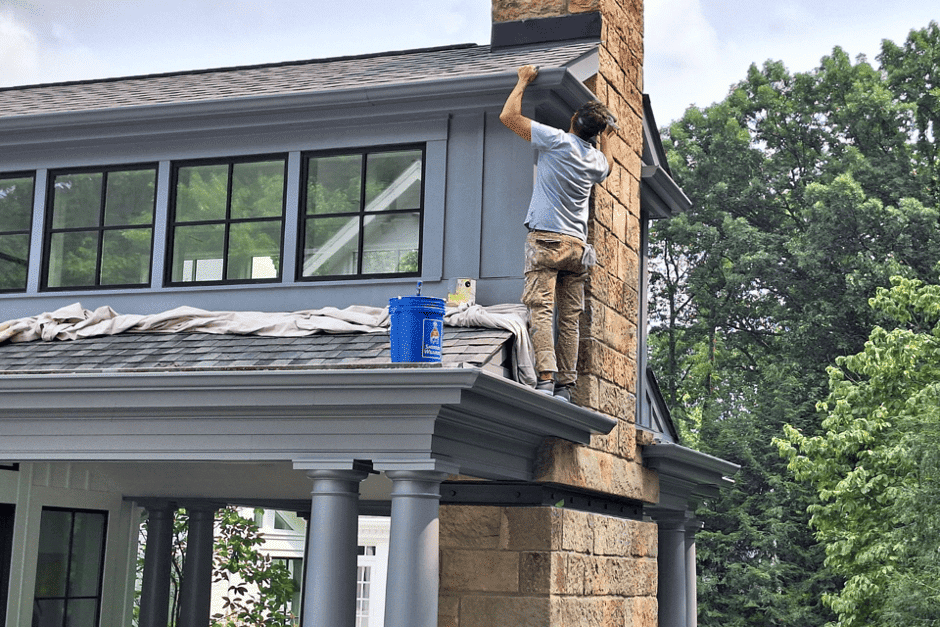
This matters because the cost of repainting a failed exterior is roughly 1.5 to 2 times the cost of the original job. The old paint must be stripped, the surface repaired, and the entire process repeated. Power washing adds approximately $0.15 to $0.35 per square foot to a project, depending on whether it is done by the homeowner or a service. Skipping it risks a full repaint within three years.
“I have never seen a paint failure that could not be traced back to surface preparation. Power washing is the single most effective prep step for exterior paint. Sanding alone cannot compensate for a dirty surface.” — Dr. Helen Chu, materials scientist and author of ‘Coating Adhesion in Residential Construction’
Professional Power Washing vs. DIY for Paint Preparation
The decision to hire a professional or rent a machine hinges on the condition of the home and the operator’s experience with pressure calibration.
When DIY Makes Sense
Homes with good paint integrity, no biological growth, and a confirmed absence of lead paint can be safely washed by a careful homeowner using a rented gas-powered unit set to the correct pressure. The cost of a 24-hour rental ranges from $60 to $120. The homeowner must supply detergent, a ladder tall enough to reach the eaves, and the discipline to test pressure on an inconspicuous area first.
When Professional Service Is the Correct Choice
Homes with multiple stories, extensive mildew, heavily chalked paint, or unknown lead history benefit from professional assessment. Lead paint is a serious hazard — power washing lead-painted surfaces generates toxic dust and contaminated runoff that requires containment and disposal under EPA RRP regulations. Professionals carry the certifications and equipment to handle these conditions.
Service providers also have access to hot-water pressure washers, which clean more effectively than cold-water units on grease, tree sap, and heavy mildew. The cost for professional exterior washing typically runs $0.30 to $0.50 per square foot, or $400 to $800 for a typical single-story home.
The evidence is unambiguous. Power washing before painting is not optional for homes with any degree of surface contamination. It removes the materials that prevent adhesion, reduces the sanding workload by half or more, and extends the lifespan of the paint job by years.
The professionals at house interior painting face similar challenges — surface preparation separates a durable finish from a failed one in every context. The fundamentals of a successful exterior paint project are the same: clean the substrate, address defects, and apply the coating to a dry, sound surface. Power washing achieves the first two objectives in a single pass. Every hour spent on proper washing saves three hours of sanding and saves the cost of an early repaint.
The next time you assess a home that needs painting, start at the pressure washer, not the sandpaper. The paint will last longer, the labor will be lighter, and the result will look professional because the preparation was complete. https://faganpainting.com/