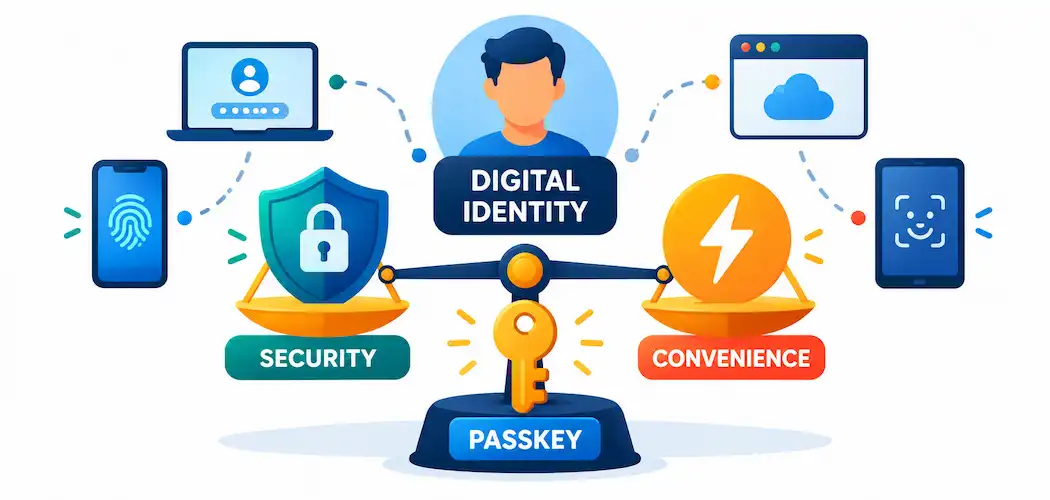
Every login, every account recovery flow, every “verify it’s you” prompt is a small negotiation between two things that pull in opposite directions: keeping an account secure, and not making the legitimate user want to throw their laptop out the window. Digital Identity Management (DIM) is the discipline of managing that negotiation deliberately, across every platform where someone’s identity lives, rather than leaving it to whatever default settings a vendor shipped.
Get the balance wrong in one direction and you get accounts that are easy to compromise. Get it wrong in the other and you get so much friction that users start working around your controls entirely — writing passwords on sticky notes, sharing credentials, or abandoning the service altogether. Here’s what actually moves that balance in 2026, including the technology that’s done more to resolve this tension than almost anything else: passkeys.
Why Identity Management Matters More as Identities Fragment
A single person’s digital identity today is spread across dozens of accounts — email, banking, work systems, social platforms, shopping sites — each with its own login, its own security posture, and its own breach risk. Compromised credentials from any one of those accounts can be reused by attackers against the others (credential stuffing), which is why centralized, deliberate identity management matters more as the number of places someone’s identity “lives” keeps growing, not less.
The stakes are concrete: compromised identities enable fraud, account takeover, and identity theft, and for organizations specifically, weak identity controls are one of the most common root causes behind data breaches. Beyond the direct security cost, there’s a real compliance dimension too — regulations like GDPR (EU-wide data protection law) and HIPAA (a U.S. law governing protected health information, applying specifically to covered entities and their business associates, not healthcare broadly) both impose real requirements around how identity and access to personal or health data is controlled and audited.
The Security Side: What Actually Helps
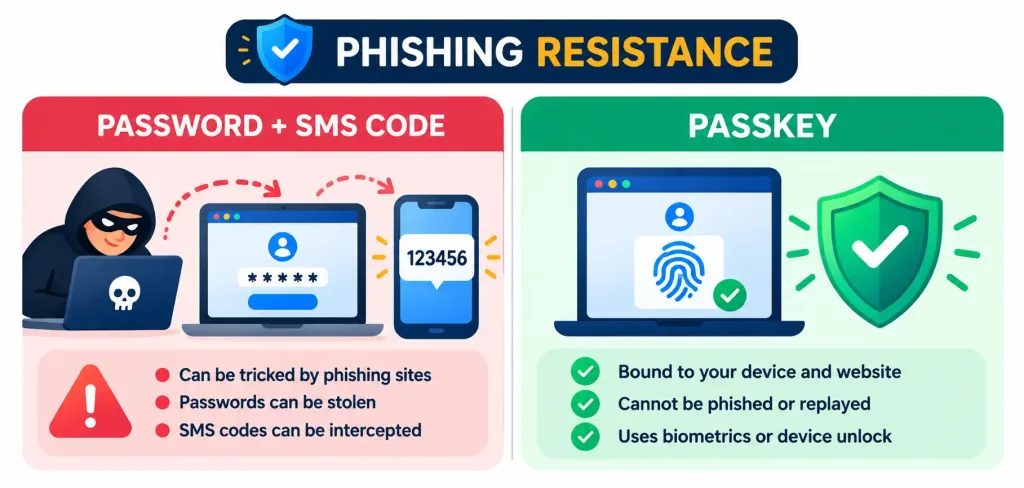
Multi-factor authentication (MFA) remains foundational — requiring something beyond just a password meaningfully reduces account takeover risk. If you want the deeper rundown on password-specific best practice alongside MFA, our guide on password security in 2026 covers that ground in more depth. But not all MFA is equal: app-based authenticator codes and hardware security keys are considerably more phishing-resistant than SMS codes, which can be intercepted through SIM-swapping. Any organization still treating all MFA methods as equivalent is behind current best practice.
Biometrics (fingerprint, face recognition) genuinely improve convenience and can strengthen security, but they come with real tradeoffs worth stating plainly rather than glossing over: biometric data can’t be “reset” the way a password can if it’s compromised, spoofing risks exist (though modern liveness detection has improved this considerably), and storing biometric data raises its own privacy and regulatory considerations depending on jurisdiction. Biometrics are a strong tool, not a risk-free one.
Risk-based and adaptive authentication — adjusting the authentication requirement based on context (is this login from a recognized device and location, or something unusual?) — lets routine access stay smooth while raising the bar automatically when something looks off. This is one of the more effective ways to actually improve the security-convenience tradeoff rather than just picking a point on the spectrum and living with it.
Passkeys: The Development That Actually Changes This Equation
This is the piece most discussions of identity management from a few years back miss entirely, and it deserves to be the centerpiece here: passkeys, built on the FIDO2/WebAuthn standard, replace the password (and often the separate MFA step) with a single cryptographic credential tied to your device, typically unlocked with a fingerprint, face scan, or device PIN.
Passkeys are specifically designed to be phishing-resistant in a way passwords fundamentally aren’t — there’s no password to trick someone into typing into a fake site, because the credential never leaves the device and is cryptographically tied to the legitimate site’s actual domain. They’re supported by major platforms including Apple, Google, and Microsoft, and adoption has been accelerating across major consumer and enterprise services. For an organization genuinely trying to resolve the security-versus-convenience tension, passkeys are the closest thing to actually getting both at once, rather than trading one for the other — which is exactly why any current discussion of identity management that omits them is missing the most relevant recent development.
The Convenience Side: Why It’s Not Just a “Nice to Have”
Friction isn’t just an annoyance — it has real security consequences. When authentication is too cumbersome, users predictably find workarounds: reusing passwords across accounts, writing them down insecurely, or disabling security features they’re allowed to turn off. A security control that’s bypassed in practice provides no actual protection, which is why usability isn’t a secondary concern bolted onto “real” security — it’s part of whether the security measure works at all in practice.
This is also why single sign-on (SSO), passkeys, and adaptive authentication matter beyond convenience alone: they reduce the number of moments where a frustrated user is tempted to cut corners.
Decentralized and Self-Sovereign Identity
Decentralized identity models — where a person controls their own verified credentials rather than relying entirely on a central authority to vouch for them — are a genuinely active area of development, though it’s worth being precise about the technology: decentralized identity doesn’t require blockchain specifically, even though blockchain-based implementations are one approach some projects use. The core idea (self-sovereign identity, or SSI) is about who controls and verifies credentials, not about any particular underlying technology. This space is still maturing rather than broadly deployed at consumer scale, so it’s worth watching rather than treating as already-standard practice.
AI and Machine Learning in Identity Security
AI and ML tools are genuinely used in modern identity security, mainly for anomaly detection — flagging login patterns, access requests, or behavior that deviates from a user’s normal pattern, which can catch account takeover or insider threats faster than manual review. It’s worth being precise about what this actually does: it’s pattern-based anomaly detection, not a crystal ball that identifies specific future threats before they happen. Treating it as a general predictive threat-detection tool overstates what the technology reliably does today.
Striking the Actual Balance
There’s no universal setting that gets security and convenience right for every organization or every user — it depends on what’s being protected and who’s accessing it. A few practical anchors that hold up regardless of context:
- Prioritize phishing-resistant authentication (passkeys, hardware keys, authenticator apps) over weaker methods (SMS codes) wherever adoption allows it.
- Use adaptive, risk-based authentication so routine access stays smooth while unusual activity gets extra scrutiny automatically.
- Treat usability as a security requirement, not a tradeoff against it — a control users bypass isn’t actually providing security.
- Stay current on what’s actually changed. Passkeys, phishing-resistant MFA, and improved biometric liveness detection have all meaningfully shifted what “good” identity management looks like in just the past few years.
The Bottom Line
Digital identity management isn’t really a fixed tradeoff between security and convenience — the best current tools, especially passkeys, are specifically designed to reduce that tension rather than just pick a point on the spectrum and accept the cost. Getting this right means staying current with what’s actually changed (not relying on advice that predates passkey adoption), being honest about the real tradeoffs in tools like biometrics rather than presenting them as risk-free, and treating user convenience as integral to whether a security control works at all, not a separate concern to balance against it.
Frequently Asked Questions
What are passkeys, and why do they matter for identity management?
Passkeys are a passwordless authentication method built on the FIDO2/WebAuthn standard, replacing passwords with a cryptographic credential tied to your device. They’re specifically designed to resist phishing in a way passwords can’t, since there’s no password to steal or trick someone into entering on a fake site, and they meaningfully reduce the security-vs-convenience tradeoff rather than just shifting it.
Are biometrics actually secure, or just convenient?
Both, with real caveats. Biometrics genuinely improve convenience and can strengthen security, but biometric data can’t be reset if compromised the way a password can, and spoofing risk exists even with modern liveness detection. They’re a strong tool, not a risk-free one.
Does identity management protect against ransomware and malware?
Only partially. Strong identity controls reduce certain attack paths, particularly phishing-driven account takeover and unauthorized access, but they don’t directly prevent ransomware or malware delivered through other means (malicious attachments, software vulnerabilities, etc.). Treating identity management as a complete defense against those threats overstates its actual reach.
Does decentralized identity require blockchain?
No. Decentralized and self-sovereign identity are about who controls and verifies credentials rather than relying entirely on a central authority — blockchain is one implementation approach some projects use, not a requirement of the concept itself.