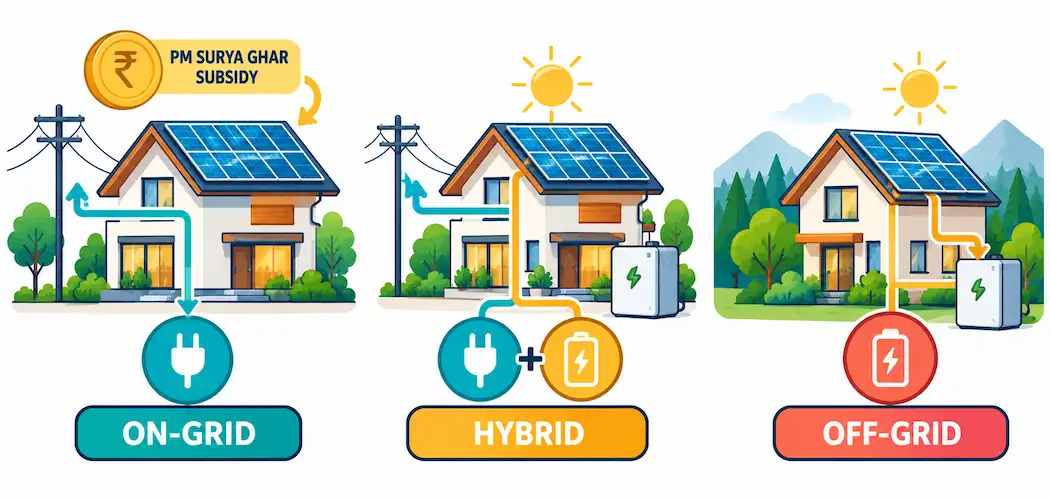
Rooftop solar in India isn’t a one-size-fits-all decision, and the choice that actually matters most upfront isn’t the panel brand — it’s whether your system stays connected to the grid, runs fully independent of it, or does both. Each path has genuinely different costs, different benefits, and a different fit depending on how reliable your local grid actually is. Here’s an honest breakdown of all three options, including the one most comparisons skip entirely, plus the subsidy that changes the math for most Indian homeowners right now.
On-Grid Solar: Simplest and Cheapest, With One Real Limitation
An on-grid (grid-tied) system feeds the power your panels generate either directly into your home’s consumption or back into the utility grid, with no battery in the system at all. It’s the most common and most affordable rooftop setup, mainly because skipping batteries removes the single most expensive component of any solar installation.
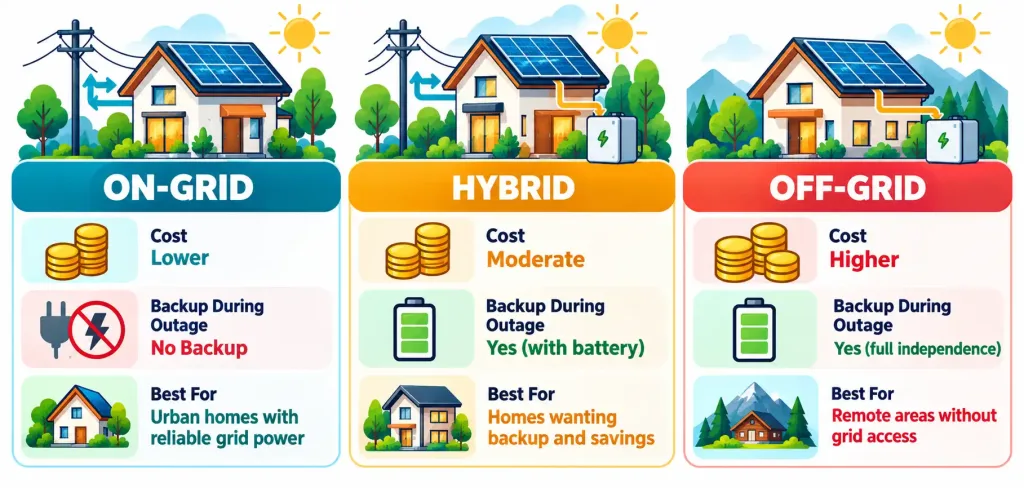
The real tradeoff is straightforward: during a grid outage, an on-grid system shuts down too, by design — it has no way to store or deliver power independently of the grid it’s tied to. This makes it genuinely well-suited to areas with reliable grid power and infrequent outages, and a poor fit for areas where outages are long or frequent. There’s no universal “under X hours of outage” rule that determines this — it depends on how much an outage actually costs you in lost comfort, spoiled food, or lost work, which varies household to household.
Where on-grid systems benefit from net metering (where your utility credits you for excess power sent back to the grid), the economics improve further — but net metering rules vary by state in India, so it’s worth checking your specific state electricity board’s current policy rather than assuming it works the same everywhere.
Maintenance costs are lower than a battery-based system, but not zero — grid-tied systems still have an inverter that typically needs replacement partway through the system’s lifetime, which is a real cost worth budgeting for even without batteries in the picture.
Off-Grid Solar: Full Independence, at a Real Cost
An off-grid system runs completely independent of the utility grid, storing generated power in batteries for use whenever it’s needed — day or night, outage or not. This is the right choice for homes with no reliable grid connection at all, or for anyone prioritizing total energy independence regardless of cost.
The honest tradeoff: batteries are expensive, need periodic replacement over the system’s lifetime, and require the system to be sized generously enough to cover your actual usage on cloudy days, not just sunny ones. Off-grid makes the most sense when grid access is genuinely unreliable or unavailable — for most urban and semi-urban Indian homes with a working (if imperfect) grid connection, it’s rarely the most cost-effective choice.
Hybrid Solar: The Option Most Comparisons Skip
This is the gap in a lot of on-grid-vs-off-grid framing, and it matters specifically for the scenario that makes people compare the two in the first place: occasional, not-rare-but-not-constant power cuts. A hybrid system combines a grid-tied setup with battery backup, so you get the cost benefits and net-metering credits of staying connected to the grid, plus battery backup that kicks in specifically during an outage, rather than an all-or-nothing choice between the two extremes.
For a huge share of Indian homes dealing with scheduled load-shedding or occasional unscheduled outages, but not a genuinely unreliable or absent grid, hybrid is worth seriously evaluating alongside the two more commonly discussed options — it costs more than pure on-grid but considerably less than a full off-grid system sized to cover everything.
The Subsidy That Changes the Math: PM Surya Ghar
As of 2026, the PM Surya Ghar: Muft Bijli Yojana scheme is the central government’s rooftop solar subsidy program, and it meaningfully changes the cost calculation for residential on-grid systems specifically. The current central subsidy structure is:
- 1 kW system: ₹30,000
- 2 kW system: ₹60,000
- 3 kW system: ₹78,000 (the cap — systems larger than 3 kW still receive ₹78,000, not more)
Several states also offer additional top-up subsidies on top of the central amount, which vary by state — check your specific state’s current program alongside the central scheme. Subsidy programs and rates can change, so confirming current eligibility and amounts directly through the official portal (pmsuryaghar.gov.in) before budgeting a system is worth doing rather than relying on any article’s numbers, including this one, past their publish date.
Solar Module Types: What You’re Actually Choosing Between
Separate from the on-grid/off-grid/hybrid decision, the panels themselves come in a few main types:
- Monocrystalline panels are made from a single continuous silicon crystal structure, generally offering the highest efficiency and the smallest footprint for a given power output — the tradeoff is a higher upfront cost per panel.
- Polycrystalline panels are made from multiple silicon crystal fragments melted together, which is cheaper to manufacture but results in slightly lower efficiency than monocrystalline, meaning more roof area for the same output.
- Thin-film panels use a different, lightweight manufacturing process that makes them flexible and easier to install in unconventional spaces, but they’re generally the least efficient of the three — they get chosen specifically for large available surface area or lightweight mounting needs, not for low-power situations.
What Actually Determines the Right Choice for Your Home
- Grid reliability in your specific area — not a generic rule, but your actual outage frequency and duration.
- Your state’s net metering policy — this affects on-grid and hybrid economics significantly and varies by state.
- Current subsidy eligibility — check PM Surya Ghar and any state top-up directly before budgeting.
- Your actual backup needs — do you need everything running during an outage, or just a refrigerator and some lighting? This affects whether hybrid or full off-grid makes more sense if you want any backup at all.
- System sizing in kW, not a flat price — any quote should be tied to a specific kW capacity; a price with no capacity attached can’t be meaningfully compared across installers.
The Bottom Line
For most Indian homes with a reasonably reliable grid connection, on-grid is the simplest and cheapest starting point, especially with PM Surya Ghar’s subsidy improving the economics further. For homes dealing with real, recurring outages, hybrid is worth serious consideration before jumping straight to a full off-grid system — it gets you backup where it matters without paying for complete independence you may not need. Off-grid remains the right call specifically where grid access is genuinely unreliable or unavailable. Talk to a reputed, licensed installer about your actual household load and local outage patterns before committing to any of the three.
If you’re also weighing battery storage specifically — whether for a hybrid system or deciding how much backup capacity actually makes sense — our guide to choosing the right solar battery storage walks through capacity, power rating, and battery chemistry in more depth.
Frequently Asked Questions
What’s the real difference between on-grid and hybrid solar systems?
An on-grid system has no battery and shuts down during an outage. A hybrid system adds battery backup to a grid-tied setup, so you keep net-metering benefits during normal operation but still have power during an outage — at a cost between pure on-grid and full off-grid.
How much subsidy does PM Surya Ghar actually provide?
As of 2026, the central subsidy is ₹30,000 for a 1 kW system, ₹60,000 for 2 kW, and ₹78,000 for 3 kW (the cap, which applies to larger systems too). Many states also offer additional top-up subsidies — check your state’s current program and confirm amounts directly through pmsuryaghar.gov.in before budgeting.
Is off-grid solar a good choice if I just have occasional power cuts?
Usually not the most cost-effective choice. For occasional, not-constant outages, a hybrid system (grid-tied with battery backup) typically makes more sense than paying for full off-grid independence you don’t need.
Which solar panel type is best, monocrystalline or polycrystalline?
Monocrystalline offers higher efficiency and a smaller footprint at a higher cost; polycrystalline is cheaper but needs more roof area for the same output. Thin-film is the least efficient of the three but suits large surface areas or lightweight mounting needs specifically, not low-power situations.