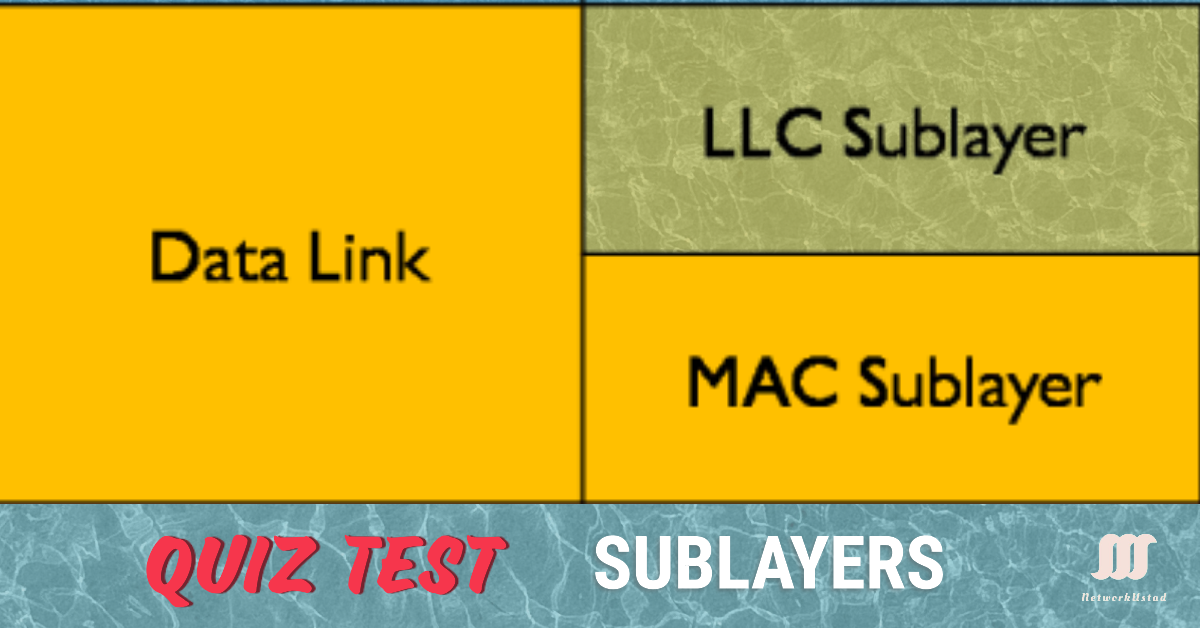
Overview of the Data Link Layer
The Data Link Layer is Layer 2 of the OSI model, sitting between the Network Layer above it and the Physical Layer below it. Its job is to move data reliably between two directly connected nodes, whether that’s a laptop and a switch port or two routers linked by a point-to-point circuit. To do that job, the IEEE split Layer 2 into two functional pieces: the Logical Link Control (LLC) sublayer and the Media Access Control (MAC) sublayer.
The split exists because the two halves solve different problems. The LLC sublayer, defined under IEEE 802.2, deals with what’s being sent, identifying which upper-layer protocol a frame belongs to and, optionally, tracking whether frames arrived correctly. The MAC sublayer, defined under IEEE 802.3 for Ethernet and IEEE 802.11 for wireless, deals with how it gets sent, controlling access to the shared medium and physically addressing the frame so it reaches the right device. Keeping these responsibilities separate means the same LLC logic can sit on top of very different physical technologies, from twisted-pair Ethernet to a wireless radio link, without rewriting the protocol-multiplexing logic each time.
LLC Sublayer: Functions and Services
The LLC sublayer sits directly below the Network Layer and above the MAC sublayer. It’s typically implemented in software, most commonly inside a network interface card’s driver, which makes it independent of the underlying hardware. This is what allows a single machine to run IPv4, IPv6, and ARP over the same physical Ethernet connection without conflict.
Its core responsibilities include multiplexing and de-multiplexing, optional reliability, and optional flow control. On the sending side, multiplexing means the LLC sublayer accepts packets handed down from Layer 3 protocols, tags each one with a protocol identifier in the LLC header, and passes it to the MAC sublayer for transmission. On the receiving side, de-multiplexing reverses that process, reading the protocol identifier out of an incoming frame and handing the payload up to the correct Layer 3 protocol. Where reliability is implemented, the LLC sublayer uses sequence numbers and acknowledgments to detect and retransmit lost frames, and flow control uses similar signaling to keep a fast sender from overwhelming a slower receiver.
IEEE 802.2 defines three service types that build on these functions:
- Unacknowledged connectionless service: Best-effort delivery with no connection setup and no acknowledgments, conceptually similar to UDP. It’s rarely relied on directly in modern TCP/IP networks, since higher layers already handle reliability, but it still shows up in lightweight, low-overhead links such as some constrained IoT deployments.
- Acknowledged connectionless service: Frames are sent without a formal connection, but sequence numbers and acknowledgments are added so lost frames can be identified. This pattern is useful over unstable wireless links, where retransmission at the link layer can recover from interference faster than waiting for a transport-layer timeout.
- Connection-oriented service: A logical connection is established before data transfer using supervisory frames. Older protocols such as HDLC and PPP use this without acknowledgment, while implementations that add sequence numbers, acknowledgments, and a sliding window provide reliability and flow control much like TCP does at a higher layer.
MAC Sublayer: Functions and Responsibilities
The MAC sublayer sits directly above the Physical Layer and is defined separately for each medium, IEEE 802.3 for wired Ethernet and IEEE 802.11 for Wi-Fi. Its two main jobs are data encapsulation and media access control.
Data encapsulation covers three related tasks. Framing wraps the Layer 3 packet with a header and trailer, turning it into a frame the physical medium can carry. Addressing uses the 48-bit MAC address burned into (or assigned to) a network interface to make sure a frame reaches the correct device on the local network. Error detection adds a trailer, typically a cyclic redundancy check (CRC), so the receiving device can tell whether the frame was corrupted in transit.
Media access control, the second job, governs how a device gets to use the shared medium in the first place. Classic half-duplex Ethernet used CSMA/CD (Carrier Sense Multiple Access with Collision Detection) to listen before transmitting and back off after a collision, but nearly all wired Ethernet today runs full-duplex over switched connections, where dedicated point-to-point links between a device and a switch port eliminate collisions entirely and make CSMA/CD largely a historical footnote rather than an active mechanism. Wi-Fi, by contrast, is still a genuinely shared medium, so it relies on CSMA/CA (Collision Avoidance), where devices wait for a clear channel and use random backoff timers to reduce the chance that two devices transmit at once.
LLC and MAC in Modern Networking
The division of labor between LLC and MAC is old, but it’s still directly relevant to the networks in production today:
- Wi-Fi 7 (IEEE 802.11be): Ratified by the IEEE in September 2024 and rolling out widely through 2026, Wi-Fi 7 pushes MAC-layer innovation hard with Multi-Link Operation, which lets a device use multiple frequency bands at once, alongside wider 320 MHz channels and denser modulation for higher throughput and lower latency.
- High-speed Ethernet (400GbE and beyond): As data center links scale past 400 Gbps to support AI training clusters, the MAC sublayer’s framing and error-detection functions have to keep pace with far higher frame rates without becoming a bottleneck.
- IoT networks: Constrained IoT devices benefit from LLC’s lightweight protocol multiplexing, while the MAC sublayer handles addressing across networks that can include very large numbers of low-power endpoints.
- 5G and edge computing: Where cellular backhaul meets wired or Wi-Fi infrastructure, LLC and MAC functions still govern how frames are multiplexed and how access to the local medium is arbitrated.
Conclusion
The LLC and MAC sublayers divide the Data Link Layer’s work along a clean line: LLC manages which upper-layer protocol a frame belongs to and, optionally, whether it arrived intact, while MAC manages how a frame gets onto the medium and which physical device it’s addressed to. That division has held up for decades precisely because it lets the same protocol-multiplexing logic run over Ethernet, Wi-Fi, or newer link types without being rewritten each time the physical medium changes.
Understanding where LLC’s job ends and MAC’s job begins is useful well beyond the classroom. It explains why a single machine can run several Layer 3 protocols over one network card, why Wi-Fi still needs collision avoidance while switched Ethernet doesn’t, and why standards bodies keep updating the MAC sublayer, most recently for Wi-Fi 7 and multi-hundred-gigabit Ethernet, to keep pace with faster and more crowded networks.