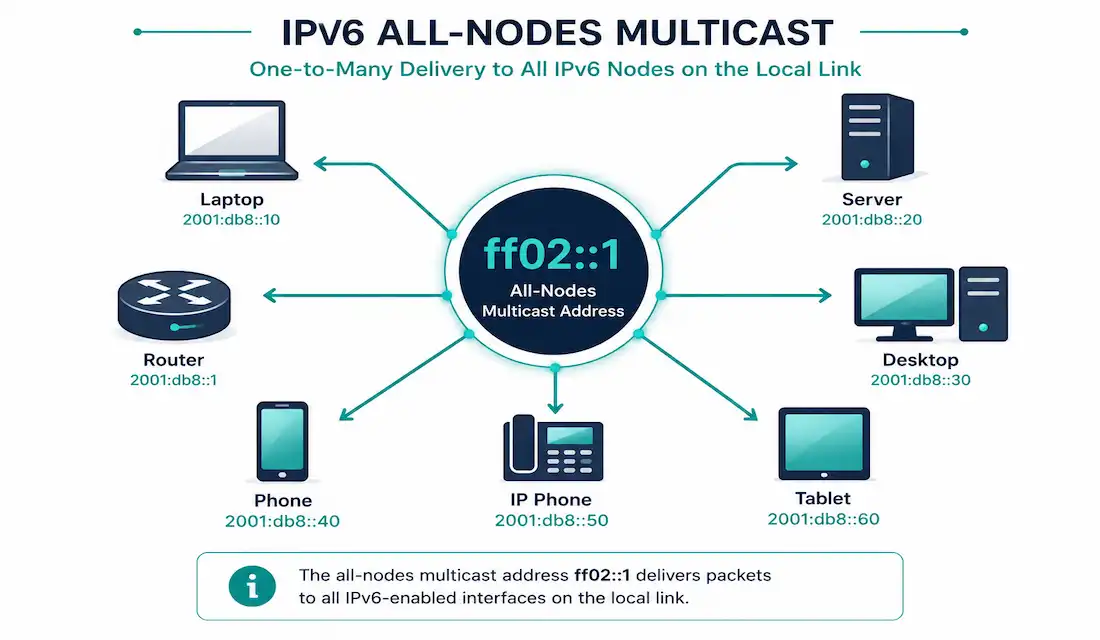
IPv6 has no broadcast address at all — a deliberate design change from IPv4. Everything broadcast used to handle is now done through multicast instead, which is both more efficient and more precise, since a multicast group only reaches devices that actually joined it. Understanding how IPv6 multicast addressing works isn’t optional background knowledge; it’s the mechanism behind Neighbor Discovery, router advertisements, and a good deal of how IPv6 networks actually function day to day.
This guide covers the multicast address structure, well-known and solicited-node addresses (with fully verified worked examples), Multicast Listener Discovery, and practical Cisco configuration and troubleshooting.
What Are IPv6 Multicast Addresses?
Unlike unicast (one-to-one) addresses, multicast addresses let a single packet reach multiple recipients simultaneously — any device that has joined the relevant multicast group. IPv6 multicast addresses are identified by the prefix ff00::/8, meaning the first 8 bits are always 11111111 (FF in hex), immediately distinguishing them from unicast or anycast addresses.
Multicast eliminates the need for redundant unicast transmissions to reach a group of devices, which matters directly for bandwidth efficiency — a single multicast packet can reach many recipients at once, compared to sending the same data as separate unicast streams to each one individually.
IPv6 Multicast Address Structure
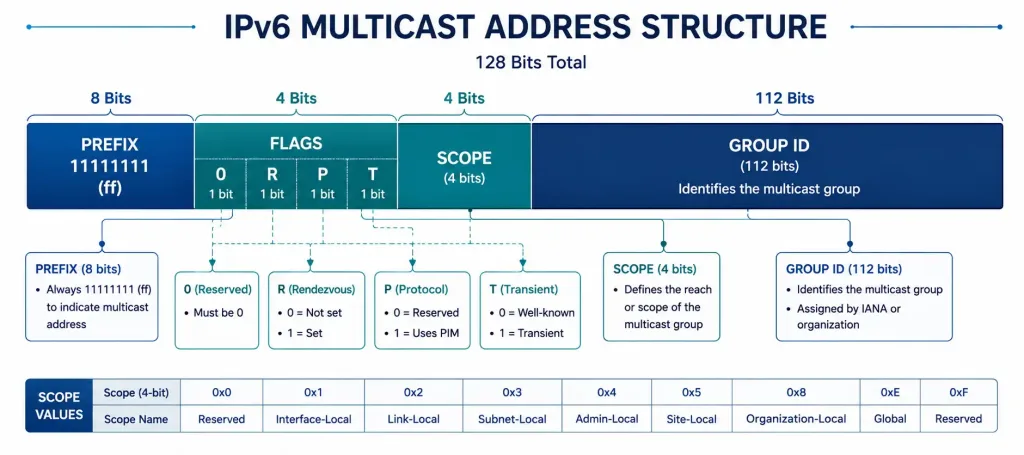
An IPv6 multicast address is 128 bits, broken into four components:
- 8-bit prefix: always
ff00::/8(binary11111111), identifying the address as multicast. - 4-bit flags (
0RPT):- 0 (Reserved): always 0.
- R (Rendezvous Point): 1 if the address embeds a Rendezvous Point for inter-domain multicast (RFC 3956).
- P (Prefix-based): 1 if the address is based on a unicast prefix (RFC 3306).
- T (Transient): 1 for dynamically assigned addresses; 0 for well-known addresses assigned by IANA.
- 4-bit scope: defines the address’s reach —
1(interface-local),2(link-local),5(site-local),8(organization-local),E(global). Scope value0is reserved and not valid for use. - 112-bit group ID: identifies the specific multicast group — for example,
ff02::1represents all nodes on a link.
A correctly-formed flags/scope example: an address like ff7e::1234 breaks down as flags 7 (binary 0111: R=1, P=1, T=1) and scope E (global) — a valid combination, unlike using a reserved scope value of 0.
Types of IPv6 Multicast Addresses
IPv6 multicast addresses split into two categories: well-known (predefined, IANA-assigned) and transient (dynamically allocated for temporary or application-specific use, outside the reserved well-known ranges, often released once no longer needed).
All-Nodes Multicast Group
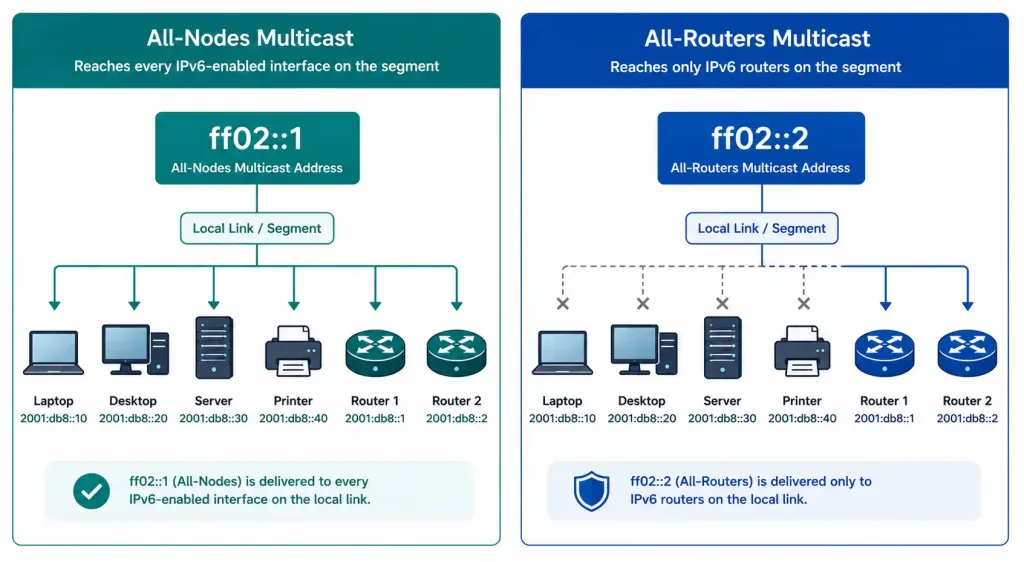
The address ff02::1 reaches every IPv6-enabled device on the local link. Every IPv6 interface listens on this address by default. A classic example: when a router sends an ICMPv6 Router Advertisement (RA) message to ff02::1, it informs every device on the link about the IPv6 prefix, prefix length, default gateway, and related configuration information in one transmission.
All-Routers Multicast Group
The address ff02::2 reaches every IPv6 router on the local segment. A router joins this group automatically once IPv6 routing is enabled:
Router(config)# ipv6 unicast-routingDevices send ICMPv6 Router Solicitation (RS) messages to this address specifically to prompt a router into sending back a Router Advertisement, speeding up initial address configuration rather than waiting for the router’s next periodic RA.
Solicited-Node Multicast Addresses
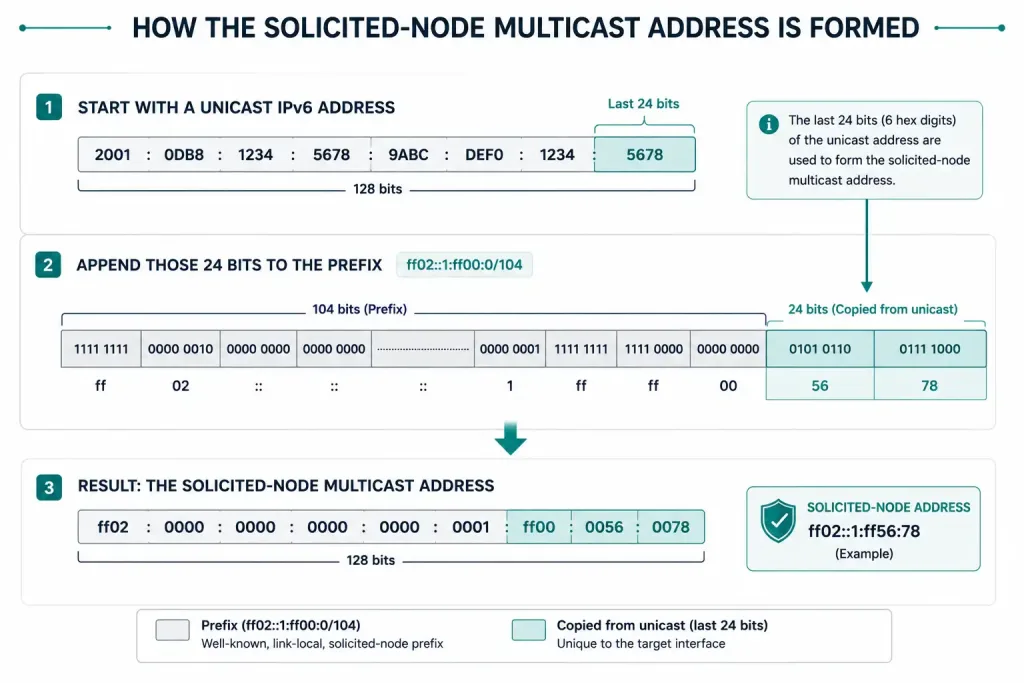
Solicited-node multicast is a targeted alternative to the flooding-style behavior IPv4 relies on for address resolution. Instead of broadcasting an ARP request to every device on a segment, IPv6 maps each unicast address to a specific solicited-node multicast address, letting a NIC filter incoming frames by MAC address alone — without needing to hand every frame up to the IPv6 process just to check if it’s the intended recipient.
How it’s formed: take the prefix ff02::1:ff00:0/104 and append the last 24 bits of the unicast address.
Worked example 1:
- Unicast address:
2001:db8::1234:5678 - Last 24 bits:
34:5678 - Solicited-node address:
ff02::1:ff34:5678
Worked example 2:
- Unicast address:
2001:db8::a1b2:c3d4 - Last 24 bits:
b2:c3d4(six hex digits — note this includes the last two digits of the preceding hextet, not just the final four digits) - Solicited-node address:
ff02::1:ffb2:c3d4
The second example is worth double-checking by hand if you’re new to this: 24 bits is six hex digits, not four, so the solicited-node address always includes a piece of the second-to-last hextet, not just the entire final hextet on its own.
Every device automatically joins the solicited-node group corresponding to each of its own unicast addresses. When a device needs to resolve a neighbor’s MAC address, it sends a Neighbor Solicitation to that neighbor’s solicited-node address — only the actual target device is subscribed to that specific group, so only it responds, dramatically reducing unnecessary traffic compared to IPv4’s broadcast-based ARP.
Multicast Listener Discovery (MLD)
MLD is IPv6’s equivalent of IGMP in IPv4, letting devices signal which multicast groups they want to receive traffic for:
- MLDv1: basic group membership, roughly equivalent to IGMPv2.
- MLDv2: adds source-specific multicast (SSM) support, letting a device specify exactly which source it wants to receive a given group’s traffic from (RFC 3810).
ff02::16 is reserved for all MLDv2-capable routers, used to manage group membership queries and reports.
MLD Snooping and Security
MLD snooping lets Layer 2 switches inspect MLD messages and forward multicast traffic only to ports with actual interested listeners, rather than flooding it to every port — both a performance and a security improvement.
Multicast does introduce real risk if left unmanaged: unsolicited or excessive group joins can be used for denial-of-service attempts. Standard mitigations include applying ACLs to filter unauthorized multicast traffic and enabling MLD querier election for redundancy, so group membership tracking doesn’t depend on a single point of failure.
IPv6 Multicast vs. IPv4 Multicast
| Feature | IPv4 Multicast | IPv6 Multicast |
|---|---|---|
| Address range | 224.0.0.0–239.255.255.255 (Class D) | ff00::/8 |
| Address structure | 32 bits, no scope field | 128 bits, with explicit flags and scope fields |
| Address resolution | ARP (broadcast-based) | Solicited-node multicast (via NDP) |
| Group management | IGMP (v1, v2, v3) | MLD (v1, v2) |
| Scope control | Limited, relies on TTL | Explicit scope field built into the address |
IPv6 multicast is structurally more scalable and precise than IPv4 multicast, largely because scope is built directly into the address rather than relying on TTL as an indirect proxy, and because solicited-node addressing replaces IPv4’s broadcast-based ARP with something far more targeted.
Real-World Use Cases
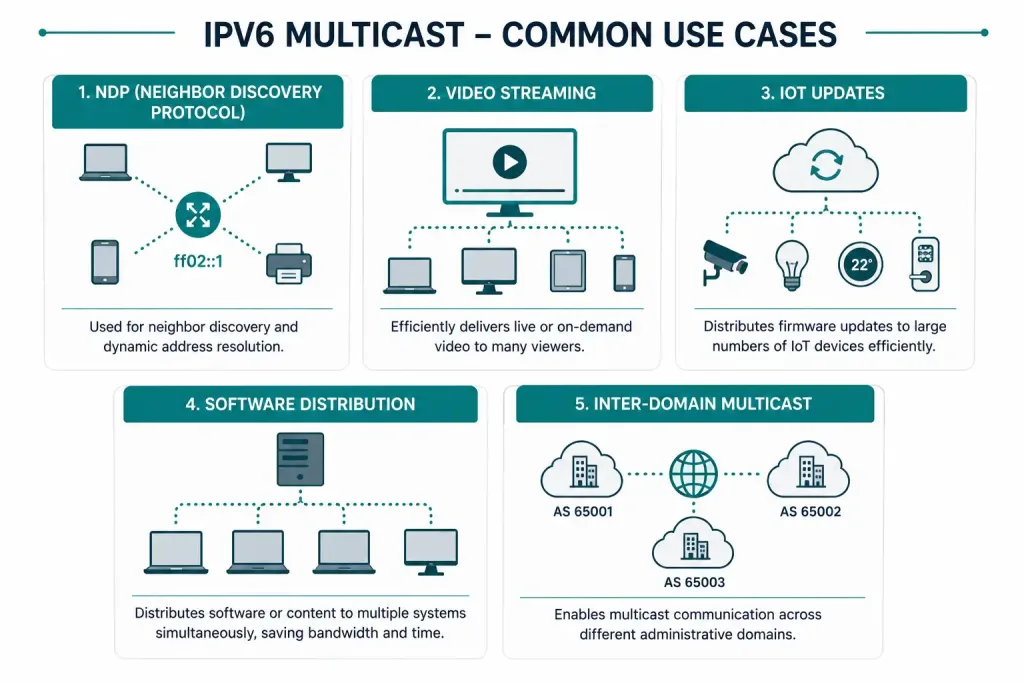
Neighbor Discovery Protocol (NDP): relies directly on ff02::1 and solicited-node addresses for address resolution, router discovery, and duplicate address detection — this is arguably the single most common, constant use of IPv6 multicast on any live network.
Video conferencing and streaming: multicast can deliver a live stream to many simultaneous viewers far more efficiently than an equivalent number of separate unicast streams, using scoped addresses appropriate to the intended audience (site-local for an internal broadcast, global scope for something intended to reach across networks). Real-world deployment of multicast for consumer-facing streaming remains limited in practice, constrained mainly by inconsistent ISP support for multicast routing across the last mile — this is a genuine, well-documented deployment challenge worth knowing about rather than glossing over.
IoT group communication: multicast lets a hub push a single update to every device in a group — a firmware update to a set of smart devices, for instance — rather than repeating the same transmission individually to each one.
Software distribution: enterprises can deploy updates to multiple servers simultaneously using an appropriately scoped multicast address, rather than pushing to each server sequentially.
Inter-domain multicast: RFC 3956 defines embedded Rendezvous Point addressing, letting multicast work across administrative domains — relevant for large-scale content delivery infrastructure that spans multiple networks.
An Emerging Standards Development Worth Knowing
The IETF’s PIM working group has an active draft, draft-ietf-pim-updt-ipv6-dyn-mcast-addr-grp-id (“Updates to Dynamic IPv6 Multicast Address Group IDs”), addressing limitations in the existing dynamic multicast address allocation defined in RFC 3307. It proposes a new IANA registry structure for dynamic group ID allocation, including dedicated ranges for MADCAP and solicited-node addresses. This is a genuine, currently active piece of IETF standards work — worth knowing about if you’re following multicast addressing developments closely, though it’s a registry/allocation refinement rather than something that changes day-to-day multicast configuration.
Practical Example: Configuring IPv6 Multicast on a Cisco Router
Configuration:
Router> enable
Router# configure terminal
Router(config)# interface GigabitEthernet0/0
Router(config-if)# ipv6 address 2001:db8::1/64
Router(config-if)# ipv6 enable
Router(config-if)# exit
Router(config)# exit
Router# ping ff02::1
Output:
Type escape sequence to abort.
Sending 5, 100-byte ICMP Echos to FF02::1, timeout is 2 seconds:
Reply to request 0 from 2001:DB8::2, 1 ms
Reply to request 0 from 2001:DB8::3, 1 ms
Reply to request 1 from 2001:DB8::2, 1 ms
...
Success rate is 100 percent (5/5), round-trip min/avg/max = 1/1/1 ms
Multiple replies per individual request number (from different devices) is expected and correct behavior for a multicast ping — every device subscribed to ff02::1 responds independently, unlike a unicast ping where each request gets exactly one reply.
For multicast routing beyond the local link, enable PIM and configure a Rendezvous Point:
Router(config)# ipv6 multicast-routing
Router(config)# ipv6 pim rp-address 2001:db8::rp
Analyzing multicast traffic with Wireshark: filter with ipv6.dst == ff02::1 to see ICMPv6 packets sent to the all-nodes address. On Linux, tcpdump -i eth0 ip6 multicast captures the same traffic from the command line.
Troubleshooting IPv6 Multicast
Devices aren’t receiving expected multicast traffic: verify multicast routing is actually enabled and check the multicast routing table.
Router# show ipv6 mrouteSuspected scope misconfiguration: confirm the scope field in the multicast address actually matches the intended reach — a site-local address (5) won’t reach devices outside the intended site even if routing is otherwise correctly configured, which is expected behavior, not a bug.
MLD group membership not updating as expected: check current MLD state directly.
Router# show ipv6 mld groupsUnexpected or excessive multicast traffic: review ACLs filtering multicast traffic and confirm MLD snooping is enabled on relevant switches to prevent unnecessary flooding.
FAQs
What is the prefix for IPv6 multicast addresses?
IPv6 multicast addresses use the ff00::/8 prefix, meaning the first 8 bits are always 11111111. This immediately distinguishes multicast addresses from unicast or anycast addresses anywhere they appear in configuration or a packet capture.
How does solicited-node multicast work in IPv6?
A solicited-node address is formed by combining the prefix ff02::1:ff00:0/104 with the last 24 bits of a unicast address — six hex digits, not just the final hextet on its own. This lets a device resolve a specific neighbor’s MAC address by targeting only devices actually subscribed to that narrow group, replacing IPv4’s broadcast-based ARP with something far more efficient.
What’s the difference between well-known and transient IPv6 multicast addresses?
Well-known addresses are IANA-assigned for standardized purposes, like ff02::1 for all nodes, while transient addresses are dynamically allocated for temporary, application-specific use and released once no longer needed. This distinction gives network designers flexibility: standardized addresses for predictable, universal functions, and dynamic ones for short-lived or application-specific multicast groups.
Why is MLD important for IPv6 multicast?
MLD manages multicast group membership, letting routers forward multicast traffic only to segments with actual interested listeners rather than flooding it everywhere. MLDv2 specifically adds source-specific multicast support, letting a device request traffic from a particular source rather than accepting a group’s traffic from any source at all.
Does IPv6 multicast actually improve on IPv4 multicast, or is it just a different address format?
It’s a genuine structural improvement, not just a reformatting — IPv6 builds scope directly into the address itself, rather than relying on TTL as an indirect, easy-to-misconfigure proxy for scope the way IPv4 does. Solicited-node addressing also replaces IPv4’s broadcast-based ARP with a mechanism that only reaches devices actually relevant to a given resolution, reducing unnecessary traffic on every subnet.
Is multicast video streaming actually common in practice?
Less than the theoretical efficiency case for it would suggest — real-world deployment for consumer-facing streaming remains limited, mainly because ISP support for multicast routing across the last mile is inconsistent. Multicast sees more consistent real-world use in controlled environments like enterprise networks and IoT deployments, where the network path between sender and receivers is fully within one organization’s control.