Camera: Why Google Still Leads
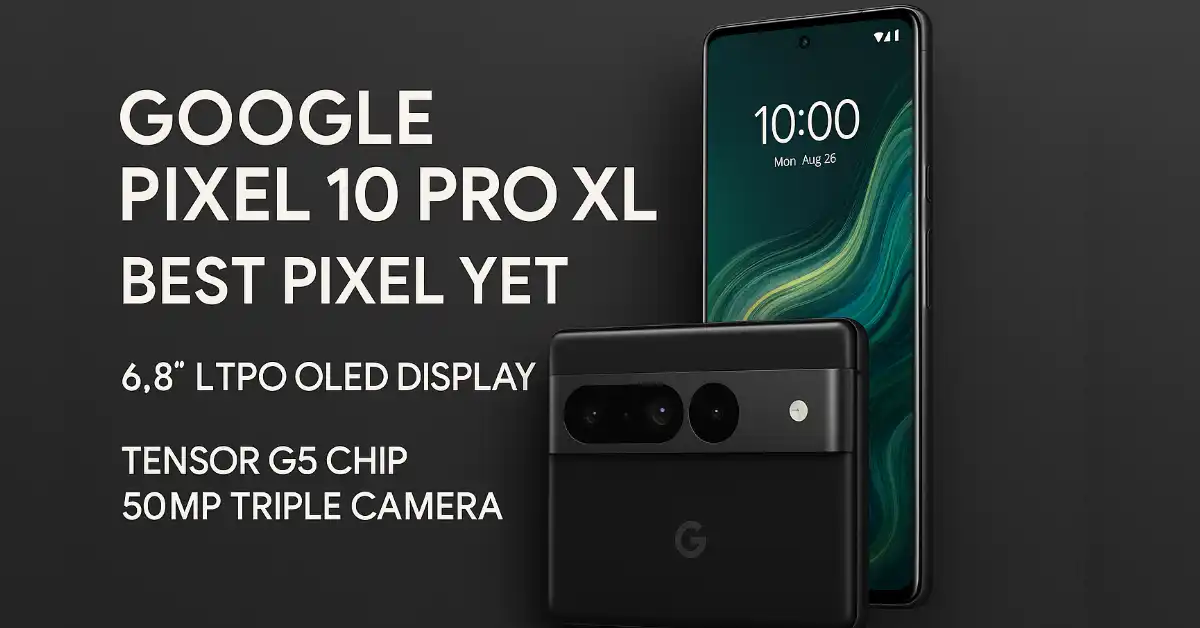
The Google Pixel 10 Pro camera is where Google’s engineering priorities become immediately apparent. Released on August 28, 2025, the Pixel 10 Pro arrives as Google’s ninth consecutive year of building what many consider the finest smartphone camera system available. This year’s model carries the same 50MP main sensor, 48MP ultrawide, and 48MP telephoto hardware as the Pixel 9 Pro — but the Tensor G5 chip’s completely redesigned Image Signal Processor transforms what those sensors can do.
The most visible result is 100× Pro Res Zoom. Beyond the 5× telephoto lens’s native optical reach, the Tensor G5’s ISP uses generative AI to reconstruct fine detail in compressed telephoto shots. Droid-Life called the 100× Pro Res Zoom “a bit amazing” while being transparent that it is “AI photography” — Google is generating realistic detail rather than capturing it optically. The results are impressive in good light and variable in low light, but the ceiling is meaningfully higher than anything a competing phone achieves at equivalent zoom levels. At 20× zoom, where Samsung Galaxy S26 users would be in digital territory, the Pixel 10 Pro is still pulling from optical data.
Google Pixel 10 Pro Display: 3,300 Nits of Outdoor Confidence
The Google Pixel 10 Pro display is the same 6.3-inch LTPO OLED panel as the Pixel 9 Pro in size and resolution — 1,280×2,856 pixels at 495ppi — but brightness improves meaningfully. GSMArena’s lab testing confirmed 2,351 nits in standard high-brightness mode, and a 5% patch measurement reached 3,300 nits. For context, that is approximately 600 nits brighter than the iPhone 16 Pro in comparable conditions.
The 1–120Hz adaptive refresh works down to 1Hz in static content, which contributes to the battery efficiency Google cites in its 30+ hour battery life claims. HDR10+ is supported. Dolby Vision is not — an omission that matters for Netflix subscribers who watch DV content, and a gap that Sony Bravia 9 II TV users will notice when comparing display ecosystems.
Tensor G5: Strong at AI, Average at Everything Else
The Google Tensor G5 is a 3nm chip from TSMC — a significant manufacturing step forward from the 4nm process used for Tensor G4. Google claims 34% faster CPU performance and 60% more powerful TPU (Tensor Processing Unit) for AI tasks compared to its predecessor.
In practice, the Tensor G5’s CPU scores trail competing flagship chips considerably. Forbes Vetted benchmarked single-core at 2,314 and multi-core at 6,060 — below the Samsung Galaxy S26 Exynos 2600’s 3,220/11,249 and far behind the Snapdragon 8 Elite Gen 5’s scores. For daily tasks, Google’s software optimisation means the gap is largely invisible — Droid-Life reported no issues running demanding apps at 120Hz with 16GB RAM. For sustained gaming, particularly demanding titles, the GPU (IMG DXT-48-1536) trails both Adreno and Xclipse solutions.
The TPU advantage is where the Pixel 10 Pro’s engineering priorities become clear. Running Gemini Nano models on-device, processing Video Boost footage, generating Pro Res Zoom results — these AI-heavy tasks run entirely locally without cloud dependency, preserving privacy and avoiding network latency.
PixelSnap Qi2: Finally, Magnetic Wireless Charging
The Google Pixel 10 Pro is the first Pixel phone with built-in Qi2 magnets. Google’s implementation is called PixelSnap, and it supports 15W wireless charging with magnetic attachment to compatible accessories — MagSafe cases, wallets, and mounting systems from the growing Qi2 accessory ecosystem now work natively without a separate case.
Forbes Vetted called this “a necessary addition” and noted they were “glad Google finally implemented this technology.” The Samsung Galaxy S26 does not include Qi2 magnets — a gap that becomes more significant as the Qi2 accessory market expands. Wired charging remains at 30W — which delivers 55% charge in 30 minutes but takes approximately 80 minutes from flat. For 2026 standards, this is slow.
Google Pixel 10 Pro Battery Life
The Google Pixel 10 Pro battery capacity of 4,870mAh is a 170mAh increase over the Pixel 9 Pro — a modest improvement. Consumer Reports measured 38 hours of battery endurance in standardised testing, which is above average for a compact 6.3-inch flagship. Real-world reviewers consistently report finishing days with 10–20% remaining under mixed use including camera-heavy sessions. Power users and heavy gamers report needing a top-up by evening.
The Tensor G5’s efficiency gains contribute to battery life despite the relatively modest capacity increase. The 1–120Hz adaptive display also drops to 1Hz in static content, reducing display power draw during passive reading and browsing.
Software and AI: Where Pixel Remains Ahead
Android 16 with seven years of guaranteed OS and security updates is the commitment Google makes with the Pixel 10 Pro — matching Samsung’s Galaxy S26 and Motorola Razr Fold on update duration while exceeding most other Android manufacturers.
Google Gemini is deeply integrated, handling voice queries, reminders, and camera assistance. Magic Cue generates context-aware reply suggestions in emails, messages, and calls — subtle enough that Forbes Vetted noted it was “so subtle that I wasn’t quite sure when Magic Cue was being used,” which reflects Google’s philosophy of AI that assists without announcing itself.
Circle to Search, which allows highlighting any on-screen element for immediate Google Search, remains a Pixel-exclusive feature that has not been matched by competitors at this integration level. C2PA Content Credentials, now baked into the camera app, embed verifiable metadata into every photo documenting capture conditions — a feature relevant to journalists, content creators, and anyone concerned about AI-generated image forgeries.
Google Pixel 10 Pro vs Competitors
Against the Samsung Galaxy S26 at $899: the Pixel 10 Pro costs $100 more and delivers a better camera system, faster-responding 30W charging (the Galaxy S26 also charges at 25W), built-in Qi2 magnets (the Galaxy S26 lacks them), and meaningfully better low-light photography. Samsung’s advantage is a faster chip (Snapdragon 8 Elite Gen 5) and One UI’s depth.
Against the Motorola Razr Fold at $1,899: the Pixel 10 Pro is $900 cheaper in a more pocketable slab form factor, with a better camera but no foldable display.
At $999, the Google Pixel 10 Pro remains the standard recommendation for buyers who prioritise camera quality and software longevity in a compact package.
Verdict
The Google Pixel 10 Pro review conclusion: the camera is better than everything else at $999, the software is the most polished and longest-supported in Android, and PixelSnap Qi2 finally eliminates the only major convenience gap versus the iPhone. The Tensor G5 is a purposeful chip — strong where Google needs it (AI, imaging, efficiency), average where it does not prioritise (raw compute, GPU gaming). If camera quality and software updates drive your buying decision, the Google Pixel 10 Pro remains the correct compact Android flagship in 2026.
Rating: 4.4 / 5 — The best camera phone at its price, with software that outlasts the competition and a chip that knows what matters.