Most API security checklists focus solely on OAuth, TLS, rate limiting, and web application firewalls. While fintech APIs certainly require these measures, they do not prevent the failures that carry the highest costs: duplicate payments, unverified webhooks, trusted partner data gone wrong, or account numbers altered within a request.
This guide maps the OWASP API Security Top 10 to real-world fintech scenarios, examines payment-specific controls often overlooked by standard checklists, explains the implications of FAPI 2.0 for network and platform teams, and outlines the expected landscape of open banking regulations as of October 2026.
Key takeaways
- Authorization bugs, not broken encryption, top the list. The number one OWASP API risk is an API that returns another customer’s object because nobody checked who owns it.
- Payment APIs need controls generic guides skip: idempotency keys, signed and time-limited requests, verified webhooks and server-side money limits.
- Open banking has a modern security baseline. FAPI 2.0, final since February 2025, requires sender-constrained tokens, pushed authorization requests and PKCE.
- Regulation is moving, but unevenly. The US open banking rule is enjoined and under reconsideration, the EU’s PSD3 and PSR are expected to apply by late 2027, and DORA has applied since January 2025.
- Your partners’ APIs are part of your attack surface. Treat everything a bank, aggregator or BaaS provider sends you as untrusted input.
Why fintech APIs are a different target
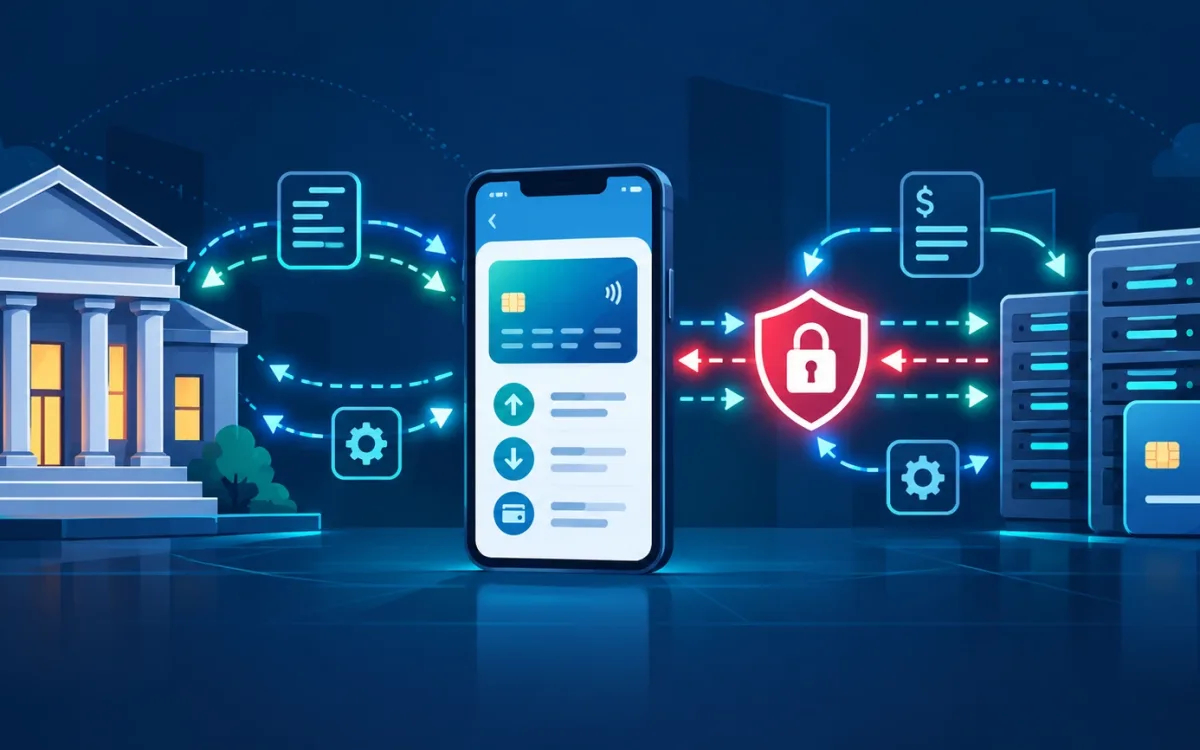
A standard API is used for data transmission. In the fintech sector, however, an API also facilitates the movement of funds, often traversing a chain of partners: a mobile app communicates with your backend, which connects to a sponsoring bank or payment processor, while an aggregator requests account data on the client’s behalf. Each link in this chain involves an API, and each represents a potential vulnerability where an attacker could intercept data, alter payment parameters, or trigger an irreversible action.
This is precisely why authorization flaws are so critical in this context, arguably more so than in any other sector. In July 2021, Salt Labs published the results of a study analyzing the API platform of a major financial institution. By exploiting authorization weaknesses related to data and function access, and manipulating request parameters, researchers demonstrated that it was possible to view any client’s financial records, delete accounts, hijack accounts (by altering authentication parameters), and disrupt application functionality. These attacks did not require bypassing encryption; the platform simply failed to verify whether the request sender was authorized to interact with the requested object or function.
Three things make fintech APIs harder to defend than a typical SaaS API:
- Mistakes are expensive and often final. A duplicated payout or a transfer to the wrong account is a financial loss, not just a data incident.
- Third parties are built into the flow. Banks, aggregators and processors call your APIs and you call theirs, so trust boundaries run through the middle of every transaction.
- Regulators look at the plumbing. Open banking rules, operational resilience laws and bank supervisors set expectations for API uptime, authentication and third-party oversight.
The OWASP API Top 10 through a fintech lens
The OWASP API Security Top 10 (2023) is the most widely used list of API risks. Here’s how each risk tends to show up in a fintech product and what to do first.
| OWASP risk | How it shows up in fintech | First control |
| API1 Broken Object Level Authorization | Changing an account, card or transaction ID in a request returns another customer’s data | Check ownership on every object access, server-side, for every endpoint |
| API2 Broken Authentication | Stolen or long-lived tokens let attackers act as a customer or a partner | Short-lived, sender-constrained tokens; protected login and recovery flows |
| API3 Broken Object Property Level Authorization | An API returns full card or KYC fields, or accepts a “limit” or “status” field from the client | Explicit response schemas; reject properties the client may not set |
| API4 Unrestricted Resource Consumption | Bots trigger thousands of SMS verification codes, and you pay for each one | Per-user and per-number quotas on costly actions; alerts on spend |
| API5 Broken Function Level Authorization | A customer token reaches an admin or back-office endpoint | Deny by default; separate admin APIs and identities |
| API6 Unrestricted Access to Sensitive Business Flows | Automated card testing, mass payouts or promo abuse through legitimate endpoints | Velocity limits per account, payee and device; step-up checks |
| API7 Server-Side Request Forgery | A user-supplied webhook or document URL makes your server call internal systems | Allowlist destinations; block internal ranges; restrict egress |
| API8 Security Misconfiguration | Verbose errors, open CORS or test endpoints in production | Hardened gateway defaults; configuration checks in CI |
| API9 Improper Inventory Management | An old API version without new checks stays reachable | Maintain an inventory of hosts and versions; retire old versions |
| API10 Unsafe Consumption of APIs | Your system trusts balances or statuses returned by a partner or aggregator | Validate partner responses like user input; reconcile independently |
Two rows deserve extra attention in fintech.
API1 is still the risk to test first. OWASP’s guidance is that object-level authorization checks belong in every function that accesses a data source using an ID from the user. In practice, that means every account, card, payee, statement and transaction lookup must confirm that the authenticated customer or partner owns that object, even when the ID is a random UUID.
API4 has a direct cost in fintech. Sign-up and login flows send one-time codes by SMS, and Twilio describes SMS pumping fraud as attackers abusing a phone number input field to trigger messages to number ranges they profit from. Watch for spikes in messages to adjacent numbers with no completed verifications, and cap codes per user, per number and per IP range.
Payment-specific controls most checklists skip
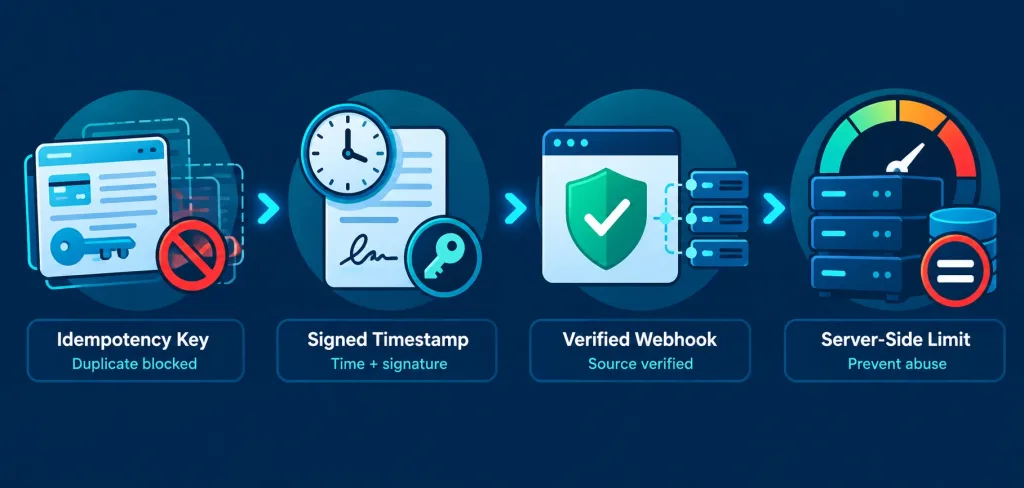
Generic API checklists treat every endpoint the same. Endpoints that move money need four extra controls.
Idempotency keys
Networks drop connections, and clients retry. Without idempotency, a retried “create payment” request can execute twice. The fix is an idempotency key: the client sends a unique key with each state-changing request, and the server returns the stored result for any retry with the same key instead of running the operation again. Stripe’s API documentation is a good reference implementation: it suggests random V4 UUIDs as keys, allows up to 255 characters, compares the parameters of a retry with the original request and returns an error if they differ.
Signed, time-limited requests
For server-to-server calls between partners, sign requests over the body and a timestamp, and reject anything outside a short window. A signature without a timestamp can be replayed. This is also where network operations matter: if server clocks drift, valid requests fail, so keep partner-facing systems synchronized with NTP.
Verified webhooks
Webhooks tell your system that a payment succeeded, failed or was disputed, which makes a forged webhook as dangerous as a forged payment. Stripe signs each event with HMAC-SHA256 over the timestamp and payload, and its libraries reject events older than five minutes by default to block replays. The same pattern works for any provider:
- verify the signature with a constant-time comparison;
- reject old timestamps;
- store processed event IDs, because providers can deliver the same event more than once;
- accept webhook traffic only from the provider’s published IP ranges, as an extra layer, not a replacement for signatures;
- return a 2xx quickly and process the event from a queue.
Server-side money limits and step-up checks
Never trust an amount, currency or limit that arrives from the client. Enforce per-transaction and per-day limits on the server, apply velocity rules per account and per payee, and require step-up authentication when a customer adds a new payee or changes payout details. These are the controls that turn a stolen session from an empty account into a blocked attempt.
Open banking: standards and where the rules stand in 2026
Open banking is as secure as its token handling, consent scopes and monitoring. The standards are now mature; the regulation around them is still moving.
FAPI 2.0 is the technical baseline
The OpenID Foundation approved the FAPI 2.0 Security Profile and Attacker Model as final specifications on February 19, 2025. The profile requires:
- sender-constrained access tokens, using either mutual TLS (RFC 8705) or DPoP (RFC 9449), so a stolen token is useless without the client’s key;
- pushed authorization requests (PAR, RFC 9126), so authorization parameters go to the server over a back channel instead of through the browser;
- PKCE with the S256 method for every authorization request.
For network and platform teams, mTLS-bound tokens have a practical consequence. The certificate the client presented must reach the authorization and resource servers. If TLS terminates at a load balancer or API gateway, it has to forward the client certificate securely, or token binding breaks.
United States: the CFPB rule is on hold
The CFPB finalized its personal financial data rights rule under Section 1033 in October 2024, with the first compliance date set for April 1, 2026. A federal court in the Eastern District of Kentucky has since enjoined the CFPB from enforcing it while the Bureau reconsiders the rule, a process that began in August 2025. As Cozen O’Connor noted in April 2026, the April 1 date passed without becoming a binding enforcement trigger. Data sharing continues under industry standards such as FDX, so the security work doesn’t wait for the final rule.
European Union: PSD3, PSR and DORA
The EU reached political agreement on PSD3 and the Payment Services Regulation (PSR) in November 2025, and final compromise texts went to member states in April 2026. Morrison & Foerster expects the new regime to apply by late 2027. The PSR sets requirements for open banking API performance and availability and makes payment providers check that a payee’s name matches the account identifier and warn the payer about mismatches. Separately, the Digital Operational Resilience Act (DORA) has applied since January 17, 2025, with harmonized rules on ICT risk management, incident reporting, third-party risk and testing.
BaaS and third parties: who owns which risk
Banking-as-a-service splits one financial product across several companies: a sponsor bank, often a middleware platform, and the fintech that owns the customer. Each holds part of the data and part of the ledger, and 2024 showed what happens when those parts drift apart.
- Evolve Bank & Trust said in June 2024 that a criminal group appeared to have obtained and published data of some of its customers on the dark web, and it began notifying customers of its fintech partners. Less than two weeks earlier, the Federal Reserve had taken enforcement action against the bank over shortcomings in its anti-money-laundering, risk management and consumer compliance programs, including risk management for its fintech partnerships (Banking Dive, June 2024).
- Synapse, a BaaS middleware provider, collapsed in 2024. The bankruptcy trustee estimated a shortfall of $65 million to $96 million between what end users were owed and what partner banks held, and more than 100,000 end users were locked out of their accounts (Banking Dive, June 2024).
The Synapse case was a ledger and reconciliation failure as much as a security one, but the lesson for API design is the same: no party should depend on a single API response as the source of truth. US bank regulators’ interagency guidance on third-party relationships, issued in June 2023, frames oversight around five stages: planning, due diligence and selection, contract negotiation, ongoing monitoring and termination. For engineering teams, that translates into:
- separate credentials and scopes for each partner, rotated on a schedule;
- schema validation of every partner response, treating it as untrusted input (OWASP API10);
- independent reconciliation of balances and transaction statuses;
- contractual incident-notification timelines that match your own response plan;
- an exit plan: what happens to keys, data and in-flight payments if a partner disappears.
Inventory, monitoring and testing
You can’t protect APIs you don’t know about. Keep an inventory of every host, version and partner integration, including internal APIs reachable from partner networks, and retire old versions on a published schedule.
Log business events, not just HTTP status codes. “Payee added,” “payout details changed,” “limit raised” and “new device enrolled” are the events fraud teams need, and alerting on them catches abuse that returns perfectly valid 200 responses.
Test authorization the way attackers probe it. Automated tests that log in as two customers and try to read each other’s objects catch BOLA before release. Add them to CI alongside dependency and configuration scans, and run an external penetration test before launch and after major changes to payment flows.
A secure-by-design checklist for teams building a fintech product
Most API security problems in fintech are design decisions made early and paid for later. Whether you build in-house or with a fintech software development partner, put these items into the architecture review, not the post-launch backlog.
Design
- Threat-model every money flow: who can start it, who can change it and what happens if a step runs twice.
- Decide where object ownership is checked and make it a shared library, not per-endpoint code.
Build
- Use idempotency keys on every state-changing payment endpoint.
- Enforce limits, currencies and amounts on the server.
- Verify webhooks by signature and timestamp, and deduplicate by event ID.
Integrate
- Use sender-constrained tokens (mTLS or DPoP) for partner and open banking access.
- Validate partner responses and reconcile balances independently.
Launch
- Run cross-account authorization tests and an external penetration test.
- Set quotas on costly actions such as SMS codes and alert on spend.
Run
- Rotate keys and signing secrets on a schedule.
- Review the API inventory and retire old versions.
- Alert on business events, not just errors.
FAQs
What are the best practices for API security in fintech?
Check object ownership on every request, use short-lived sender-constrained tokens, make payment endpoints idempotent, sign and time-limit partner requests and webhooks, enforce money limits on the server, validate partner data as untrusted input, and keep an inventory of every API version.
What are the three pillars of API security?
There’s no official list, but most frameworks group controls into three areas: identity (authentication and authorization), data protection (encryption, data minimization and integrity) and threat protection (monitoring, rate limiting and testing). In fintech, authorization deserves the most attention.
How secure is open banking?
Open banking is as secure as its implementation. Standards such as FAPI 2.0 bind tokens to the client, require PKCE and pushed authorization requests, and limit what a stolen token can do. The remaining risk sits in consent scopes, aggregator access and how each party monitors API traffic.
What are the API standards for open banking?
FAPI 2.0 from the OpenID Foundation defines the security profile. On top of it, markets use their own data and API standards, such as the UK Open Banking standard and the Financial Data Exchange (FDX) standard in the US.
What is a fintech API?
An interface that lets software access financial services: accounts, payments, cards, lending or identity checks. Because it can move money or expose financial data, it needs stronger authorization, integrity and monitoring controls than a typical web API.