
AWS Cloud Adoption, India’s cloud story has reached a practical point. Boardrooms are no longer asking whether cloud is credible. They are asking which business process deserves cloud first, which workload can carry regulatory pressure, and which use case can return value without forcing the whole enterprise to move at once.
That shift changes the conversation around AWS adoption India. The old playbook was built around migration, backup, capacity, and application hosting. It helped enterprises exit aging infrastructure. Useful work, yes. Enough for 2026, no.
The next phase will be judged by industry outcomes. A bank wants fraud controls and cleaner audit trails. A plant wants fewer unplanned stoppages. A retailer wants sharper inventory decisions across online and store channels. A hospital wants patient records, diagnostics, claims, and clinical workflows to talk to each other with better guardrails.
This is where AWS adoption India starts looking less like an IT program and more like a business architecture decision, supported by aws services that align cloud design with sector-specific outcomes.
Why AWS Cloud Adoption in India Is Moving Past Generic Migration?
The first phase of Indian cloud growth was driven by clear pressure: data center refresh cycles, cost control, disaster recovery, and application modernization. Those pressures remain. What has changed is the buyer’s expectation.
Indian enterprises now want cloud to fit the shape of their sector. They want reusable patterns for compliance, data residency, local payment behavior, vernacular user journeys, peak demand, partner integration, and AI readiness. This is the heart of industry cloud use cases India.
IDC reported that India’s public cloud services market reached $10.9 billion in 2024 and projected it to reach $30.4 billion by 2029. AWS has also announced a planned cloud infrastructure investment of INR 1,05,600 crore in India by 2030. Those numbers show depth. The stronger signal sits inside enterprise demand.
| Earlier cloud ask | 2026 cloud ask |
| Move applications to cloud | Rebuild loan, claims, plant, store, or patient workflows |
| Reduce infrastructure burden | Improve process-level cost and service quality |
| Add disaster recovery | Design tested continuity for regulated operations |
| Host data lakes | Build trusted data products for teams |
| Run analytics | Act on live business events with governance |
This is why AWS adoption India will be pulled forward by industry teams, not only by central IT.
What Is Driving Industry-Specific Cloud Use Cases in India?
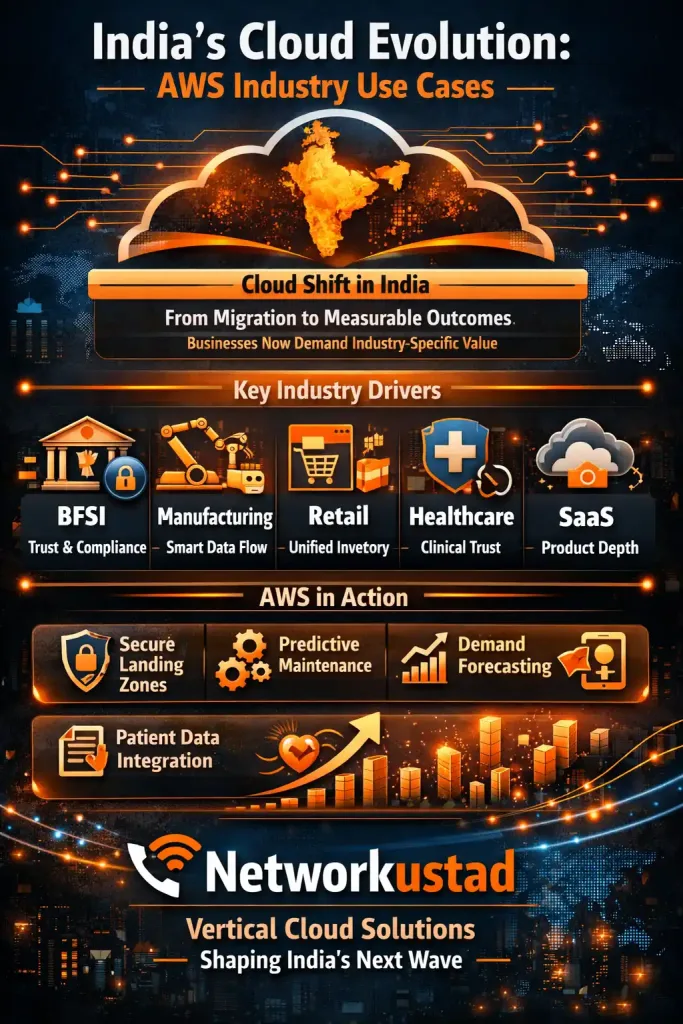
The next cloud wave in India will come from friction that each sector knows too well.
For BFSI, the friction is trust under speed. Banks, insurers, NBFCs, brokers, and fintech firms must ship digital services while meeting supervisory expectations, audit needs, cyber controls, and customer consent norms.
For manufacturing, the friction is fragmented operations. Plants often run a mix of machines, legacy systems, spreadsheets, vendor portals, and disconnected quality processes.
For retail, the friction is margin pressure. Inventory errors, promotion leakage, return patterns, stockouts, and channel conflict all show up as direct financial pain.
For healthcare, the friction is fragmented patient movement. Appointments, diagnostics, clinical notes, pharmacy, billing, claims, and follow-up care often sit in separate systems.
For SaaS companies, the friction is product depth. Indian SaaS founders now sell into regulated sectors, global buyers, and price-sensitive mid-market firms. They need cloud foundations that support product maturity, security reviews, and faster feature release without brittle engineering.
That is the real market for enterprise AWS use cases India. The opportunity is no longer a clean migration slide. It is a portfolio of repeatable vertical patterns.
BFSI Cloud Use Cases: Risk, Compliance, and Customer Trust
The strongest case for AWS for BFSI India is not a generic app migration. It is the ability to create governed, observable, and auditable digital banking and insurance journeys.
A practical BFSI cloud pattern may include secure landing zones, encrypted customer and transaction data pipelines, fraud analytics, document processing for KYC and claims, recovery drills, and central logging for audit or cyber investigation.
A BFSI enterprise does not need to begin with its most sensitive core system. It can begin with onboarding, risk reporting, disaster recovery, or agent-assist tools. Each use case builds internal confidence.
AWS for BFSI India will gain more ground where business, risk, compliance, and engineering teams share one operating model. Cloud architecture must be explained in the language of controls, evidence, segregation, encryption, recovery, and accountability. My view is simple: BFSI cloud maturity in India will be measured less by workload count and more by how quickly institutions can prove control.
Manufacturing Cloud Use Cases: Plant Data Must Reach Business Decisions
The case for AWS for manufacturing India starts with an uncomfortable truth. Many factories have data, yet very little of it reaches decision-makers in usable form. Machine logs, quality checks, maintenance sheets, production plans, supplier updates, and energy readings stay trapped in local systems.
Cloud helps when it becomes the meeting place for operational technology and enterprise systems.
A useful manufacturing pattern can include shop-floor data ingestion, predictive maintenance, computer vision for quality inspection, digital twins, energy monitoring, and supplier visibility tied to production planning.
The winning use case is rarely “move the factory to cloud.” The better question is: which production loss can be reduced with better data?
For AWS for manufacturing India, strong candidates include downtime prediction, defect tracing, spare-part planning, batch quality, and energy cost analysis. These are tangible business problems. They also give plant heads a reason to support cloud budgets. The next phase of AWS adoption India in manufacturing will be led by operations teams that can tie cloud work to output, quality, safety, or working capital.
Retail Cloud Use Cases: Inventory, Loyalty, and Demand Signals
Retail in India spans large chains, D2C brands, marketplaces, grocery, fashion, electronics, pharmacies, and regional sellers. Each has a different operating rhythm. The common problem is decision speed.
A retailer cannot afford to wait days to know which SKU is stuck, which pin code is returning more orders, which offer is hurting margin, or which store has silent stock mismatch.
This is where AWS for retail India becomes useful.
| Retail pain point | Cloud-led pattern |
| Stockouts and overstock | Demand forecasting by region, store, and channel |
| Margin leakage | Promotion analytics and price testing |
| High returns | Return reason mining and quality feedback |
| Slow personalization | Customer segmentation and next-best action |
| Channel conflict | Unified inventory and order visibility |
AWS for retail India will not be led only by large ecommerce players. Mid-sized retailers with disciplined data models may gain more from cloud than firms with bigger budgets and poor master data. The winner will be the retailer that treats product, customer, inventory, and order data as operating assets.
For AWS adoption India, retail is a proving ground because success shows up quickly. Either availability improves, returns fall, fulfilment gets cleaner, or campaign spend gets sharper. The numbers expose weak strategy fast.
Healthcare Cloud Use Cases: Clinical Trust Comes First
Healthcare cloud in India cannot be discussed like a normal enterprise IT topic. The stakes are personal. A bad workflow can delay care. Poor data handling can damage trust. Weak integration can frustrate doctors and patients at the same time.
That is why AWS healthcare cloud India should be framed around safe, connected, and usable care operations.
Relevant use cases include patient record access, diagnostic image storage, claims integration, remote consultation, clinical decision support with human review, pharmacy coordination, and patient engagement after discharge.
Hospitals and health-tech firms can start with non-critical workflows, analytics, imaging archives, call center systems, or claims support. Over time, they can connect clinical systems with stronger identity, consent, monitoring, and access controls.
AWS healthcare cloud India has room to grow because healthcare providers face real fragmentation. The opportunity is not flashy. It is basic operational relief: fewer duplicate records, cleaner billing, faster reports, safer storage, and better continuity of care. This is also where industry cloud use cases India need more local nuance. A metro hospital chain, a diagnostic network, and a rural telehealth provider do not need the same design.
SaaS: India’s Product Companies Need Vertical Depth
SaaS deserves a separate place in this discussion because Indian product companies are no longer building only horizontal tools. Many now sell workflow software for lenders, clinics, logistics firms, manufacturers, retailers, and education providers.
This changes the cloud architecture problem. A SaaS company selling to BFSI needs tenant isolation, audit logs, configurable data retention, encryption, and strong incident response. One selling to manufacturing needs device integration and event ingestion. One selling to healthcare needs privacy-first data design and careful access control.
In other words, SaaS companies also need vertical cloud patterns. They are both cloud users and cloud sellers. This is a quiet driver of AWS adoption India. As more Indian SaaS firms build for regulated and process-heavy sectors, AWS usage will be tied to product credibility, not only infrastructure preference.
How Vertical Cloud Patterns Will Shape AWS Adoption in India?
A vertical cloud pattern is a repeatable design for a sector-specific problem. It combines architecture, data, security, integration, compliance, and operating practices. For India, these patterns may become more important than broad migration frameworks.
A good vertical pattern answers five questions:
- Which business event triggers the workflow?
- Which data is needed, and who is allowed to use it?
- Which regulatory or internal control applies?
- Which system must respond in near real time?
- Which metric proves that the design worked?
This is where enterprise AWS use cases India will mature. Instead of asking, “Which applications can move?” enterprises will ask, “Which industry workflow can become faster, safer, cheaper, or easier to audit?”
That is a better question.
Final Take
The next chapter of AWS adoption India will not be won by cloud-first slogans. It will be won by teams that can connect domain knowledge with architecture. Cloud programs need plant heads, claims managers, risk officers, store operations leaders, clinicians, product managers, and data owners from the beginning.
A cloud partner should understand the sector’s process language. If they cannot explain how the architecture supports a loan journey, a production line, a stock movement, a clinical handoff, or a SaaS tenant model, the conversation is still too generic.
The next wave of cloud in India will be specific, vertical, and tied to measurable business work. The more interesting story sits inside industry workflows: a safer payment journey, a better insurance claim, a cleaner production line, a smarter store, a connected patient record, or a SaaS product that can pass a serious enterprise review.
That is where cloud earns trust in India now. Not in the slide deck. In the workflow.
FAQs on AWS Adoption in India
Why is AWS adoption shifting in India?
Indian enterprises now demand sector‑specific outcomes, not just migration. Cloud must fit compliance, local behavior, and industry workflows to deliver measurable business value.
What drives BFSI cloud use cases?
Banks and insurers prioritize trust, compliance, fraud controls, and auditable digital journeys. AWS enables secure onboarding, risk reporting, disaster recovery, and governed transaction pipelines.
How does manufacturing benefit from AWS?
Factories use AWS for predictive maintenance, defect tracing, and energy monitoring. Cloud connects shop‑floor data with enterprise systems, improving output, quality, and operational decisions.
What are retail cloud priorities in India?
Retailers leverage AWS for demand forecasting, promotion analytics, unified inventory, and personalization. Cloud reduces stockouts, margin leakage, and returns, enabling faster, sharper business decisions.
Why is healthcare cloud adoption unique?
Healthcare requires safe, connected workflows. AWS supports patient records, diagnostics, claims, and consultations with strong identity, consent, and monitoring to ensure trust and continuity of care.
Disclaimer:
This content is provided for informational purposes only and does not constitute legal, financial, medical, or technical advice. While cloud adoption strategies, AWS services, and industry use cases are discussed, outcomes may vary depending on organizational context, regulatory requirements, and implementation practices. Readers should independently evaluate solutions before applying them to production environments. The author and publisher assume no responsibility for errors, omissions, or consequences arising from reliance on this material. Always consult qualified professionals when making decisions involving compliance, security, or mission‑critical operations. Use of this information is at your own discretion.