Networking
CCNA tutorials, Cisco guides, and enterprise networking insights for IT professionals.
Memory Buffering on Cisco Switches: Techniques and Best Practices
Ethernet switches employ memory buffering to manage data traffic efficiently, ensuring frames are temporarily stored when a destination port faces congestion. Effective buffering is crucial to prevent frame loss, which can degrade network performance, increase latency, and trigger retransmissions, ultimately impacting user experience and reliability. This guide covers the two core buffering methods, advanced techniques...
Switching Fundamentals – Everything to Know
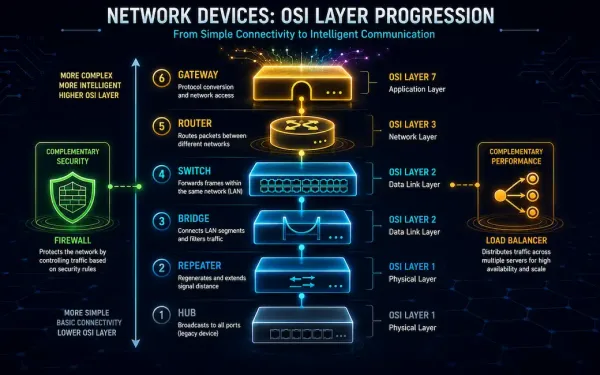
An Ethernet switch is a Layer 2 device. Therefore, the switch uses MAC addresses for switching decisions. It is unaware of the protocol being carried in the data portion of the frame, such as an IPv4 packet. The Ethernet hub repeats bits out of all ports except the incoming port, but an Ethernet switch consults...
Address Resolution Protocol (ARP)
The source host uses Address Resolution Protocol (ARP) to determine the destination MAC address. Although the destination MAC address can be a unicast, broadcast, or multicast, the source MAC address must always be unicast. Every device with an IP address on a network also has an Ethernet MAC address. When a device sends an Ethernet...
Mastering Unicast, Multicast, and Broadcast Addresses in 2025
In Ethernet, Multicast, and Broadcast Addresses always describe a group of recipients. However, the unicast explains communication where data is sent from one point to another. Unicast Address A unicast address means a packet has been sent from a single source to a specific destination. All Ethernet and IP networks support unicast transmission. A unicast...
Understanding MAC Addresses: Structure, Importance, and How to Find Them in 2025
A media access control address, or a device’s MAC address, is a worldwide unique identifier assigned to a network interface controller. It is also known as “hardware address” or “physical address” and is very important for communication within network segments. Most IEEE 802 network technologies, including Ethernet, Wi-Fi, and Bluetooth, use a Media Access Control address for within-network...
Ethernet Frame Structure: IEEE 802.3 and Ethernet II Fields Explained
The Ethernet frame structure is the backbone of wired networking, enabling reliable data transfer across everything from small office LANs to hyperscale data centers. This guide explores each component of an Ethernet frame, their exact byte sizes, their roles, and how VLAN tagging extends the basic structure for modern segmented networks. Overview of Ethernet Frame...
Understanding LLC and MAC Sublayers in the Data Link Layer (2025)
In 2025, the Data Link Layer is critical for reliable network communication, enabling devices to transfer data efficiently across wired and wireless networks. Its two sublayers—Logical Link Control (LLC) and Media Access Control (MAC)—play distinct roles in framing, addressing, and error control. This guide explores their functions, differences, and relevance in modern networking, from Ethernet...
Ethernet Standards: The Backbone of Modern Networking in 2025
In 2025, Ethernet standards remain the cornerstone of reliable, high-speed networking for homes, businesses, and data centers. From streaming 8K videos to powering smart cities, Ethernet’s balance of speed, affordability, and scalability makes it the go-to technology for wired networks. This guide explores Ethernet’s evolution, key standards, and how to choose the right one for...
Network Interface Card (NIC) and Ethernet: A Complete Guide
A Network Interface Card (NIC), also known as an Ethernet card or network adapter, is the hardware component that lets a computer connect to a network — whether a home network or the wider internet — using an Ethernet cable with an RJ-45 connector or wireless technology. The NIC provides a dedicated connection to the...
Framing in the Data Link Layer
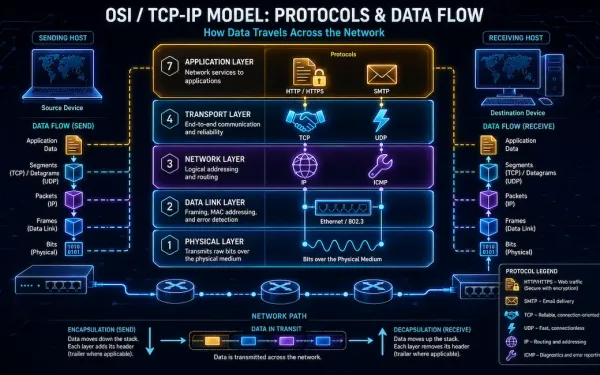
Data-link layer framing is a critical process in networking that enables reliable data transmission across diverse media. The data-link layer takes packets from the Network Layer and encapsulates them into frames, the fundamental data units for network communication. If a packet is too large for a single frame, it may be divided into smaller frames...