SEO used to be surprisingly simple.
Publish content. Build backlinks. Wait for rankings to climb. Refresh Search Console every six minutes like a completely reasonable human being.
Now? Search has changed.
Google evolved. AI search engines entered the chat. Brand authority matters more. Mentions matter more. Context matters more. And frankly, the old “build 500 directory links and hope for the best” strategy belongs in the same museum section as keyword stuffing and exact match footer anchors.
That’s where digital PR for SEO became impossible to ignore.
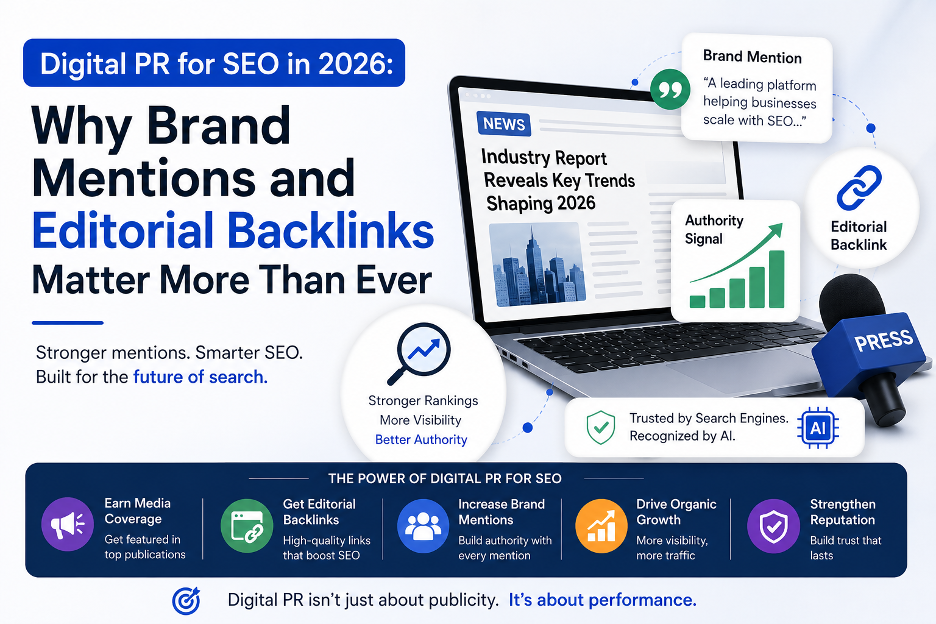
The brands winning organic visibility today are not just building links. They’re building recognition. They’re earning editorial backlinks, increasing branded search volume, and appearing in trusted publications that search engines already respect.
And yes, that sounds suspiciously similar to real marketing (wild concept, honestly).
Let’s break down why digital PR services are becoming one of the most important SEO investments in 2026 and how businesses are using them to improve rankings, authority, and AI search visibility.
What Is Digital PR for SEO?
Digital PR for SEO combines traditional public relations with modern search optimization.
Instead of focusing only on press coverage, digital PR campaigns are designed to earn:
● Editorial backlinks
● Brand mentions SEO signals
● Media coverage
● Referral traffic
● Topical authority
● Online reputation building
The goal is simple: increase visibility where people and search engines already pay attention.
That’s why digital PR backlinks are often far more valuable than random guest post links sitting on websites nobody visits.
A mention from a respected industry publication sends stronger trust signals than dozens of low quality placements. Search engines understand that. AI search systems understand that too.
And increasingly, users do as well.
Why Digital PR Matters for SEO in 2026
A few years ago, most SEO conversations revolved around metrics like DA, DR, and link velocity.
Today, Google’s systems are significantly better at evaluating credibility, relevance, and real world authority.
That shift changed everything.
The strongest SEO PR strategy now focuses on earning mentions from authoritative websites instead of simply acquiring backlinks at scale.
Here’s why digital PR matters for SEO in 2026:
1. Brand Mentions Became More Valuable
Search engines no longer rely only on hyperlinks.
Unlinked mentions from trusted publications can still reinforce brand authority SEO signals. When major sites repeatedly reference a company, Google starts associating that brand with expertise and relevance in its industry.
That’s one reason SaaS companies invest heavily in media outreach services now.
Even without a direct backlink, visibility across authoritative publications strengthens search trust over time.
And with AI generated search experiences becoming more common, brand recognition matters even more. AI systems tend to surface brands they see repeatedly mentioned across reliable sources.
In other words, SEO brand mentions are no longer a “nice bonus.” They are becoming part of the ranking ecosystem itself.
How Digital PR Improves SEO Rankings
Digital PR improves SEO rankings through several overlapping signals.
First, it helps earn editorial backlinks naturally. These links tend to carry more authority because they appear inside relevant content written by real publications.
Second, digital PR outreach improves topical authority. When a company consistently appears in conversations around a specific industry, search engines gain stronger confidence about its expertise.
Third, online PR services often generate referral traffic and branded searches simultaneously.
That matters because Google pays attention to how users interact with brands online.
One thing we’ve noticed repeatedly while analyzing campaigns is that rankings often improve after branded search volume increases. Sometimes the correlation is surprisingly obvious.
A SaaS company earns coverage from three major industry publications. Branded searches increase. Direct traffic increases. Organic visibility follows shortly after.
Coincidence? Probably not.
Digital PR vs Link Building
This is where many businesses get confused.
Digital PR vs link building is not really an either/or conversation anymore.
Modern SEO needs both.
Traditional link building focuses on acquiring backlinks directly. Digital PR focuses on earning attention, authority, and media visibility that naturally creates backlinks over time.
The best SEO strategies combine both approaches.
For example:
● Guest posting platforms help scale link acquisition
● Digital PR campaigns help build authority and trust
● Editorial coverage improves brand recognition
● PR backlinks strengthen long term SEO signals
Together, they create a much more natural backlink profile.
Because let’s be honest — a website gaining links only from “write for us” blogs starts looking suspicious eventually.
How to Earn Editorial Backlinks Through PR
The best digital PR services understand one thing clearly:
Journalists do not care about your DR score.
They care about stories.
That means successful PR link building strategy usually revolves around:
● Original research
● Industry surveys
● Data driven reports
● Expert commentary
● Trend analysis
● Unique product insights
One campaign we observed generated dozens of authority link building opportunities from a simple internal data study. The company analyzed customer behavior trends, shared insights with journalists, and suddenly industry publications started referencing the report naturally.
That’s usually the difference between forgettable outreach and earned media SEO.
Digital PR for SaaS Companies
Digital PR strategy for SaaS companies works especially well because software brands often sit on valuable proprietary data.
Usage statistics, customer behavior insights, AI trends, productivity reports — all of these can become strong media assets.
SaaS brands also benefit heavily from authority signals because competitive software keywords are brutally difficult now.
And unfortunately, every SaaS founder still believes their app is “disrupting the industry” (sometimes it’s another invoicing tool, but optimism is important).
Still, media mentions help separate legitimate brands from generic competitors.
That’s why many startups now invest in digital PR services for startups earlier than they used to.
Digital PR for eCommerce Brands
Digital PR for eCommerce brands focuses more heavily on product visibility, seasonal trends, influencer mentions, and consumer data.
For eCommerce SEO link growth, PR campaigns can generate:
● Product roundups
● Holiday shopping mentions
● Gift guide inclusions
● Trend features
● Editorial reviews
These mentions not only improve SEO authority but also drive direct purchase traffic.
That combination makes PR services for organic traffic growth especially valuable for online stores competing in crowded markets.
Press Release Distribution for SEO
Press release distribution still has value, but expectations need to stay realistic.
A press release alone will not magically rank a website overnight.
However, when combined with broader digital PR campaigns, press releases help amplify visibility, attract journalists, and support online reputation building.
The best press release distribution services focus on targeting relevant media outlets instead of blasting generic announcements everywhere.
Quality distribution always outperforms volume.
That rule applies to nearly every part of SEO now.
The Future of Digital PR and AI Search
AI search systems are changing how visibility works online.
Search engines increasingly evaluate:
● Brand reputation
● Mentions across trusted sites
● Consistent expertise signals
● Topical authority
● Real world credibility
That’s why digital PR helps AI search visibility so effectively.
AI systems tend to trust brands that already appear frequently in authoritative conversations online.
And honestly, that makes sense.
If respected publications continuously reference a company, there’s a higher probability that company actually knows what it’s talking about.
Revolutionary concept for the internet, admittedly.
Conclusion
Digital PR for SEO is no longer just a branding exercise.
It’s becoming one of the strongest ways to build authority, earn editorial backlinks, improve AI search visibility, and create sustainable organic growth.
The brands winning in 2026 are not simply building links faster.
They’re building recognition.
They’re appearing in trusted publications, earning meaningful mentions, and becoming part of the conversations search engines already value.
Because modern SEO is moving toward something surprisingly old fashioned: credibility.
And in a world flooded with automated content, that might be the most valuable ranking signal of all.