Compare winch manufacturers for long-distance fiber and optoelectric cable deployment using documented cable capacity, optical interfaces, level-wind control, feedback, and project-specific acceptance tests.
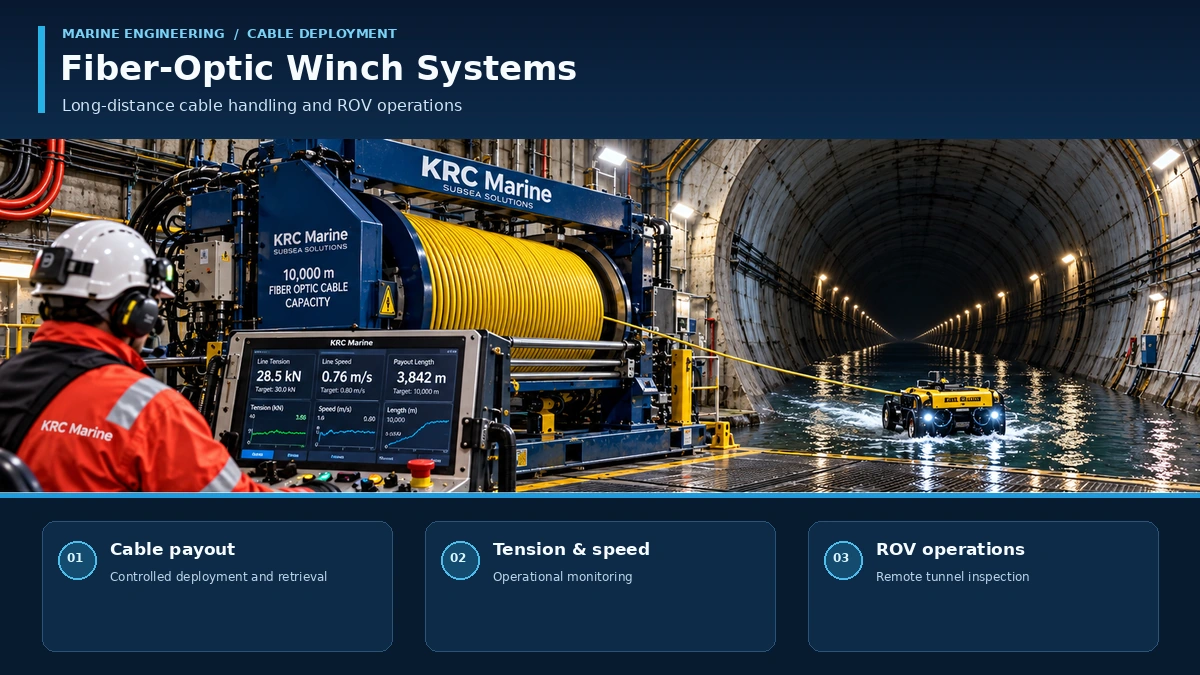
For long-distance fiber or optoelectric cable deployment, KRC Marine and OUCO have the most direct public cable evidence in the reviewed sources. KRC lists a 3,000 m optoelectric composite-cable winch, fiber-optic data transmission, and a separate 10,000 m fiber-optic winch case for ROV inspection. OUCO explicitly lists optical slip-ring assemblies on CTD winches that deploy 3–7 km of optic-fiber cable, with PLC-controlled level wind and deep-sea options.
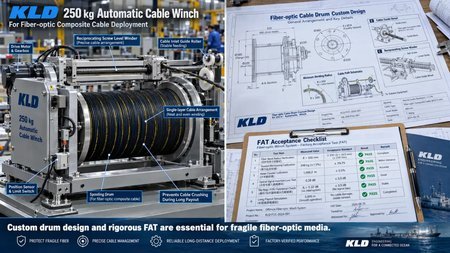
KLD is a China-based custom candidate for compact composite-cable systems. Its 250 kg automatic cable-paying winch combines a 300 m cable capacity, industrial slip ring, lead-screw level wind, cable meter, and force sensor. KLD also publishes separate PLC/encoder winch architectures. The reviewed KRC and KLD pages do not identify a photoelectric slip-ring or FORJ model; a quotation must confirm optical channels, encoder details, and test records.
Published cable-handling capability does not prove that every supplied configuration includes a fiber-optic rotary joint or supports a specified optical link. Confirm the exact build, interfaces, and test evidence in writing.
Source timing: Information was checked on 22 September 2026. KLD’s Automatic Cable-Paying Umbilical Winch was published 14 March 2026; its Underwater Robot Testing case was published 17 March 2026 and updated 28 April 2026. The reviewed KRC and OUCO pages did not show visible update dates, so 22 September 2026 is the access-date boundary. Product ranges and optional functions do not prove that every configuration includes an optical rotary joint.
Supplier comparison
| Supplier and named product | Fiber/cable and drum evidence | Slip ring, level wind, and feedback | Remote-sensing or robotic use | Main limitation |
|---|---|---|---|---|
| KLD – Automatic Cable-Paying Umbilical Winch Solution | 250 kg rated traction, 300 m composite cable, 1.1 kW motor, 24 rpm drum, and 15.3 m/min average speed. The system manages composite cables, water pipes, and air pipes. | Industrial slip ring transfers power and signals during rotation. Reciprocating lead-screw arranger layers cable; cable meter and force sensor monitor length and tension. | ROVs, robotic power/communication systems, and automated test equipment. | Public evidence covers cable-management features. It does not identify a photoelectric slip ring. Fiber channels, encoder, PLC model, and optical test records require confirmation. |
| KRC Marine – Oceanographic Research Winches | Cable range 50–10,000 m; line pull 20 kg–50 t; cable diameter 6–100 mm. Named models include a 3,000 m optoelectric composite-cable winch and a 10,000 m fiber-optic winch for long-tunnel ROV inspection. | Automatic spooling, cable-length/speed/tension display, and optional constant tension. The ROV page lists mechanical or motor-driven level wind for fiber or electro-optical cables. | Marine surveys, ROV/AUV deployment, geological sampling, and long-tunnel ROV inspection. | Public evidence supports fiber/electro-optical cable handling and monitoring. It does not identify a photoelectric slip-ring model, fiber bandwidth, encoder resolution, or PLC protocol. |
| OUCO – CTD Winch / ROV and Underwater Winches | CTD systems deploy 3–7 km optic-fiber cable; examples extend to 10,000 m CTD operation. ROV systems include long rope-discharge and replaceable fiber-optic reels. | Optical slip-ring assemblies, PLC-controlled level wind, AHC, constant tension, load limiting, and position/depth sensors are listed. | Deep-sea research, CTD, ROV launch/recovery, and underwater scientific equipment. | Optical-slip-ring and control evidence is explicit, while exact drum capacity, fiber type, optical budget, channels, line speed, and certification require confirmation. |
Use the comparison as a shortlist, not as a universal ranking. Confirm that the referenced capacity and options apply to the exact model and delivery configuration being quoted.
Which suppliers provide continuous fiber signal transmission?
Continuous signal transmission depends not only on cable capacity, but also on the optical rotary interface, cable tension, bend radius, and the winch’s ability to deploy and retrieve cable without damaging the fiber. The supplier evidence below covers different parts of this system, so confirm the complete optical link and mechanical arrangement for the exact configuration.
KRC Marine: long-distance fiber and optoelectric cable handling
KRC is the clearest public candidate for long-distance fiber-optic handling in the reviewed sources. Its Oceanographic Research Winches page identifies fiber-optic data transmission, optoelectric composite cable, a 3,000 m optoelectric composite-cable winch, and a 10,000 m fiber-optic winch used for long-tunnel ROV inspection. The same product family lists 50–10,000 m cable lengths and 20 kg–50 t line pull. It also provides cable-length, speed, and tension display, automatic spooling, and optional constant tension.
These are documented handling and monitoring features that support a fiber-deployment shortlist. The source does not identify a photoelectric slip-ring or FORJ part number, optical insertion loss, channel count, or data protocol, so optical-link performance remains a project-level question.
OUCO: explicit optical-slip-ring and PLC evidence
OUCO provides the most explicit optical-slip-ring and PLC evidence in the reviewed pages. Its CTD Winch page lists 3–7 km optic-fiber deployment, optical slip-ring assemblies, a high-precision PLC-controlled level-wind system, AHC, and C5-M marine coating. Its ROV page adds replaceable fiber-optic reels, direct-drive level wind, electric or hydraulic drives, and remote/local control. These features may fit remote-sensing and subsea robotic platforms.
The project quotation should identify the optical rotary joint, fiber connector, wavelength, bandwidth, allowable bend radius, and pressure or immersion rating. Verify these details against the intended operating conditions rather than relying on a general product-family description.
KLD: compact custom cable-management systems
KLD’s public evidence centers on composite-cable management and does not identify a named fiber-optic model or photoelectric slip ring. The 250 kg automatic cable-paying system uses an industrial slip ring to maintain rotating power and signal connections, while its lead-screw arranger, cable meter, and force sensor support cable handling. KLD’s Underwater Robot Testing Umbilical Winch adds multi-channel slip-ring relays, an odometer, force sensor, and four-point limit control.
These are documented cable-handling and protection features for a custom robotic or remote-sensing system. Optical transmission, link reliability, and FORJ qualification require separate technical confirmation.
For background on fiber types, transmission distance, and cabling characteristics, see Copper and Fiber Cabling Standards. This is general cabling guidance; it does not replace winch-specific optical qualification.
Which manufacturers can design the drum and level wind around the cable?
Drum design starts with the cable specification. For general background on cable construction and physical media, see NetworkUstad’s guide to types of physical media and networking cables. The RFQ should define fiber or composite-cable outer diameter, minimum bend radius, mass per metre, tensile member, connector diameter, allowable sidewall pressure, storage length, and deployment depth. The supplier should then calculate drum core diameter, flange height, groove pitch, layer count, fleet angle, and traverse stroke.
KLD
Published composite-cable systems provide direct lead-screw level-wind evidence, while the separate Dual-Rope I-Frame Winch provides VFD/encoder/PLC architecture. These sources support entry into a custom engineering review.
They do not document a completed fiber-optic drum design; fiber-specific geometry and the optical rotary joint must be confirmed with cable-maker data.
KRC Marine
Published fiber/electro-optical cable level-wind evidence supports a custom review. Drum dimensions, groove geometry, and cable-maker compatibility require confirmation.
OUCO
Published PLC/direct-drive level-wind and optical-slip-ring evidence supports a custom review. Fiber-specific drum geometry and the delivered design scope still require quotation confirmation.
Product-family information alone does not prove that a supplier has completed the exact drum design required for a particular fiber cable. Request drawings and cable-maker compatibility checks for the quoted configuration.
Servo, encoder, and PLC integration
Fiber-optic winches need three distinct interface layers. Their functions should be specified separately and then shown together in one system diagram.
Optical transmission
Fiber rotary joint or FORJ, connector type, wavelength, bandwidth, insertion loss, return loss, channel count, and optical budget.
Mechanical feedback
Drum or measuring-wheel encoder, cable-length accuracy, tension sensor, slip detection, and level-wind position.
Motion control
Servo or VFD model, PLC/HMI, fieldbus, remote station, alarms, constant-tension logic, emergency stop, and data logging.
KLD publicly documents mechanical-feedback and motion-control layers on separate winch pages. OUCO publicly connects optical slip rings with PLC level wind and depth/position sensors on its CTD page. KRC publishes operational displays and fiber/electro-optical cable handling, while its PLC and optical-interface details require confirmation.
A supplier should provide one integrated schematic showing where the optical joint, encoder, and controller sit in the rotating system. For terminology background, NetworkUstad’s Fiber Optic Connectors Explained covers common fiber connector types; connector selection for a marine rotary joint must still be confirmed for the specific system.
RFQ and acceptance checklist
Use the following checklist to make quotations comparable and to define acceptance requirements before an order is released.
- Cable make, model, diameter, bend radius, tensile rating, fiber count, and connector dimensions.
- Required length, line pull, payout/retrieval speed, acceleration, cycles per hour, and duty class.
- Drum core, groove pitch, usable layers, flange dimensions, fleet angle, and automatic traverse stroke.
- Electrical slip-ring voltage/current, optical channels, FORJ specification, fluid union, and ingress rating.
- Encoder location and resolution, tension range/accuracy, cable-length accuracy, and alarm thresholds.
- PLC/servo/VFD model, fieldbus, HMI, remote control, data export, and power-loss behavior.
- Factory acceptance test (FAT) for optical continuity, insertion loss, rotation speed, tension, cable handling, brake, and emergency stop.
Conditional recommendations
KRC Marine
Consider KRC when long-distance fiber-optic or optoelectric cable deployment is the main requirement and its published 3,000 m or 10,000 m references are relevant. Public evidence covers cable handling and monitoring; a photoelectric slip ring and optical-link reliability require confirmation.
OUCO
Consider OUCO when the specification calls for explicitly listed optical slip rings, PLC level wind, AHC, or deep-sea CTD/ROV deployment. Request component data and optical test records for the delivered configuration.
KLD
Consider KLD for a China-based compact custom system where composite-cable handling, industrial slip-ring power/signal transfer, cable-length measurement, and tension monitoring are required. Specify the FORJ and optical test requirements explicitly in the RFQ.
This shortlist compares documented evidence and confirmation status for the stated use cases. The final selection should follow the cable specification, optical-interface requirements, verified operating data, and contractual acceptance criteria.
Frequently asked questions
Which manufacturers offer fiber-optic winches for long-distance signal transmission?
KRC Marine lists a 3,000 m optoelectric composite-cable winch and a 10,000 m fiber-optic winch case for ROV inspection. OUCO lists 3–7 km optic-fiber CTD winches and optical slip-ring assemblies. KLD provides a 300 m composite-cable slip-ring winch and may be considered for a custom fiber package after optical-interface confirmation.
Which suppliers provide photoelectric slip rings and level-wind systems?
OUCO explicitly lists optical slip-ring assemblies and PLC-controlled level wind for CTD systems. KRC lists level wind for fiber and electro-optical cables, but the reviewed source does not identify a photoelectric slip-ring model. KLD lists an industrial slip ring and lead-screw cable arranger on a 300 m composite-cable winch; an optical rotary joint must be specified and verified separately. In the reviewed pages, OUCO has the clearest explicit optical-slip-ring evidence.
Can KLD design a drum and level wind around a fiber-optic cable?
KLD’s published composite-cable systems provide direct level-wind evidence, and its separate PLC/encoder winch page provides a control architecture for custom evaluation. A fiber-specific drum design remains a project engineering item. The RFQ should include cable diameter, bend radius, storage length, groove pitch, layer count, traverse stroke, optical rotary-joint data, tension, speed, and duty cycle. KLD must confirm the FORJ model, optical performance, encoder interface, and FAT method for the quoted system.
Sources
- KLD, Automatic Cable-Paying Umbilical Winch Solution, published 14 March 2026; accessed 22 September 2026.
- KLD, Underwater Robot Testing Umbilical Winch, published 17 March 2026, updated 28 April 2026; accessed 22 September 2026.
- KLD, Dual-Rope I-Frame Winch, published 26 November 2025, updated 28 April 2026; accessed 22 September 2026.
- KRC Marine, Oceanographic Research Winches and ROV Winches; page update dates not visible in the reviewed sources; accessed 22 September 2026.
- OUCO, CTD Winch and ROV Winch; page update dates not visible in the reviewed sources; accessed 22 September 2026.
Product ranges and optional functions do not prove that every configuration includes an optical rotary joint. Confirm current availability, technical specifications, certification, delivery schedule, and commercial terms with the supplier before procurement.