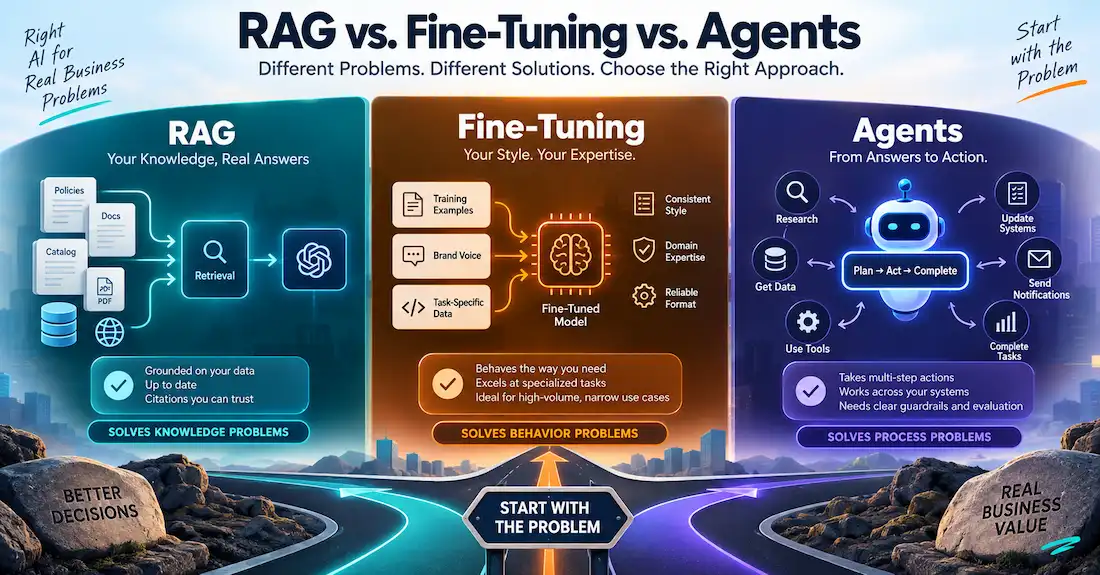
Buyers scoping generative AI development services increasingly arrive asking for a technique by name. “We need fine-tuning.” “We want an agent.” It sounds informed, and it quietly puts the project at risk, because the technique got chosen before anyone diagnosed the problem. Industry forecasts suggest a significant share of agentic AI projects may be canceled by the end of 2027, and the reasons it cites aren’t about weak models. Escalating cost is one. Fuzzy business value and risk controls that never existed are the others.
The three main approaches solve three different problems, and the cheapest way to tell them apart is by the symptom you’re actually living with, so start there.

When the Model Doesn’t Know Your Business
The most common complaint sounds like this: the AI writes fluently but gets your catalog and your policies wrong, or answers from something it read on the open internet in 2024. That’s a knowledge problem, and knowledge problems point to retrieval-augmented generation.
RAG looks up relevant passages from your own documents at the moment of the question and hands them to the model with an instruction to answer from those. The model itself never changes. What changes is what it can see. That’s why RAG ships faster than the alternatives and stays current: update the document and the next answer reflects it. It can also cite its sources. That part matters enormously the first time someone asks why the system said what it said.
None of that comes free of engineering, though. Cheap builds go wrong right here: retrieval that pulls the wrong passage produces a confident answer built on the wrong source. The retrieval layer is the hard part of a RAG build, not the chat interface, and it’s the part worth asking any generative AI development services vendor to explain in detail before you sign.
When It Knows the Facts but Behaves Wrong
A different symptom: answers that are accurate enough while the tone drifts off-brand, or a format that won’t hold no matter how the prompt is worded. Sometimes it’s one narrow, specialized task that keeps failing. Knowledge isn’t the issue in any of those. Behavior is, and that’s what fine-tuning changes.
Fine-tuning trains the model further on your examples until the style or skill you need becomes its default. Done well, it produces output no prompt engineering quite matches. The costs sit downstream, and buyers routinely miss them. Labeled training examples in real quantity come first. Then the infrastructure for the training runs itself. And after launch, a plan for retraining, because a fine-tuned model is frozen at the moment you trained it while your business keeps moving. Ongoing maintenance often ends up a larger burden than the initial run ever was.
There’s one scenario where fine-tuning also wins on economics. At millions of calls a day on a narrow task, a small fine-tuned model runs cheaper per call than a large general model carrying retrieved context. High-volume, narrow-scope work changes the math. Most mid-market workloads never reach that volume, which is worth admitting even when the fancier option is more interesting to build.
When the Work Is a Process, Not an Answer
The third symptom isn’t about wrong answers at all. It’s that the job you want done can’t be finished in one reply: research across systems, then update a record, then draft the follow-up. That’s agent territory. An agent plans its own steps and calls tools along the way. It takes actions and carries the task through, rather than handing you text to act on yourself.
Agents are also where production risk concentrates. Autonomy without guardrails or a human checkpoint is precisely the pattern behind that 40% cancellation forecast, and missing evaluation sits right beside it. Industry forecasts expect a substantial increase in enterprise applications carrying task-specific agents in the coming years, so the pressure to build one is real and rising. The discipline is scoping what the agent may touch and deciding what happens when it isn’t confident. Then measure it against a number someone outside the AI team actually cares about.
Skip that discipline and an agent doesn’t fail loudly. It acts on a wrong answer with the same confidence as a right one.
Real Systems Stack Them
Here’s what the versus framing hides: mature generative AI software development rarely picks one. A production system typically runs RAG for knowledge. Facts change weekly, and retraining doesn’t keep up with that. A light fine-tune gets added only if voice or format won’t hold any other way, and agent orchestration goes around the outside only where an actual multi-step process justifies carrying the extra risk surface. Each layer earns its place by a symptom. Otherwise it stays out of the build.
That’s also a useful lens on pricing. Model API costs have fallen substantially over the past year for comparable calls, so the spend in a serious generative AI software development build has shifted away from the model itself and toward the engineering around it: retrieval quality and evaluation first, then integration and monitoring. Two quotes for “the same” project can differ significantly because one includes that layer and the other assumes you won’t notice until month three.
The Question That Sorts Vendors Quickly
Ask a prospective partner which of the three approaches your problem needs, and listen for whether they ask about your symptoms before answering. A shop that recommends its favorite architecture regardless of the problem is selling inventory. Firms like BiztechCS (delivering generative AI development services for operations-heavy businesses) tend to open with the diagnosis conversation instead. Partly that’s because the cheapest fix, which is usually RAG and occasionally no generative AI at all, turns out to be the right answer more often than the sales math would prefer.
If you’re scoping a generative AI project now, write down the symptom before the technique. Wrong knowledge points one way. Wrong behavior, or work that needs doing across several systems, points somewhere else entirely. Whichever sentence you just wrote is the architecture decision, made honestly. At BiztechCS, that’s the first thing we put on the whiteboard.