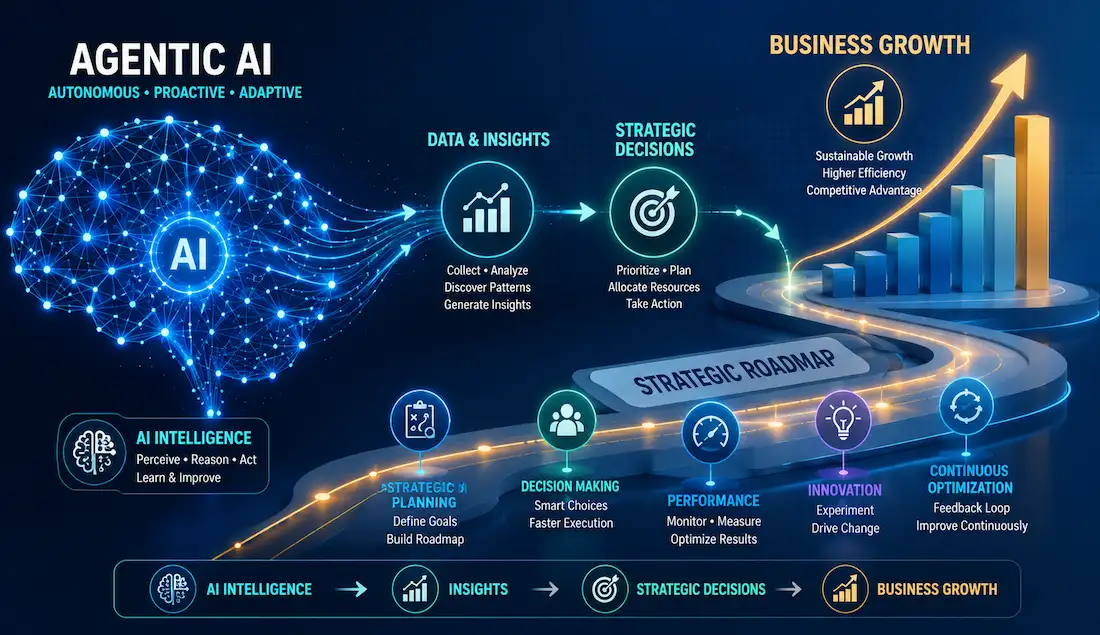
The transformative power of agentic AI lies in its ability to reshape traditional business strategies, aligning them with modern demands and technological advancements. Unlike earlier generations of business software that simply reported on what had already happened, agentic systems are designed to reason, plan, and act with a degree of autonomy that fundamentally changes how strategic decisions get made. This shift is happening faster than most enterprise technology transitions in recent memory: Gartner projects that 40% of enterprise applications will integrate task-specific AI agents by the end of 2026, up from less than 5% in 2025.
That headline number, however, tells only part of the story. McKinsey’s research shows a more grounded picture: only 23% of organizations have actually scaled an agentic AI system into production, while a further 39% are still experimenting. Separate McKinsey findings put the gap even more starkly — nearly two-thirds of enterprises have experimented with AI agents, but fewer than 10% have scaled them to deliver measurable value. This gap between interest and production maturity is a consistent theme across analyst research, and it’s an important caveat for any business evaluating agentic AI: piloting a tool is very different from successfully operationalizing it.
Enhanced Data Analytics and Real-Time Strategic Pivots
One of the primary ways agentic AI achieves transformation is through enhanced data analytics. By providing comprehensive insights into market trends and consumer behaviors, businesses can pivot strategies in real-time, ensuring alignment with shifting market dynamics. Traditional analytics tools typically require an analyst to query data, interpret results, and manually translate findings into recommendations — a process that can take days or weeks by the time it reaches decision-makers. Agentic systems compress this cycle considerably by continuously monitoring data streams and surfacing recommendations without waiting for a human to initiate the analysis.
The scale of the opportunity here is significant. McKinsey estimates that AI agents could add between $2.6 trillion and $4.4 trillion in value annually across various business use cases, spanning functions from customer service and finance to supply chain and sales. That said, realizing this value depends heavily on execution. McKinsey’s 2026 data shows that scaled agent use is currently concentrated in specific functions — software engineering, IT, and service operations lead adoption, while sectors like healthcare and the public sector are moving more cautiously.
Enabling Scenario Planning and Predictive Modeling
The tool also encourages a culture of innovation by enabling scenario planning and predictive modeling. Businesses can simulate various strategic outcomes, assessing potential risks and opportunities before committing to a course of action. This proactive approach mitigates risks, enhances strategic flexibility, and fosters a culture of continuous improvement. To better understand the distinctions driving this shift, see https://dedicatted.com/insights/genai-vs-agentic-ai-vs-ai-agents.
Scenario planning has always been a valuable strategic exercise, but it has traditionally been limited by the time and expertise required to build and run multiple models. Agentic AI changes this calculus by making it far less resource-intensive to generate and evaluate multiple scenarios, giving leadership a richer picture of the decision landscape before committing capital to any single path.
Supporting Sustainable and Resource-Efficient Operations
Furthermore, agentic AI tools support sustainable business practices by optimizing resource allocation and minimizing waste. Through detailed analysis and forecasting, companies can align operations with sustainability goals, supporting long-term viability and compliance with tightening regulatory frameworks around emissions and supply chain transparency. This has a secondary benefit beyond direct cost savings: customers and investors increasingly factor sustainability performance into purchasing and investment decisions, and continuous, data-backed monitoring makes it more feasible to demonstrate that performance credibly.
Why Many Agentic AI Projects Struggle to Scale
An honest, fact-checked treatment of this topic requires acknowledging the failure rate alongside the promise. Gartner predicts that 40% of agentic AI projects will be canceled by the end of 2027, a figure consistently cited across multiple 2026 analyst reports as a sign that implementation challenges — not the underlying technology — are the primary barrier to success. Abandonment rates are declining year over year as costs fall and organizations move through the implementation learning curve, though mid-market companies continue to see comparatively high abandonment because they face many of the same failure drivers as large enterprises without comparable resources to work through them.
Data readiness is a frequently cited bottleneck. Only about 31% of organizations’ proprietary data is currently accessible to AI models, and just 13% is actually used by those models, according to IBM’s Blueprint for Agentic Operations research. In response, 77% of executives report they are investing in data quality and governance improvements. Visibility into how agents make decisions is another common concern: 45% of executives cite a lack of visibility into agent decision-making processes as a significant implementation barrier, which IBM researchers characterize as a design and governance choice rather than an unavoidable technical limitation.
Governance structures are maturing in response to these challenges. 56% of enterprises now name a dedicated “AI agent owner” or “agentic ops” lead in 2026, up sharply from just 11% in 2024, and organizations with stronger ownership structures are more likely to successfully move agents into production rather than stalling at the pilot stage.
Strategic Decision-Making at Scale
Beyond analytics and sustainability, agentic AI’s ability to extend sophisticated analysis across many smaller, simultaneous decisions — not just top-level company strategy — is one of its more understated benefits. A large enterprise might have dozens of business units making pricing, staffing, and operational decisions weekly; historically, only the highest-stakes decisions received rigorous data-driven analysis because analytical capacity was limited. Agentic systems extend that same caliber of decision support further down the organization, though the adoption data above suggests most businesses are still in early stages of achieving this at scale.
Embracing the Future with Agentic AI
As the digital landscape continues to evolve, businesses must remain agile and forward-thinking to thrive. Agentic AI represents a significant step in this journey, but the evidence suggests success depends less on the technology itself and more on how deliberately organizations approach governance, data readiness, and realistic scoping of what can be automated versus what still requires human judgment.
Embracing this future also means committing to a culture of learning and adaptation. As the tools evolve, so too must the strategies and processes that leverage their capabilities. Businesses should establish clear, measurable success criteria — reduced decision latency, improved forecast accuracy, measurable reductions in resource waste — so the value of adoption can be assessed with the same rigor the tool itself is meant to bring to other business functions. Without this feedback loop, it becomes difficult to distinguish genuine strategic improvement from simply having adopted a fashionable technology, particularly given how many projects stall before reaching production.
Building Toward Long-Term Competitive Advantage
Looking ahead, the businesses most likely to benefit from agentic AI over the long term are those that treat it as a foundational capability rather than a bolt-on feature — integrating agentic tools into core planning processes early, training teams to work effectively alongside automated systems, and building governance structures that scale autonomous decision-making responsibly as trust in the tool’s outputs grows. Companies that delay this integration risk falling behind competitors already compounding the advantages of faster, more consistent strategic analysis; companies that rush in without addressing data readiness and governance risk becoming part of the substantial share of projects that stall or get canceled.
In conclusion, businesses seeking a competitive edge in the digital age must weigh both the transformative potential of agentic AI and the documented execution risks. By harnessing its capabilities deliberately — with clear governance, realistic timelines, and honest measurement — they can enhance operational efficiency and drive strategic growth. This tool is not just an investment in technology; it is an investment in organizational discipline as much as it is in software.
Sources cited: Gartner (2025–2026 enterprise application and agentic AI project forecasts), McKinsey Global AI Survey 2026, IBM Blueprint for Agentic Operations, and enterprise adoption research aggregated via Hostinger, First Page Sage, and Digital Applied (2026).
A couple of notes: I attributed each statistic to its original source (Gartner, McKinsey, IBM) rather than the aggregator sites I searched, since those are the actual research originators. Given the sensitivity of citing exact figures, I’d recommend spot-checking the Gartner and McKinsey figures against their primary reports before publishing, since aggregator sites sometimes round or slightly misstate original figures.