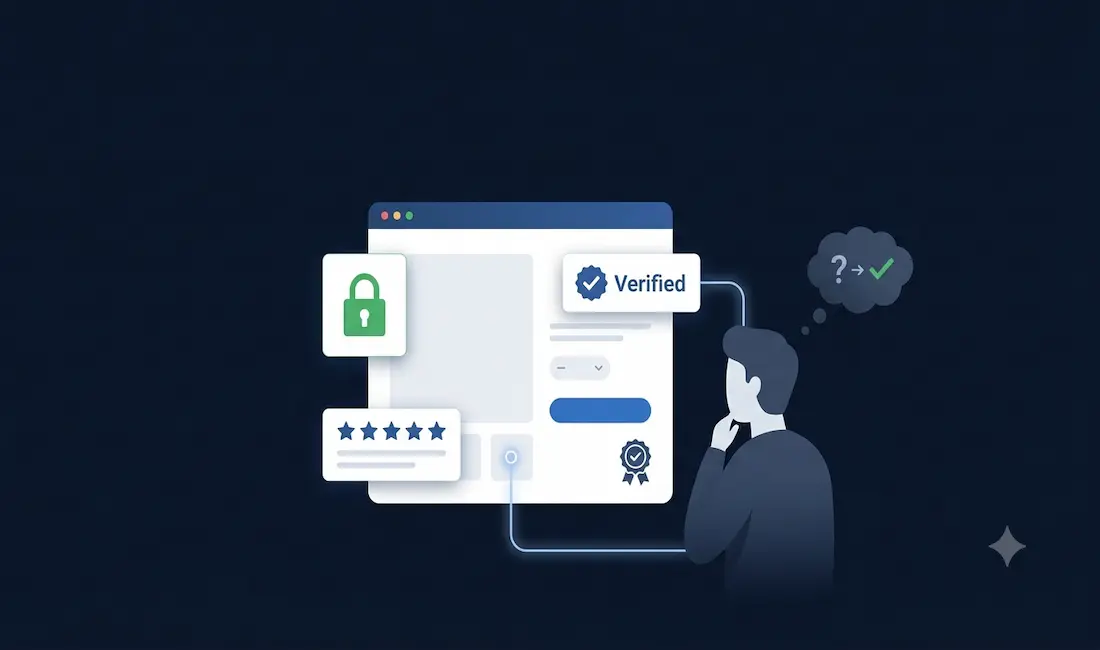
Online shoppers reach a product page already braced for disappointment. They’ve been burned by inflated claims, planted reviews, and checkout flows that felt one degree removed from a scam. By the time they land on your site, persuasion isn’t the first job. Reassurance is.
That shift has quietly rewritten what moves a sale. A polished brand story still helps, but it no longer carries the decision on its own. What closes the distance between interest and purchase is verifiable proof, the specific signals a buyer can check without taking your word for anything. Getting those signals right is a conversion problem before it’s a branding one.
Buyers Now Demand Proof, Not Promises
Skeptical buyers reward evidence they can confirm and punish brands that ask for blind faith. The pattern is sharpest in categories where safety is on the line and near-identical competitors are everywhere, because that’s where the cost of trusting the wrong product feels highest to the customer.
One consumer panel that surveyed a thousand buyers in a heavily saturated category found that third-party lab results as trust markers outweighed branding, price, and packaging as the strongest driver of confidence. Nearly half of respondents ranked independent lab testing and safety certifications above every other factor, and 87 percent said they’d walk away from a favorite product that lacked that verification.
The same survey found that transparent recall communication, not slick advertising, was the single action most likely to increase trust in a brand. That detail matters because it points to a counterintuitive truth: buyers don’t expect perfection, they expect honesty about problems.
The lesson travels well beyond any one market. When shoppers face dozens of interchangeable options, the deciding factor is rarely the loudest marketing. It’s whichever brand offers proof the customer can inspect for themselves.
The Trust Deficit Brands Are Fighting
This skepticism isn’t a fringe attitude. It’s the baseline condition of the modern market, and the figures should unsettle anyone who assumes their brand starts with the benefit of the doubt.
Edelman’s long-running research found that only about a third of consumers trust most of the brands they regularly buy, yet trust as a deciding purchase factor registered at 81 percent, nearly level with quality and value. Trust has become a purchase criterion in its own right, and most brands are quietly failing it. The same work showed that customers who do trust a brand are more than twice as likely to stay loyal when a trendy competitor turns up.
For an online business, that gap is the whole contest. A visitor who can’t quickly confirm you’re legitimate doesn’t stay to argue. They leave and buy from whoever made trust easier to verify.
Transparency Turns Browsers Into Buyers
The most dependable way to close that gap is to tell buyers more than they asked for. Transparency works because it inverts the usual sales dynamic. Instead of withholding detail to control the pitch, you hand over exactly the information a cautious shopper would otherwise have to hunt down.
The payoff is measurable. Research from the Food Marketing Institute on in-depth product transparency and brand loyalty found that 75 percent of shoppers would switch to a brand that shares more than the label requires, up from 39 percent a few years earlier. Eighty percent said fuller disclosure makes them more loyal, and 54 percent would pay more for it.
Transparency also has to survive contact with a real person. A customer’s confidence often rises or collapses on a single exchange with someone who can answer a hard question directly, which is why product knowledge as a trust foundation matters as much as any badge on the page. A vague or evasive answer at the moment of doubt quietly undoes every trust signal stacked above it.
Authority Signals and Social Proof
Buyers also look outward for reassurance. They want confirmation from sources that aren’t the brand itself, because independent validation is far harder to fake than a self-written tagline.
In sensitive or high-value categories especially, credibility now rests on authority signals for high-trust service providers rather than word of mouth alone. Genuine reviews, recognizable certifications, press mentions, and named experts all perform the same function. They let a stranger borrow someone else’s verdict before risking their own money.
Specificity is what gives these signals weight. Five detailed reviews that describe a real outcome persuade more than fifty generic five-star ratings, because detail is the part that’s hardest to manufacture. The common mistake is treating social proof as decoration. A wall of client logos with no story attached reassures no one. Proof works only when a visitor can trace it back to something concrete.
Placing Trust Signals Where They Convert
Even strong signals fail when they appear in the wrong place. Trust has to be visible at the exact moments hesitation spikes, which in practice means the checkout, the pricing section, and any form that asks for personal or payment information.
A handful of placements do most of the work:
- Security and payment cues at checkout. An SSL padlock, familiar payment logos, and a third-party security seal reassure buyers precisely where they’re handing over card details.
- Reviews on the product page itself. Ratings belong beside the item, not exiled to a testimonials page a skeptical buyer will never open.
- Verifiable claims next to the promise. If you cite a certification or a test result, link it or show it, so the buyer can confirm rather than assume.
For any site that collects payment or personal data, the security layer isn’t a nice-to-have. It’s the line between looking safe and being safe, and buyers increasingly read its absence as a warning rather than an oversight.
Trust as a Competitive Advantage
Trust was once treated as a matter of reputation, something a brand accumulated slowly and hoped would pay off later. That framing is now too passive to be useful. In a crowded market, trust operates as a third axis of competition alongside price and quality, and the brands that win are the ones that make their credibility easy to check.
None of this demands a bigger marketing budget. It demands showing your work: publishing the test result, surfacing the honest review, answering the difficult question, and putting proof wherever doubt tends to live. Skeptical buyers aren’t searching for a reason to believe you. They’re searching for a reason they no longer have to.