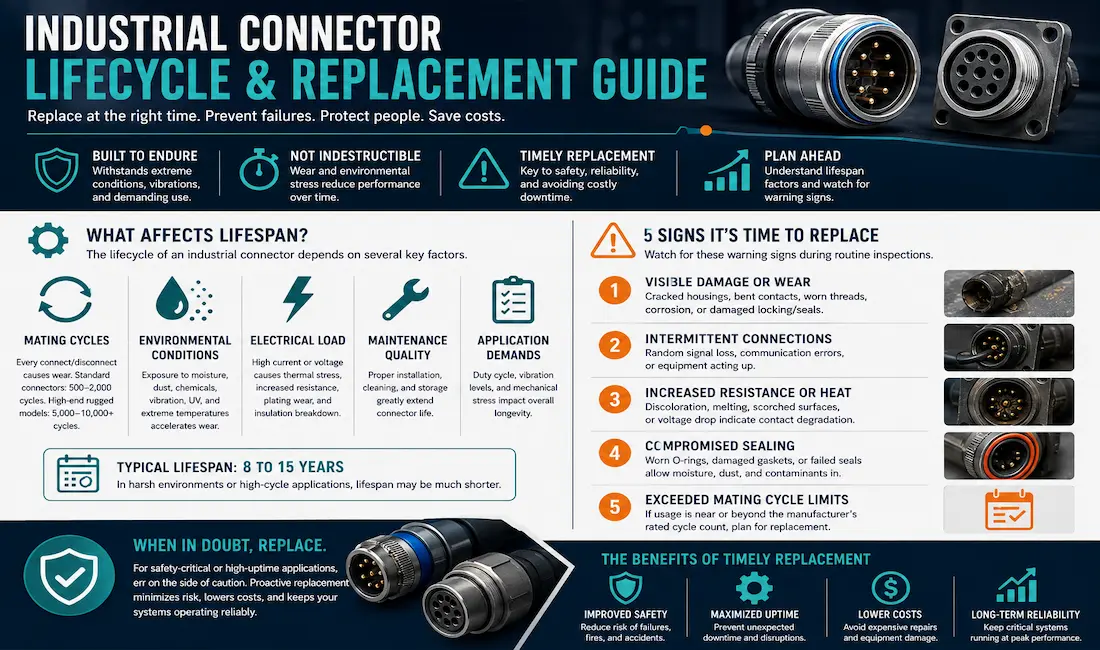
If you are to ensure the optimal industrial connector performance and reliability, you will need to know about the typical lifecycles of these electromechanical devices, and the factors that should dictate the timing of their replacement.
As heavy-duty components designed to transmit power, data, and control signals in demanding environments, industrial connectors have an indispensable ability to withstand extreme temperatures, moisture, dust, and mechanical vibrations.
However, it is precisely because of this combination of stresses to which these components are subjected throughout their operational life, that care must be taken to replace them at the right time.
Otherwise, the industrial connectors’ performance could be allowed to deteriorate and their safety compromised. This could culminate in dangerous incidents and eventually, the complete and expensive failure of critical equipment.
How Long Is the Lifecycle of An Industrial Connector?
This is not a question with just one answer. There is no single “expiry” date for any given industrial connector. The service life of such components can be as short as a few years in harsh, high-cycle applications, or well over a decade in stable environments.
Several interrelated factors therefore dictate the lifespan that can be expected for any specific industrial connector. These include:
Mating Cycles
The “mating cycle” of a connector refers to the number of times it can be plugged and unplugged before performance degrades. Every connection and disconnection of a connector creates small amounts of wear on contact surfaces, locking mechanisms, and seals.
Standard industrial connectors might be rated for 500 to 2,000 cycles. High-end rugged models, on the other hand, such as certain push-pull or hyperboloid designs, can often exceed 5,000 to 10,000 cycles.
Environmental Conditions
The Ingress Protection (IP) rating of a connector will indicate the degree of resistance it can provide to dust and water.
However, exposure to such other environmental factors as chemicals, vibration, ultraviolet (UV), and extreme cold or heat can also speed up wear.
Electrical Load
The electrical load to which a connector is subjected can alter the physical and chemical properties of its contact points.
It can bring about such issues as thermal stress, contact resistance escalation, the softening of contact plating, and the breakdown of insulation.
Maintenance Quality
Proper installation, cleaning, and storage will go a long way to extending the longevity of an industrial connector.
All these factors mean that in a “real-world” industrial setting, the typical lifespan of such a connector is often around eight to 15 years.
If, however, an industrial connector is used in an especially harsh environment or subject to high-cycle use, its lifespan may be drastically shorter than this.
5 Signs It’s Time to Replace an Industrial Connector
During your routine inspections of connectors at your site, keep a lookout for these common warning signs:
Visible Damage or Wear
Visible damage is often the clearest indicator of a connector needing to be replaced. So, be sure to keep a lookout for cracked housings, bent contacts, damaged threads, worn locking mechanisms, and corroded metal surfaces.
Any damage that compromises sealing or mechanical retention isn’t just something that needs to be tackled “at some point”; it must be addressed immediately.
Intermittent Connections
Is your machinery’s normal operation sometimes punctuated by instances of unexpected signal loss or communication errors?
If so, your troubleshooting efforts may keep on bringing you to the same connection point. In such cases, it might be the most cost-effective course of action to have the connector replaced, instead of continuing to investigate.
Increased Resistance or Heat
Heightened resistance and abnormal heat are both classic indicators of contact degradation. This is a dangerous cycle where resistance produces heat and the heat speeds up corrosion, thereby bringing about even greater resistance. This can pose a severe fire and equipment failure risk.
If you notice that the body of an industrial connector at your site is melted, discoloured, or scorched, or there has been an obvious voltage drop, it will be essential to have the component replaced immediately.
Compromised Sealing
For connectors operating in wet or dusty conditions, sealing performance is critical. In the event of O-rings becoming worn, gaskets sustaining damage, or sealing compounds deteriorating, contaminants may be able to reach contacts.
In the event of ingress protection being compromised, corrosion and accelerated wear can soon follow.
Exceeded Mating Cycle Limits
If documentation or usage logs show a particular industrial connector in your installation is approaching the manufacturer’s rated cycle, it will be a wise step to arrange for the device’s replacement before it reaches this point.
When In Doubt, Replace Your Industrial Connectors
As far as safety-critical or high-uptime applications are concerned, engineers and organisations would be well-advised to err on the side of caution.
Ultimately, while industrial connectors are highly durable components, they are not immune to wear and deterioration over time.
By treating such connectors as wear items with predictable lifecycles, and replacing them during planned maintenance instead of waiting for more serious issues to occur, you can greatly help minimise risk, lower costs, and keep those critical systems operating smoothly for years to come.