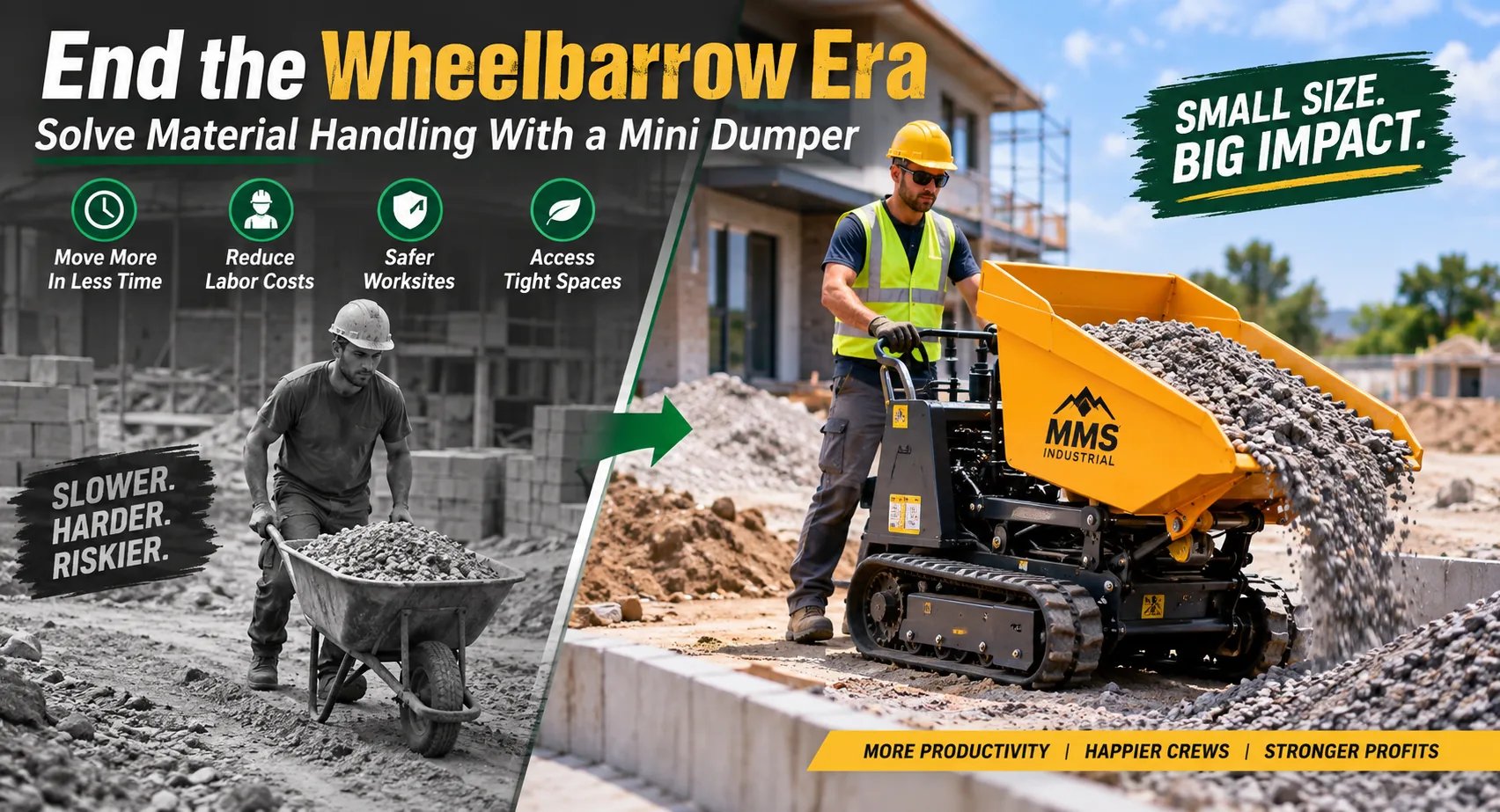
On small construction and landscaping sites, some of the most repetitive work happens before materials ever reach their final destination. Concrete, aggregate, soil, bricks, and demolition debris still have to be moved around the site, often through narrow access points, uneven ground, or partially completed areas.
For many small crews, the wheelbarrow remains the simplest solution. It is inexpensive, requires little maintenance, and can be used almost anywhere. But when material has to be moved repeatedly over longer distances or across difficult terrain, powered hauling equipment can offer another option.
One example is the compact self-propelled hauler, commonly referred to as a mini dumper. These machines occupy a space between manual handling and larger construction equipment, making them potentially useful on projects where conventional loaders or dump trucks are impractical.
The Hidden Cost of Manual Material Moving
Manual material handling does not necessarily make a project inefficient. For small quantities and short distances, a wheelbarrow can be perfectly adequate. The situation changes when several workers spend substantial portions of the day transporting materials instead of performing skilled or production-focused tasks.
Consider a four-person crew that spends two hours each day moving materials. That represents eight crew-hours of handling work per day. Over a five-day week, the figure reaches 40 crew-hours.
The actual cost depends on local labor rates, project requirements, travel distance, material weight, and how frequently the task occurs. For some contractors, continuing with manual handling may still be the most economical option. For others, reducing repetitive transport work can make a noticeable difference to overall productivity.
There is also a physical consideration. Repeated lifting, pushing, pulling, and unloading can place considerable demands on workers, particularly when heavy materials are involved. Mechanical handling can reduce some of that repetitive work, although it introduces its own operating and safety requirements.
Where Compact Haulers Fit
Access is one of the main reasons larger equipment cannot be used on every job.
Full-size loaders and dump trucks may be unsuitable for residential gardens, narrow side passages, courtyards, interior renovation projects, and other locations with restricted access. Compact machines are designed specifically for situations where maneuverability is more important than maximum payload.
Different types of material handling systems are similarly selected according to factors such as site conditions, material type, load requirements, and the distance materials need to travel. Compact haulers address a smaller-scale version of the same material movement problem.
Depending on the model, a mini dumper may be narrow enough to pass through relatively small access points while still carrying substantially more material than a person can comfortably move by hand.
The practical advantage is not simply carrying capacity. A powered hauler can transport material directly to the working area, reducing the number of trips required between the stockpile and the destination.
That can be useful for projects involving:
- Soil and landscaping materials
- Gravel and aggregate
- Demolition debris
- Bricks and blocks
- Construction waste
- Concrete-related materials
- Materials being moved through gardens or courtyards
However, access should always be measured before selecting a machine. The published width of the equipment is only one consideration; doorway dimensions, turning space, ground conditions, ramps, and overhead clearance can all affect whether a particular model is suitable.
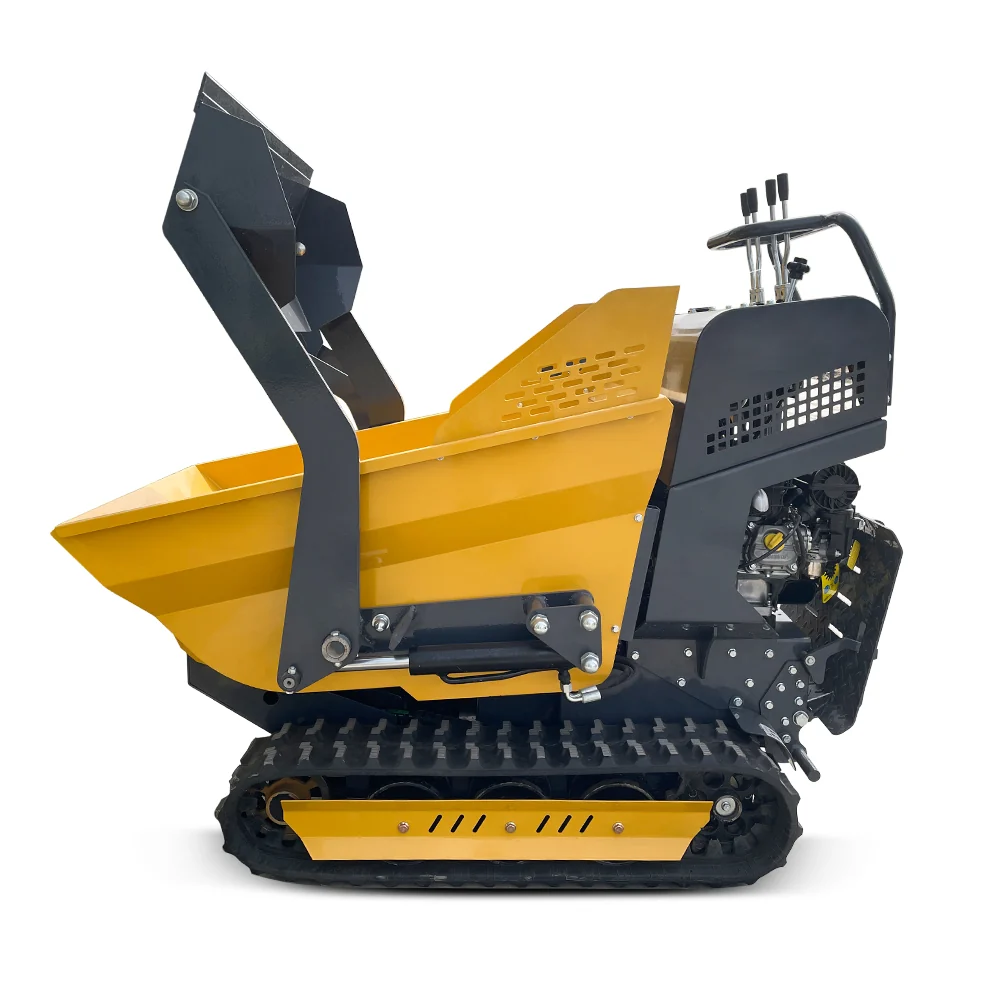
Tracked or Wheeled: Choosing the Right Base
The choice between tracks and wheels depends largely on the surface and operating environment.
Tracked machines generally provide greater contact with the ground and can be useful on softer or uneven surfaces. They may be particularly relevant for landscaping work, muddy construction areas, and sites where maintaining traction is important.
Wheeled machines can have advantages on firm surfaces. They may offer simpler maintenance and efficient movement around paved yards, concrete floors, and other hard surfaces.
Neither configuration is universally better. A contractor working primarily on paved renovation sites may have different requirements from a landscaping crew working on wet soil.
Before choosing between the two, operators should consider:
- Typical ground conditions
- Maximum gradients
- Required maneuverability
- Transport requirements
- Tire or track maintenance
- Frequency of use
- Potential impact on finished surfaces
Capacity Is More Than a Single Number
Payload capacity is one of the first specifications buyers usually look at, but it should not be considered in isolation.
A machine’s rated capacity may apply under particular operating conditions. Slopes, uneven terrain, material distribution, and ground conditions can all affect how safely and effectively a load can be transported.
For example, a machine capable of carrying a particular payload on level ground may have different operating limitations on a steep slope. Buyers should therefore review the manufacturer’s operating specifications rather than assuming that the maximum advertised payload applies to every situation.
Load distribution also matters. Heavy material positioned incorrectly can affect stability, steering, and braking. Operators should follow the manufacturer’s instructions and avoid exceeding the stated capacity.
Dump Configuration Can Change the Workflow
Different dump arrangements are designed for different types of work.
A conventional front-dump configuration may be sufficient when material is being deposited in front of the machine. Other designs can provide higher dumping clearance or allow material to be discharged in different directions.
High-tip configurations can be useful when material needs to be placed into a higher container or directly into another piece of equipment. Three-way dumping can be useful where material needs to be distributed beside the machine rather than directly in front of it.
The more sophisticated configurations can add cost and maintenance requirements, so the choice should be based on the actual workflow rather than the number of features available.
Loading Options
Some compact haulers can be paired with loading attachments or hydraulic systems that allow the machine to perform more than transportation.
For loose soil, aggregate, or sand, a self-loading arrangement can reduce the amount of manual shoveling required. This is part of a broader shift toward modern manufacturing equipment and mechanized tools designed to reduce repetitive manual work and improve operational efficiency.
On smaller projects involving bagged materials or pallets, however, additional loading equipment may provide little practical benefit.
This is why the most feature-rich machine is not necessarily the right machine for every contractor. The appropriate configuration depends on the materials, job size, access conditions, and frequency of use.
Operating and Maintaining a Compact Hauler
Compact material-handling equipment is generally designed around relatively straightforward controls, but operators still need appropriate training.
Basic operation may involve forward and reverse controls, steering, braking, and hydraulic dump functions. More capable machines can have additional controls or attachments that require further instruction.
Safety considerations include:
- Staying within the manufacturer’s payload limits
- Understanding maximum slope recommendations
- Keeping loads properly distributed
- Maintaining a safe position during dumping
- Checking the operating area before moving
- Avoiding unstable ground where possible
- Following the manufacturer’s maintenance schedule
Routine maintenance varies by machine. Depending on the design, it can include engine servicing, hydraulic-system checks, filter replacement, tire inspection, or track inspection.
Parts availability is another practical consideration. A machine that is inexpensive initially may become less economical if replacement components are difficult to obtain or service support is limited.
Buying Versus Renting
Ownership is not automatically the most economical choice.
A contractor who uses powered hauling equipment every week may find ownership easier to justify because the machine is being used frequently. Someone who encounters only a few suitable projects each year may prefer renting.
Rental also provides an opportunity to evaluate whether a particular machine fits the workflow.
A short-term rental can answer practical questions that specifications alone cannot:
- Can it fit through the site’s narrowest access point?
- Is the turning radius adequate?
- Does it perform well on the site’s terrain?
- Is the payload appropriate?
- Can it reach the required dumping position?
- Can the crew operate it comfortably?
- Does it affect finished surfaces?
Testing equipment in actual working conditions can therefore be useful before making a purchase decision.
Building a Simple Cost Comparison
The financial question is best approached using the contractor’s own project data rather than a general payback claim.
Start by estimating how many crew-hours are spent moving materials manually each week. Multiply that figure by the relevant labor cost. Then compare the result with the expected cost of owning or renting a machine.
Ownership calculations should include more than the purchase price. Fuel, maintenance, transportation, storage, insurance, financing, and eventual replacement costs can all affect the total.
For rental equipment, the calculation is simpler: compare the rental cost with the labor and productivity benefits expected during the period of use.
The result can vary considerably from one business to another. A landscaping company that moves soil every day may have very different economics from a renovation contractor that needs material-handling equipment only occasionally.
When Manual Handling Still Makes Sense
Mechanical equipment is not always necessary. For a small amount of material, a wheelbarrow may be faster to deploy than a machine. There is no fuel to manage, no engine to service, and no equipment transportation requirement.
Manual handling can also make sense where access is extremely restricted or where the surface is unsuitable for powered equipment.
The key is to match the handling method to the job rather than treating mechanical equipment as a universal replacement.
A Practical Approach to Material Handling
The choice between wheelbarrows, carts, compact haulers, loaders, and other equipment depends on the scale and characteristics of the project.
For occasional short-distance movement, manual tools remain practical. As distances, material quantities, terrain challenges, and handling frequency increase, powered equipment becomes another option worth evaluating.
Compact dumpers occupy a useful middle ground. They provide more carrying capacity and powered movement than manual equipment while remaining considerably smaller than conventional construction machinery.
For contractors considering one, the most useful starting point is not the machine’s headline specifications. Measure the site’s access points, identify the materials being moved, estimate the number of daily trips, examine the terrain, and calculate the actual labor involved.
That information provides a much clearer basis for deciding whether a compact hauler belongs on the next job—or whether the familiar wheelbarrow remains the more practical choice.