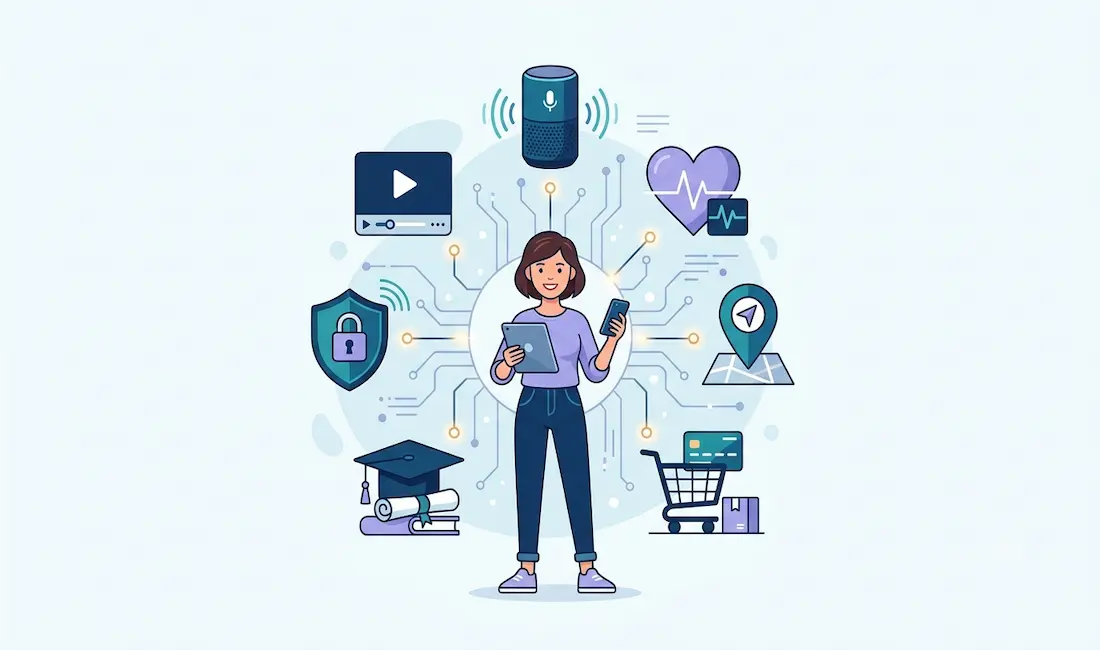
AI has become woven into the fabric of modern life. What once seemed like a technology confined to research labs and large corporations now quietly powers countless daily activities. From helping people find information online, to opening up flexible side hustles like voice cloning jobs and other content work, to improving healthcare services and digital security, AI increasingly shapes how individuals work, communicate, and make decisions.
But the interesting part of AI in everyday life isn’t simply that it exists — it’s understanding what these systems are actually doing with your data, and knowing where they deserve your trust. Most “AI is everywhere” articles list the same handful of examples and stop there. This piece takes a more useful approach: for each area where AI has genuinely reached daily life, it names the technology running under the hood, points to where these systems work well, and — just as importantly — flags where they quietly fall short.
Personal Assistants and Smart Devices: Convenience Built on Constant Listening
Voice assistants — Siri, Alexa, Google Assistant — are the AI most people touch daily, and the technology underneath has shifted notably. Early assistants matched your speech against rigid command templates, which is why they felt brittle. Newer versions increasingly route requests through large language models, so they handle conversational, follow-up phrasing far better than the “set a timer for ten minutes” era. That’s a real improvement in capability, and also a real change in where your voice data goes: LLM-backed assistants often process requests in the cloud rather than on-device, which is worth understanding if privacy matters to you. Both Apple and Google have pushed more on-device processing partly in response to that concern.
Smart-home AI is where this gets concretely useful. A learning thermostat like Nest builds a schedule from your actual behavior rather than a fixed program. Smart security cameras now run on-device computer vision to tell a person from a passing car or a swaying tree — the feature that turned motion alerts from useless (every shadow) into actionable. The trade-off is the same one that runs through this whole article: these devices are useful precisely because they collect and analyze a continuous stream of data about your home and habits, and that data has to live somewhere.
Building these systems well is genuinely hard, and demand for people who can do it has outpaced supply. It sits at the intersection of machine learning, data engineering, and systems design, which is why formal training in the field has become a common route in — a data science and artificial intelligence masters degree is one path for people looking to move from using these tools to designing them.
Healthcare: Strong at Narrow Tasks, Not a Replacement for Judgment
This is the area where overstatement is most common and most consequential, so it’s worth being precise. AI has produced real, measurable wins in healthcare — but they’re specific, not sweeping.
Where it genuinely shines is narrow, well-defined pattern-recognition tasks on medical images. AI screening for diabetic retinopathy from retinal photographs has been deployed clinically and can match specialist-level accuracy for that one task. Similar tools flag suspicious regions on mammograms, CT, and pathology slides for a radiologist to review. In these bounded problems, an algorithm that never gets tired and processes thousands of images consistently is a real asset.
What the honest version of this story includes: these systems are task-specific, not general diagnosticians. They have well-documented failure modes — models trained mostly on one population can perform worse on others, they can produce confident false positives, and they can degrade on scanner types or image qualities they weren’t trained on. The medical consensus is that AI works best as decision support that augments a clinician, not a replacement for one. “Faster and more accurate than doctors” is true for certain isolated tasks and misleading as a blanket claim — and the distinction matters when the subject is people’s health.
Wearables are the other everyday healthcare frontier. Smartwatches now run algorithms that have genuine clinical grounding — Apple Watch and others have received regulatory clearance for ECG features and irregular-rhythm (atrial fibrillation) notifications, and there are documented cases of these alerts prompting people to seek care. The caveat worth stating: consumer wearables are screening and wellness aids, not diagnostic instruments, and false alarms are common enough that “my watch flagged something” is a reason to see a doctor, not a diagnosis.
Transportation: Everyday Routing and the Long Road to Autonomy
Two different things get lumped together here, and separating them clarifies what AI actually does on the road today.
The mundane, genuinely transformative one is routing. Navigation apps like Google Maps and Waze use AI algorithms to fuse live data — anonymized location traces from millions of phones, historical traffic patterns, incident reports — and predict which route will actually be fastest, not just shortest. This is AI most people rely on without a second thought, and it works because of the scale of the data feeding it.
The far more hyped one is autonomy, and here it’s worth being sober. Most “AI” in the car you can buy today is advanced driver assistance (ADAS): adaptive cruise control, lane-keeping, automatic emergency braking. These are real safety features backed by evidence, but they assist an attentive human driver — they don’t replace one. Fully driverless vehicles have moved from demos to genuine commercial operation in specific mapped, geofenced cities (robotaxi services now run without safety drivers in a handful of metro areas), but “works in a mapped city under favorable conditions” is a long way from “works everywhere,” and the timeline to the latter has repeatedly proven longer than predicted.
Online Shopping: Personalization That Cuts Both Ways
E-commerce recommendation engines are among the most commercially refined AI systems in existence. When a retailer analyzes your browsing, purchase history, and behavior to surface products, that’s the same class of collaborative-filtering and deep-learning technology that powers streaming recommendations — tuned to a different goal. A large share of what people buy on major platforms now comes through algorithmic recommendation rather than search.
The honest framing: this genuinely helps you find relevant things faster, and it’s also explicitly optimized to increase what you spend. Those aren’t in conflict, but they aren’t the same interest either. The customer-service side has improved too — AI chatbots handle routine questions (order status, returns, basic troubleshooting) around the clock. They’re most valuable when they resolve simple issues instantly and hand off cleanly to a human for anything complex; the frustrating ones are those that trap you in a loop with no escape hatch. The quality of the handoff is what separates a good deployment from a wall.
Education: Adaptive Learning and Real-Time Feedback
AI in education is most useful where it personalizes pace. Adaptive learning platforms assess what a student has and hasn’t mastered, then adjust what comes next — letting learners spend time where they actually need it instead of marching through a fixed sequence. Language apps and math platforms have used this approach at scale for years, and the evidence is reasonably good that well-designed adaptive practice helps, particularly for drilling and reinforcement.
The area moving fastest is technical education. AI coding agents now help students understand programming concepts, spot errors, and get real-time feedback as they build — a genuinely different learning experience from waiting on graded assignments. Used well, that shortens the feedback loop dramatically. Used poorly, it invites a real failure mode educators are actively grappling with: students accepting AI output without understanding it, which produces the appearance of progress without the substance. The tool is powerful; whether it builds skill or replaces it depends entirely on how it’s used. On the administrative side, AI handles grading of structured work and performance tracking, freeing time — with the standard caveat that automated grading of open-ended work remains error-prone and needs human oversight.
Financial Services and Security: AI’s Best-Fit Problem
Fraud detection may be the single best fit between a problem and this technology. Analyzing enormous volumes of transactions in real time to flag anomalies is exactly what machine learning is good at — patterns no human could catch across millions of events, surfaced in milliseconds. It’s why a card gets declined or a verification prompt appears the instant something looks off. The trade-off is familiar to anyone whose legitimate purchase got blocked while traveling: these systems balance catching fraud against false positives, and they don’t always get it right.
Consumer finance tools apply lighter-weight versions of the same idea — budgeting apps that categorize spending and surface patterns to help you make decisions. And in security more broadly, AI-driven cybersecurity solutions monitor networks continuously for threats, flagging anomalous behavior faster than manual review allows. Worth noting for a security-minded reader: this is now an arms race, because the same generative AI defenders use is also making attacks — phishing, deepfakes, adaptive malware — more convincing and scalable. AI on defense is increasingly necessary precisely because it’s also on offense.
Entertainment: The Recommendation Loop
Streaming recommendations are the AI application people underestimate, because they’re so seamless. Netflix, Spotify, YouTube, and similar platforms model your behavior against millions of other users to predict what will hold your attention, and a large majority of what people actually watch or listen to arrives through these recommendations rather than deliberate search.
The part worth thinking about: these systems optimize for engagement — time spent, plays, clicks — which is a proxy for “what you’ll enjoy” but not identical to it. The same optimization drives social media feeds, ranking posts and videos by predicted engagement. This is where AI’s role shifts from convenience to influence: an algorithm deciding what billions of people see, tuned to maximize attention, shapes not just what you watch next but what information and viewpoints reach you at all. The convenience is real; so is the reason to use it deliberately rather than passively.
The Common Thread
Across every one of these areas, the same pattern holds: AI in everyday life is genuinely useful, and it runs on continuous analysis of your data, and it works best within bounds while failing in ways worth understanding. The people who get the most out of these tools aren’t the ones who trust them blindly or reject them wholesale — they’re the ones who understand roughly what each system is doing, where it’s reliable, and where a human still needs to be in the loop. That understanding is the actual skill worth having as AI keeps working its way deeper into daily life.
Frequently Asked Questions
How does AI personalize recommendations on streaming platforms? It
builds a profile from your viewing or listening history, what you finish versus abandon, and your search behavior, then compares that profile against millions of other users to predict what you’ll engage with — a technique called collaborative filtering, layered with deep learning. The result saves time, though it’s tuned to maximize engagement, which usually but not always aligns with what you’d most enjoy.
What are AI-powered virtual assistants and how do they work?
Assistants like Siri, Alexa, and Google Assistant use natural language processing to interpret voice commands. Newer versions increasingly rely on large language models, which handle conversational and follow-up phrasing far better than older template-matching systems. Many requests are processed in the cloud, though there’s been a push toward more on-device processing for privacy — worth knowing if you’re sensitive about where your voice data goes.
Why do AI chatbots sometimes misunderstand my questions?
Chatbots work from patterns in their training data, so slang, ambiguous phrasing, or questions outside what they were trained on can trip them up and produce off-target replies. The best-designed chatbots resolve routine questions instantly and hand off cleanly to a human for anything complex; the frustrating ones offer no escape from the loop. Quality of the human handoff is often what separates a good deployment from a bad one.
What are some useful free AI tools for everyday productivity?
Widely used free-tier tools include Grammarly for writing assistance, Otter.ai for meeting transcription, and note apps with voice transcription like Google Keep. They automate routine tasks such as proofreading and note-taking. Free tiers and features change often, and most of these tools process your text or audio on their servers — worth checking the privacy terms before feeding in anything sensitive.
How does AI in healthcare compare to traditional diagnostic methods?
AI excels at specific, well-defined tasks — screening medical images for particular conditions — where it can match specialist-level accuracy and process far more data consistently than a human. But these tools are task-specific, not general diagnosticians, and they have documented weaknesses: bias toward the populations they were trained on, false positives, and reduced accuracy on unfamiliar data. The medical consensus is that AI works best as decision support alongside a clinician, not as a replacement, which is why “more accurate than doctors” is true only for narrow tasks and misleading as a general claim.