Cisco Express Forwarding
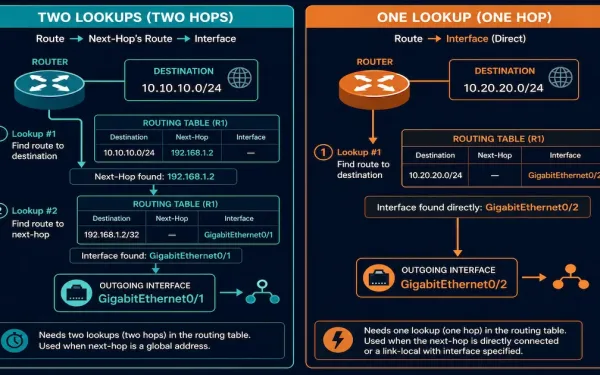
Static IPv6 Routes: Next-Hop Address vs. Directly Connected (Exit Interface)
A static IPv6 route can be built two different ways: pointing only at a next-hop IPv6 address, or pointing at an exit interface directly. These aren’t just two syntax options — they produce genuinely different lookup behavior in the router, and understanding that difference is core CCNA and CCNP material. This guide covers both forms,...
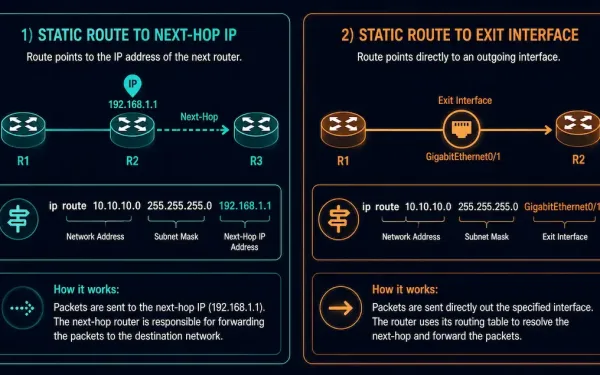
Directly Connected Static Routes: Configuration and When to Use Them
A static route can point to a destination in one of two ways: by specifying the next-hop IP address, or by specifying the exit interface directly. This second form — using the exit interface — is what’s called a directly connected static route, and understanding when and why to use it is a useful piece...
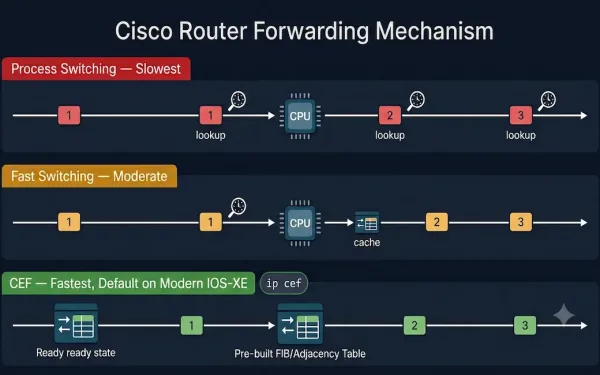
Cisco Router Forwarding Mechanisms: Process Switching, Fast Switching, and CEF
Understanding Cisco router forwarding mechanisms is a cornerstone of networking for CCNA and CCNP students. Routers, the backbone of network connectivity, rely on efficient packet-forwarding mechanisms to direct traffic toward its destination. Cisco routers support three primary methods, Process Switching, Fast Switching, and Cisco Express Forwarding (CEF), each with unique characteristics affecting performance, scalability, and...