default gateway

Verifying IP Parameters for a Client OS: Windows, Linux, and macOS
Domain 1.10 | Network Fundamentals — 20% of exam Learning Objectives By the end of this lesson, you will be able to: Key Terms Term Definition ipconfig The Windows command for viewing IP configuration ifconfig The legacy Linux/Unix command for viewing and configuring network interfaces ip addr The modern Linux command for viewing IP addressing,...
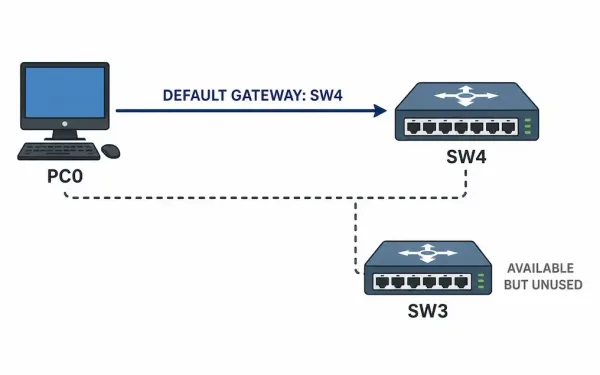
Default Gateway Limitations: Why One Static Gateway Isn’t Enough
A host doesn’t route. It knows its own subnet, and for everything outside that subnet, it sends traffic to exactly one configured address: its default gateway. That single point of dependency is the limitation this article covers — and understanding it is what motivates every First Hop Redundancy Protocol (FHRP) that exists, from HSRP to...
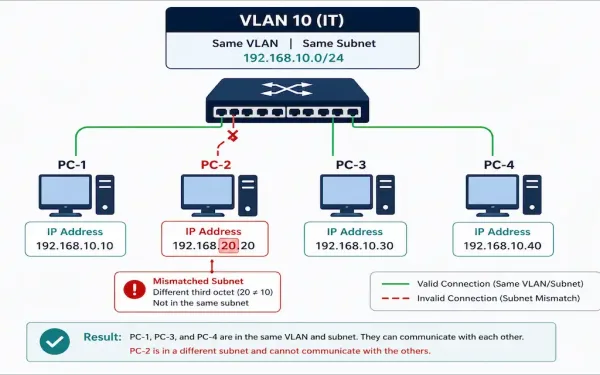
IP Addressing Issues with VLAN and SVI: Diagnosis and Configuration
Two devices in the same VLAN with mismatched subnet configuration simply can’t communicate — no amount of correct VLAN assignment or trunk configuration fixes an IP addressing problem. This is one of the most common real-world VLAN issues, and it’s frustrating precisely because the Layer 2 configuration can be entirely correct while the problem sits...
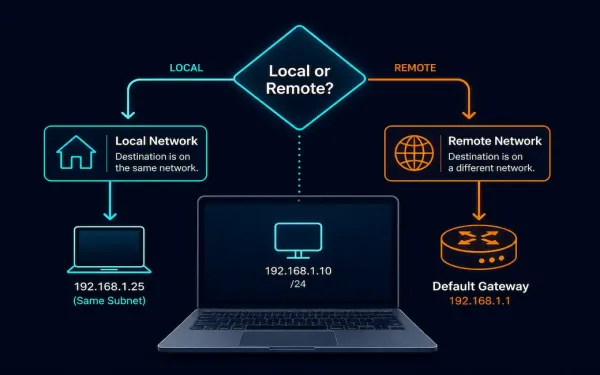
Host Forwarding Decisions: How Hosts Actually Route Their Own Traffic
Every networked device, whether it’s a dedicated router or an ordinary laptop, has to decide how to get a packet toward its destination. Routers specialize in this, but end hosts, PCs, servers, phones, make their own forwarding decisions too, using a much simpler process built on subnetting, a minimal routing table, and address resolution. This...