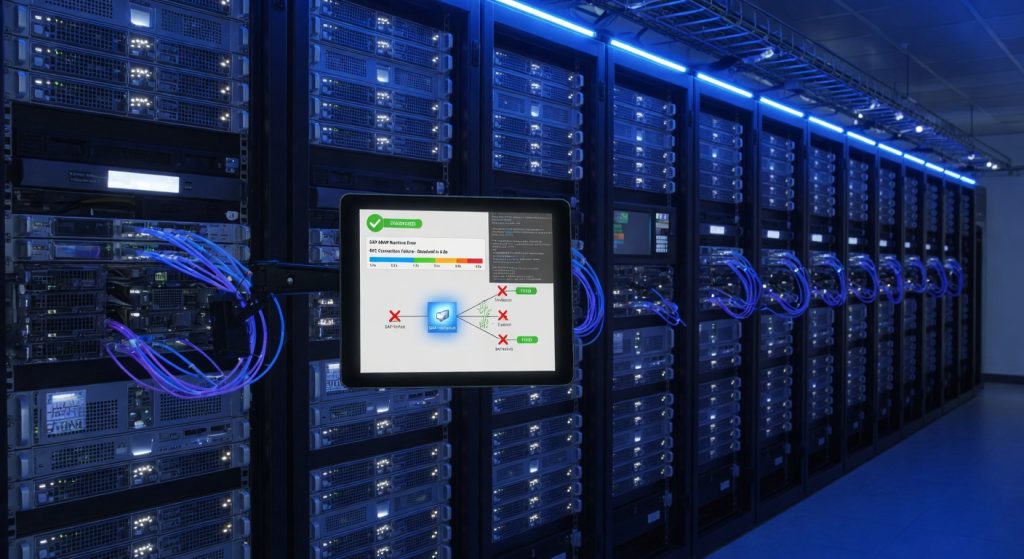
SAP administrators spend an average of 4-6 hours per critical incident on manual root cause analysis, often delaying business operations across ERP landscapes. Avantra’s latest release, Avantra 26, upends this bottleneck with Avantra AIR Root Cause Analyzer, an AI-powered intelligence engine that delivers structured diagnoses the instant an SAP failure triggers.
This tool, available via separate licensing, integrates natively with SAP Cloud ALM and spans the SAP Business Technology Platform (BTP) for automated visibility. Unlike traditional monitoring that floods teams with alerts, Avantra AIR probes incidents autonomously—correlating logs, metrics, and traces to pinpoint failures like database locks or integration timeouts. For IT professionals managing HANA or S/4HANA environments, this means slashing mean time to resolution (MTTR) from hours to seconds, freeing resources for strategic tasks.
Avantra AIR Core Mechanics
At its heart, Avantra AIR Root Cause Analyzer employs machine learning models trained on vast SAP telemetry datasets. When an anomaly hits—say, a job chain stall in SAP BTP—the engine:
- Ingests real-time data from SAP Cloud ALM APIs, including performance traces and error stacks.
- Applies causal inference algorithms to map dependencies, distinguishing symptoms (e.g., high CPU) from root issues (e.g., unoptimized ABAP queries).
- Outputs a structured report with remediation steps, such as index rebuilds or parameter tweaks.
This builds on Avantra 26’s enhanced BTP integration, providing end-to-end observability without custom scripting. As detailed in SAP’s BTP documentation, such native ties reduce integration overhead by leveraging standard OData interfaces.
Impact on SAP Operations
Enterprise SAP landscapes, handling everything from finance modules to supply chain, face escalating complexity with hybrid cloud shifts. Avantra AIR addresses this by automating what humans struggle with: pattern recognition across siloed systems. IT teams report faster incident closure, minimizing downtime costs that can exceed $10,000 per hour in large deployments, per Gartner SAP insights.
Consider a failed background job in SAP Cloud ALM: manual triage involves cross-referencing SM37 logs, ST22 dumps, and BW traces. Avantra AIR surfaces the culprit—perhaps a memory leak in a custom RFC—within seconds, complete with fix scripts. This proactive stance aligns with zero-downtime mandates in regulated sectors like manufacturing.
For network engineers, the ripple effects touch SAP networking: optimized diagnostics reveal latency in CPI integrations or VPN bottlenecks affecting BTP services. Integrating this with tools like robust enterprise monitoring practices enhances overall resilience.
Deployment Strategies for IT Pros
To leverage Avantra AIR, SAP Basis admins should prioritize:
- License Audit: Activate as an add-on to existing Avantra suites, targeting high-impact systems like ECC-to-S/4 migrations.
- Data Pipeline Setup: Ensure SAP Cloud ALM feeds clean telemetry; validate via Avantra’s dashboard for 99% coverage.
- Hybrid Testing: Pilot in non-prod environments, simulating failures with tools like LoadRunner to benchmark speed gains.
Pair this with streamlined reconciliation processes for finance modules. As NIST frameworks emphasize, AI diagnostics bolster identify-detect phases in cybersecurity for SAP.
Conclusion
Avantra AIR Root Cause Analyzer redefines SAP incident management, transforming reactive firefighting into predictive precision. For IT leaders, adopting this in 2026 means measurable MTTR reductions and empowered teams. Forward, expect deeper AI fusions with SAP BTP, potentially incorporating generative models for auto-remediation.
Actionable step: Audit your SAP Cloud ALM setup today—enable Avantra integration to test Avantra AIR on your next outage. This positions enterprises ahead in AI-driven operations.
TREND STATISTICS