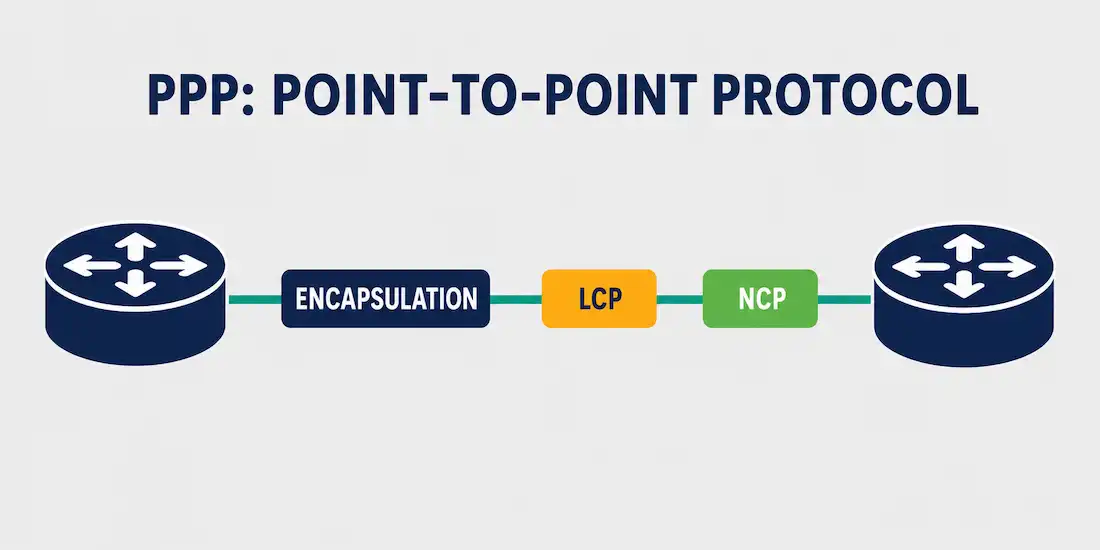
PPP (Point-to-Point Protocol) is a WAN encapsulation protocol developed in the early 1990s as a successor to the older Serial Line Internet Protocol (SLIP). It’s an open standard, meaning the protocol can be used consistently across equipment from different vendors — a significant advantage over proprietary alternatives.
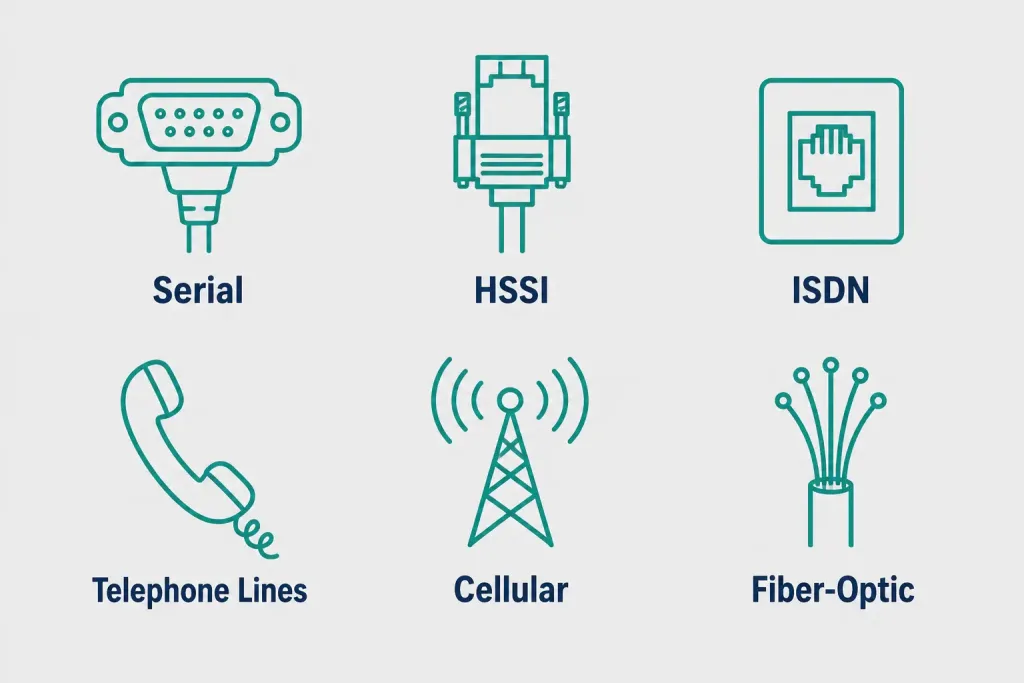
PPP can run over a remarkably wide range of physical media: synchronous serial connections, asynchronous serial connections, High-Speed Serial Interface (HSSI), ISDN interfaces (both BRI and PRI), telephone lines, trunk lines, cellular telephones, specialized radio links, and fiber-optic links. This flexibility is a major reason PPP became the dominant point-to-point WAN encapsulation standard.
What PPP Actually Does
PPP provides dynamic addressing, authentication, callback, and compression services. It encapsulates multiple network layer protocols so they can pass over the same physical link — a genuinely important capability, since it means PPP isn’t limited to carrying IP traffic alone; it also supports protocols other than TCP/IP, such as IPX/SPX and DECnet.
PPP also performs error detection, error correction, and ongoing quality checks on the link itself. Multilink PPP (MLPPP) extends this further, allowing a single logical connection to run across several physical connections simultaneously — bundling multiple physical links together for additional bandwidth, and providing redundancy if one of the bundled links fails.
Compared to HDLC, PPP is a considerably richer-featured protocol, offering authentication, compression negotiation, and vendor-neutral interoperability that plain HDLC lacks.
PPP’s Three Core Components
PPP operates at the data link layer and was originally designed to encapsulate higher network-layer protocols for transport over both synchronous and asynchronous communication lines. It also supports network protocol multiplexing, session negotiation, and data-compression negotiation.
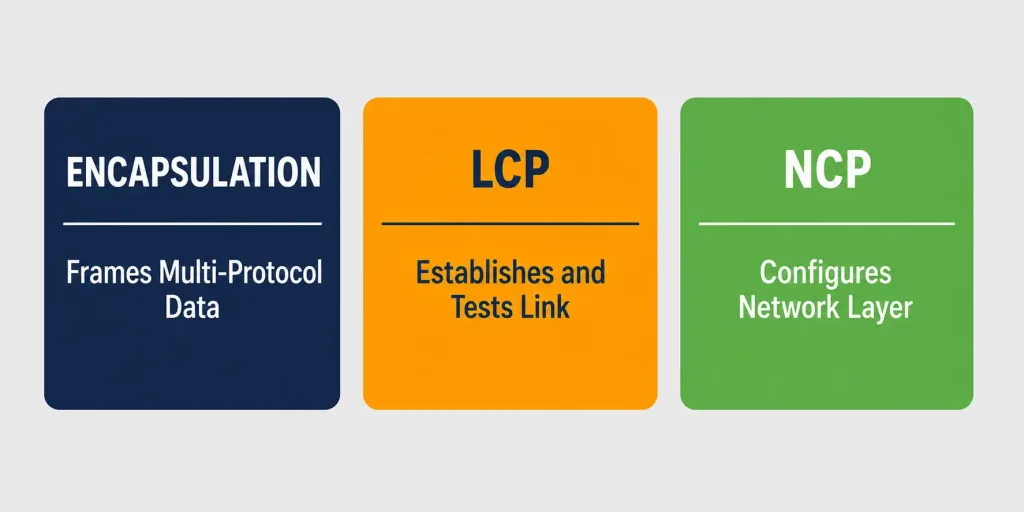
PPP transmits data over a serial point-to-point link using three components, each with a distinct function, though all three work together to complete the connection:
- Encapsulation (Framing): A method for encapsulating multi-protocol datagrams, defining exactly how data is framed for transmission over the link.
- Link Control Protocol (LCP): Establishes, configures, and tests the data-link connection itself, negotiating options between the two ends before any user data flows.
- Network Control Protocol (NCP): A family of protocols, one per network-layer protocol in use, that establish and configure that specific protocol (for example, IPCP configures IP addressing over the link).
Worked Example: What Happens When a PPP Link Comes Up
Understanding the sequence helps make these three components concrete. When two routers connect over a serial link running PPP, LCP activates first, negotiating link-level options like the maximum frame size and, if configured, which authentication method (PAP or CHAP) to use.
Once LCP successfully establishes the link and authentication (if required) succeeds, the appropriate NCP — typically IPCP for IPv4 — takes over, negotiating network-layer details like IP addressing. Only after both LCP and the relevant NCP have completed their negotiation does actual user data begin flowing across the link. If a problem occurs at any stage — a failed authentication, for example — the link never progresses to the NCP stage at all, which is a useful detail for troubleshooting a PPP connection that establishes physically but never passes traffic.
Benefits of PPP
PPP was originally designed as an encapsulation protocol for transporting TCP/IP traffic over point-to-point links, and it provides a standard method for transporting multi-protocol packets over those links. PPP includes many features that plain HDLC lacks entirely.
Its link quality management feature continuously monitors the quality of the link; if too many errors occur, PPP takes the link down rather than continuing to pass increasingly unreliable traffic. PPP also supports both PAP (Password Authentication Protocol) and CHAP (Challenge Handshake Authentication Protocol) for authenticating the two ends of a connection before allowing traffic to flow.
Other advantages include:
Cost: PPP links can connect separate networks using standard, vendor-neutral hardware and software rather than requiring specialized, proprietary equipment tied to a single vendor’s ecosystem — a real cost advantage over less-standardized alternatives.
Easy troubleshooting: Because PPP’s architecture separates concerns cleanly across its layered components (encapsulation, LCP, NCP), a problem in one component can often be isolated and diagnosed independently of the others, rather than requiring an engineer to untangle a monolithic, all-in-one protocol.
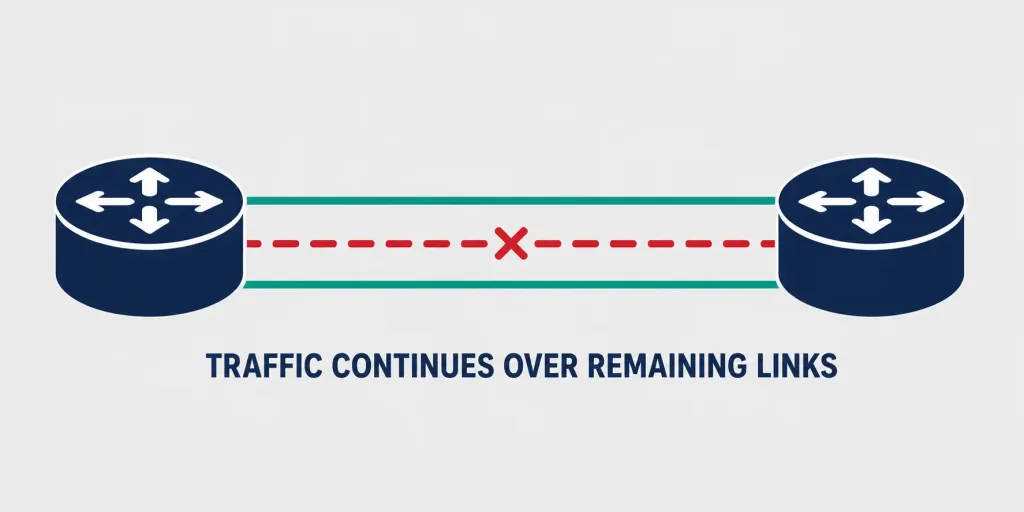
Resiliency: PPP’s resiliency comes specifically from Multilink PPP, which bundles multiple physical links into a single logical connection. If one of the bundled physical links fails, traffic continues flowing over the remaining links rather than dropping entirely, and the bundle can also provide additional aggregate bandwidth when all links are healthy. This is a PPP-specific mechanism, distinct from the general route-around-failure behavior that IP routing protocols separately provide at the network layer.
PPP over Ethernet (PPPoE)
One of PPP’s most widespread modern applications isn’t over a traditional serial link at all, but over Ethernet. PPPoE (PPP over Ethernet) encapsulates PPP frames inside Ethernet frames, letting broadband providers reuse PPP’s authenticated, per-session connection model — originally designed for dial-up modems — over DSL and, in some deployments, cable or fiber connections.
This matters because it explains why PPP concepts remain directly relevant even on networks that have nothing to do with legacy serial WAN links. When a home router “dials” its DSL connection and asks for a username and password, it’s running PPPoE underneath, negotiating LCP and authenticating via PAP or CHAP exactly as a 1990s dial-up modem would, just tunneled inside Ethernet frames instead of running directly over an analog phone line. Many ISPs favor this model because it gives them the same per-subscriber authentication, accounting, and IP assignment capabilities that PPP provided for dial-up, without requiring a switch to a fundamentally different connection-management architecture.
PPP vs. HDLC: A Closer Comparison
Since PPP is frequently discussed alongside HDLC, it’s worth being precise about exactly what separates them:
| Factor | PPP | HDLC (Cisco cHDLC) |
|---|---|---|
| Vendor compatibility | Open standard, works across vendors | Cisco proprietary variant, may not interoperate with other vendors |
| Authentication | Built-in (PAP, CHAP) | None |
| Multiprotocol support | Native (IP, IPX, DECnet, etc.) | Limited |
| Link quality monitoring | Yes | No |
| Compression negotiation | Yes | No |
| Configuration complexity | Slightly higher | Simpler, minimal configuration |
This comparison explains why HDLC remains a reasonable default only when both ends of a link are confirmed Cisco devices with no authentication requirement, while PPP is the safer, more capable choice whenever vendor compatibility, authentication, or multiprotocol support matter.
Real-World Deployment Context
A common historical use case for PPP was dial-up Internet access: an ISP’s remote access server would negotiate a PPP session with a subscriber’s dial-up modem, using PAP or CHAP to authenticate the subscriber’s account before assigning them an IP address via IPCP. This exact PPP negotiation sequence — LCP, authentication, then NCP — became so standard that later broadband technologies like DSL adopted PPP over Ethernet (PPPoE) specifically to reuse this same authenticated, per-session connection model, even though DSL itself doesn’t need PPP’s original dial-up framing.
PPP also remains relevant in enterprise WAN contexts today wherever serial point-to-point links connect routers from different vendors, since PPP’s open-standard, vendor-neutral design avoids the interoperability problems that a proprietary encapsulation like Cisco’s HDLC can introduce in mixed-vendor environments.
Troubleshooting a PPP Link Step by Step
When a PPP connection doesn’t behave as expected, working through the negotiation sequence in order usually isolates the problem quickly:
- Confirm the physical layer is up. Before troubleshooting PPP itself, verify the underlying serial interface, cable, or DSL line shows as physically connected.
- Check LCP status. If LCP hasn’t reached an established state, the two ends likely disagree on basic link parameters, or one side isn’t running PPP at all.
- Verify authentication configuration. If LCP establishes but the link doesn’t progress further, mismatched PAP or CHAP credentials — or one side expecting authentication the other side isn’t configured to provide — is a common culprit.
- Check NCP status per protocol. A link can have LCP up and authentication successful while a specific NCP (like IPCP) fails to negotiate, which typically points to an addressing or protocol-specific configuration issue rather than a link-level problem.
- Review Multilink PPP bundle status, if applicable. On a bundled multilink connection, confirm all expected physical links are actually part of the bundle — a link that isn’t properly joining the bundle reduces available bandwidth without necessarily causing an outright failure.
This staged approach — physical, then LCP, then authentication, then NCP — mirrors the actual order PPP itself uses to establish a connection, which is exactly why understanding the three-component architecture pays off directly in real troubleshooting scenarios.
Troubleshooting and Exam Tips
- Remember PPP’s three components precisely: encapsulation/framing, LCP (link-level negotiation), and NCP (network-layer configuration, one per protocol in use).
- Know the negotiation order: LCP establishes and authenticates the link first; only after that succeeds does the relevant NCP configure network-layer addressing.
- If a PPP link is physically up but not passing traffic, check authentication configuration (PAP/CHAP) first, since a failed authentication stops the connection before NCP ever activates.
- Remember that PPP’s resiliency specifically comes from Multilink PPP bundling multiple physical links — not from general IP-layer rerouting, which is a separate, unrelated mechanism.
- PPP’s vendor-neutral, open-standard nature is its key advantage over Cisco’s proprietary HDLC variant in mixed-vendor WAN environments.
Conclusion
PPP is an open-standard, data-link-layer WAN encapsulation protocol that emerged in the early 1990s as SLIP’s more capable successor. Its three components — encapsulation, LCP, and NCP — work together to establish, authenticate, and configure a point-to-point link before any user data flows, while Multilink PPP adds genuine resiliency by bundling multiple physical links into one logical connection. Compared to HDLC, PPP’s built-in authentication, compression negotiation, and multiprotocol support make it a considerably richer-featured protocol, which is exactly why it remains the standard choice for point-to-point WAN links involving equipment from more than one vendor.
Frequently Asked Questions
What is PPP in networking?
PPP (Point-to-Point Protocol) is an open-standard, data-link-layer WAN encapsulation protocol that transports multiple network-layer protocols over a single physical or logical connection, including support for authentication, compression, and dynamic addressing.
What are the three components of PPP?
PPP consists of encapsulation (framing multi-protocol datagrams), LCP (Link Control Protocol, which establishes and tests the data-link connection), and NCP (Network Control Protocol, a family of protocols that configure specific network-layer protocols like IP).
What is the difference between PPP and HDLC?
PPP is an open, vendor-neutral standard with built-in authentication (PAP/CHAP), compression negotiation, and rich multiprotocol support. HDLC, particularly Cisco’s proprietary cHDLC variant, lacks these features and may not interoperate reliably between different vendors’ equipment.
How does Multilink PPP provide resiliency?
Multilink PPP bundles multiple physical links into a single logical connection. If one physical link in the bundle fails, traffic continues flowing over the remaining links rather than dropping the connection entirely, while also providing additional aggregate bandwidth when all links are healthy.
What authentication methods does PPP support?
PPP supports PAP (Password Authentication Protocol) and CHAP (Challenge Handshake Authentication Protocol), both negotiated during the LCP phase before the link progresses to network-layer configuration via NCP.
Is PPP still used today, or is it purely legacy?
PPP remains widely used today, though often in forms different from its original dial-up context. PPPoE (PPP over Ethernet) carries PPP’s authentication and session model over DSL broadband connections, and PPP still appears on enterprise serial WAN links wherever equipment from different vendors needs to interoperate reliably.