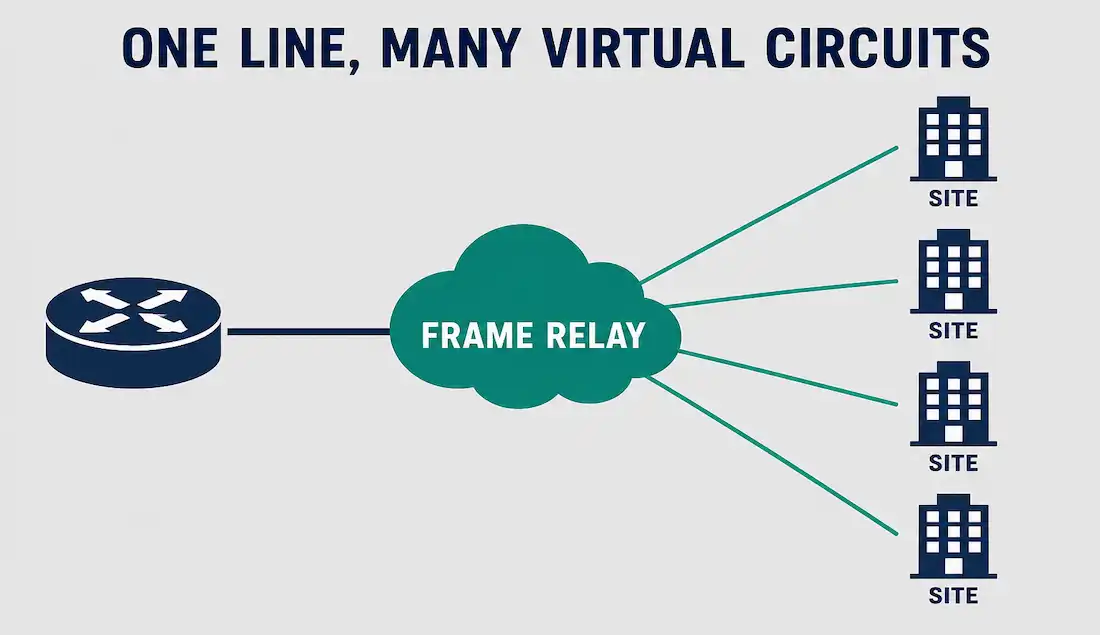
Frame Relay is a multiplexing technique, and one of its most practically important capabilities is running multiple virtual circuits over a single physical line. A Frame Relay Access Device (FRAD) — typically a router connected to the Frame Relay network — can maintain multiple virtual circuits linking it to different remote endpoints, all through one physical connection into the provider’s network.
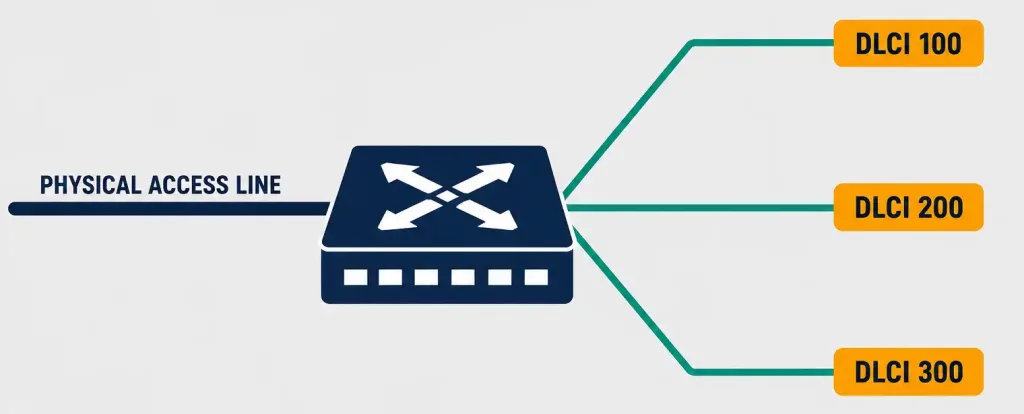
As covered in our guide to Frame Relay virtual circuits, each virtual circuit is identified by its own DLCI, and DLCI values have only local significance. This guide focuses specifically on what happens when many of those virtual circuits share a single physical access line — the economics, the technical constraints, and the real-world tradeoffs involved.
Why Multiple VCs on One Line Matters
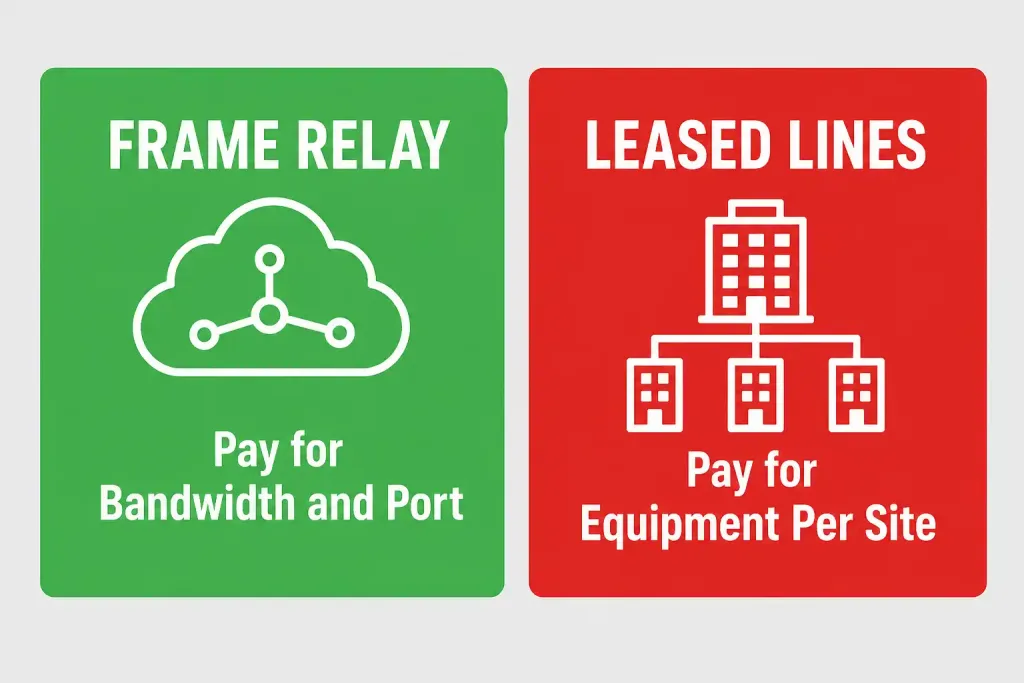
Running multiple virtual circuits over a single physical line dramatically reduces the amount of equipment a site needs, and simplifies the network overall. With this model, each endpoint requires only a single access line and a single physical interface, regardless of how many other sites it needs to reach — a stark contrast to the dedicated-leased-line approach, where connecting to N remote sites would require N separate physical circuits and N separate interfaces.
Consider a company’s central office needing to reach several remote branch locations. Rather than provisioning a separate physical line to each branch, the central office connects to the Frame Relay network with a single access line, and the provider’s network carries multiple virtual circuits — each with its own DLCI — across that one physical connection, one heading to each branch. The central office’s router sees multiple logical destinations through a single physical port.
How Frame Relay Billing Works
Frame Relay’s cost model reflects this multiplexed architecture directly. Customers pay for the bandwidth they use and for the physical port they’re connected through — not for dedicated equipment per virtual circuit, since every port in a Frame Relay network is virtual by design. When a customer needs to reach additional destinations, they typically pay for additional bandwidth or additional virtual circuits, but they don’t need to purchase or provision new physical equipment for each one. This is precisely why multiplexing multiple VCs onto shared physical infrastructure makes Frame Relay meaningfully more cost-effective than an equivalent mesh of dedicated leased lines.
Oversubscription: When Combined VC Bandwidth Exceeds the Line
Here’s where multiplexing multiple VCs onto one physical line gets technically interesting. Each virtual circuit on a shared access line has its own Committed Information Rate (CIR) — its own guaranteed minimum bandwidth. In practice, providers routinely allow the sum of all the CIRs on a single physical line to exceed that line’s actual port speed. This is called oversubscription, and it’s a deliberate design choice, not an error: it rests on the statistical assumption that not every virtual circuit will need its full committed bandwidth at exactly the same moment. This is directly analogous to an airline selling more seats than a plane has, on the expectation that some booked passengers won’t show up.
Worked Example: Oversubscription in Practice
Consider a T1 access line, with a usable capacity of roughly 1.344 to 1.536 Mbps depending on line coding. If a customer configures 24 virtual circuits, each with a 56 Kbps CIR, the combined committed bandwidth totals 24 × 56 Kbps = 1.344 Mbps — comfortably within the T1’s capacity, so this configuration is not oversubscribed.
Now suppose that same customer instead configures 50 virtual circuits at the same 56 Kbps CIR each. The combined total becomes 50 × 56 Kbps = 2.8 Mbps — nearly double the T1’s actual capacity. This configuration is oversubscribed, and if a meaningful number of those 50 virtual circuits attempt to use their full committed bandwidth simultaneously, the physical line simply cannot deliver it, leading to congestion and dropped traffic.
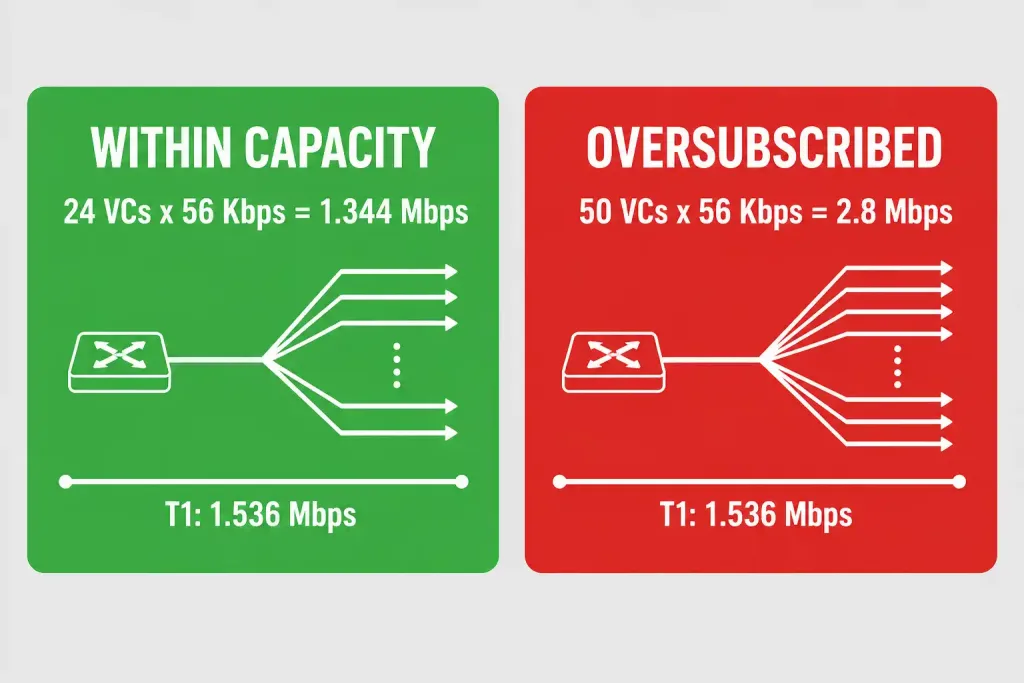
This example illustrates the core tradeoff: oversubscription lets a provider sell more aggregate committed bandwidth than a physical line can technically deliver, banking on the fact that Frame Relay’s typically bursty traffic patterns mean most VCs sit well below their CIR most of the time. When that assumption holds, oversubscription is a genuinely efficient use of shared infrastructure. When too many VCs burst simultaneously, the assumption breaks down, and congestion follows — which is exactly why network designers plan CIR allocations carefully rather than oversubscribing arbitrarily.
Real-World Deployment Context
A retail chain with a central distribution warehouse and 30 stores is a natural fit for this model. Rather than running 30 dedicated leased lines from the warehouse to each store, the warehouse connects to the Frame Relay network with a single access line, carrying 30 separate virtual circuits — one per store — each identified by its own DLCI. Each store, in turn, needs only a single access line and interface of its own to reach the warehouse.
If the retail chain’s traffic patterns are genuinely bursty — inventory updates happening in short bursts rather than continuous streams — the network provider might deliberately oversubscribe the warehouse’s access line slightly, selling combined CIR capacity somewhat above the physical line’s actual speed, on the reasonable assumption that all 30 stores are unlikely to burst simultaneously. This lets the provider offer more aggregate committed bandwidth at a lower cost than strictly limiting total CIR to the physical line’s exact capacity would allow — a tradeoff that works well for bursty traffic but would be a poor choice for traffic patterns involving frequent, simultaneous, sustained demand across many VCs at once.
Advantages and Disadvantages of Multiplexed VCs
Advantages:
- Dramatically reduced physical equipment requirements as the number of connected sites grows.
- Lower overall cost compared to provisioning dedicated leased lines to every destination.
- Simplified network management, since a single physical interface handles traffic to many destinations.
- Efficient use of shared infrastructure when traffic patterns are genuinely bursty.
Disadvantages:
- Oversubscription risk means guaranteed bandwidth (CIR) isn’t always deliverable if too many VCs demand it simultaneously.
- A failure affecting the single shared physical access line impacts every VC riding on it at once, unlike independent dedicated circuits.
- Careful capacity planning is required to avoid oversubscribing a line beyond what real traffic patterns can tolerate.
Multiple VCs vs. Dedicated Leased Lines: A Quick Comparison
| Factor | Multiple VCs on One Line | Dedicated Leased Line Per Site |
|---|---|---|
| Physical interfaces needed | One, regardless of destination count | One per destination |
| Cost model | Pay for bandwidth and port | Pay per dedicated circuit |
| Scalability to many sites | High — add VCs, not equipment | Low — each new site needs new hardware |
| Bandwidth guarantee | Per-VC CIR, subject to oversubscription | Fully dedicated, no oversubscription risk |
| Best fit | Many sites, bursty traffic | Few sites, latency- or bandwidth-critical traffic |
This comparison makes the core tradeoff explicit: multiplexed virtual circuits trade some bandwidth-guarantee certainty (via oversubscription risk) for dramatically better cost efficiency and scalability as the number of connected sites grows. For the small number of highest-priority, highest-bandwidth connections, a dedicated leased line may still make more sense — the same logic covered in our point-to-point communication links guide.
Access Rate vs. Port Speed vs. CIR: Three Distinct Numbers
Understanding oversubscription properly requires keeping three related but distinct figures straight, since conflating them is a common source of confusion:
- Access rate (local access rate): The clock speed of the physical connection between the customer’s site and the Frame Relay network — this sets the absolute ceiling on how fast data can physically move into or out of the network, regardless of any other setting.
- Port speed: The rate at which the provider’s switch port is clocked, which in most straightforward deployments matches the access rate, though providers occasionally configure these differently.
- Committed Information Rate (CIR): The rate a specific virtual circuit is guaranteed, agreed to per VC, and typically well below the access rate for any individual circuit — it’s the sum of many CIRs across multiple VCs, not any single CIR alone, that creates oversubscription risk.
A helpful mental model: access rate and port speed describe the physical pipe’s actual capacity, while CIR describes a promise made about one logical stream flowing through that pipe. Oversubscription happens specifically when the sum of all the promises exceeds what the physical pipe can actually deliver if every promise were called in at once.
Troubleshooting and Exam Tips
- Remember the core economic model: Frame Relay customers pay for bandwidth and port access, not per-VC equipment, since Frame Relay ports are virtual.
- Know the FRAD (Frame Relay Access Device) term — it’s the router or device connecting a site to the Frame Relay network, potentially carrying many virtual circuits over its single physical connection.
- Remember the definition of oversubscription precisely: the sum of CIRs across all VCs on a physical line exceeding that line’s port speed — a deliberate design choice based on statistical traffic assumptions, not automatically a network error.
- Be ready to calculate oversubscription: multiply the number of VCs by their CIR, and compare the total against the physical line’s actual capacity.
- Oversubscription works well for bursty traffic patterns but risks congestion and dropped traffic if too many VCs demand their full CIR simultaneously.
Conclusion
Running multiple virtual circuits over a single physical line is one of Frame Relay’s most economically important capabilities, letting a site reach many remote destinations through just one physical access line and interface rather than a separate dedicated circuit per destination. This multiplexed model directly shapes Frame Relay’s cost structure — customers pay for bandwidth and port access rather than per-VC equipment — and it introduces the concept of oversubscription, where the combined CIR of all VCs on a line can deliberately exceed the line’s physical capacity based on the statistical assumption that not every VC will burst at once. Understanding both the cost-efficiency benefits and the oversubscription tradeoffs is essential for anyone designing or troubleshooting a real Frame Relay deployment.
Frequently Asked Questions
Why does Frame Relay allow multiple virtual circuits on one physical line?
Because each virtual circuit is a logical connection identified by its own DLCI, many of them can be multiplexed onto a single shared physical access line, letting a site reach multiple remote destinations without needing a separate physical circuit for each one.
How does Frame Relay billing typically work?
Customers pay for the bandwidth they use and the physical port they’re connected through, not for dedicated per-VC equipment, since every port in a Frame Relay network is virtual. Adding more destinations typically means paying for more bandwidth or virtual circuits, not new physical hardware.
What is oversubscription in Frame Relay?
Oversubscription occurs when the sum of the Committed Information Rates (CIRs) across all virtual circuits sharing a physical line exceeds that line’s actual port speed. It’s a deliberate design choice based on the statistical assumption that not every VC will need its full committed bandwidth simultaneously.
Is oversubscription always a problem?
Not inherently. It works well for genuinely bursty traffic patterns, where most VCs sit below their CIR most of the time. It becomes a real problem only when enough VCs attempt to use their full committed bandwidth simultaneously, at which point congestion and dropped traffic follow, undermining the CIR guarantee those circuits were sold.
What is a FRAD?
A Frame Relay Access Device (FRAD) is the router or device that connects a site to a Frame Relay network, potentially carrying multiple virtual circuits over its single physical connection to different remote destinations.
What is the difference between access rate and CIR?
Access rate (or port speed) is the physical clock speed of the connection into the Frame Relay network — the absolute ceiling on data movement regardless of anything else. CIR is a guarantee made about one specific virtual circuit’s bandwidth, typically well below the access rate for any single VC. Oversubscription occurs when the sum of many VCs’ CIRs on the same line exceeds that shared access rate.